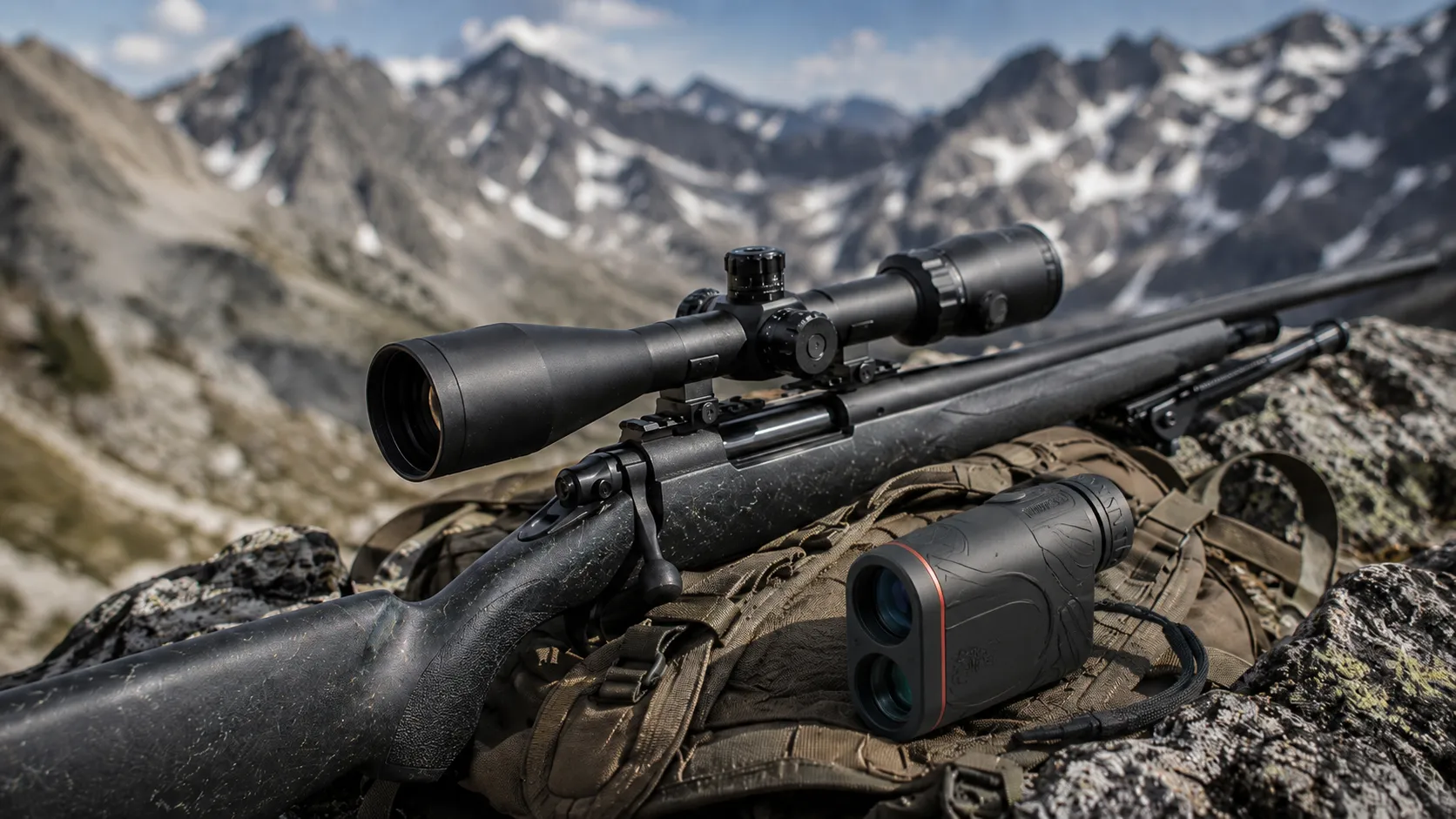
Most procurement mistakes we see stem from one assumption: that every rifle scope with rangefinder operates the same way. They don’t. A glass-etched stadiametric reticle and an active laser rangefinding system represent fundamentally different engineering approaches—and the gap between them determines whether your team gets instant ballistic solutions or manual estimations under field pressure.
For commercial outfitters equipping guides, law enforcement agencies managing fleet optics, and competition range operators standardizing equipment, the distinction matters at the budget level, the training level, and the reliability level. Selecting the wrong category means paying for capability you can’t use—or discovering the limitation during an operation. We’ve seen procurement teams over-specify active laser systems for environments where a mechanical trajectory cam would have been lighter, cheaper, and battery-independent. We’ve also watched training facilities attempt to teach dynamic ranging with passive reticles that slow reaction times beyond operational thresholds.
Active Laser vs. Passive Reticle: Understanding Rangefinder Optoelectronic Technologies
Engineering takeaway: A commercial buyer must first distinguish between active laser rangefinders, which emit infrared pulses to calculate absolute distance, and passive reticles, which rely on manual user estimation based on target size. Active systems provide instant precision but require battery power and increase the unit’s weight and complexity—an acceptable trade-off for professional operations, but a potential liability in remote deployments without reliable charging infrastructure.
Active Laser Rangefinding (LRF) Systems
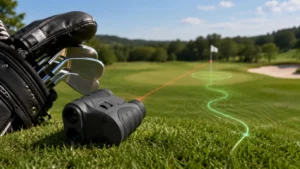
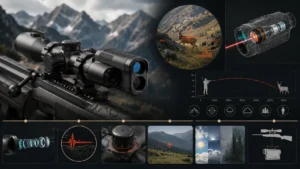
An active laser rangefinder integrated into a riflescope operates on time-of-flight measurement principles. The system fires an infrared laser pulse toward the target, the pulse reflects off the target surface, and the onboard receiver captures the return signal. A high-speed clock measures the round-trip time—typically in picoseconds—and the processor converts that interval to distance using the known speed of light. This all happens in under a second.
The engineering challenge lies in three areas: emitter collimation to keep the beam tight at extended ranges, receiver sensitivity to detect weak return signals from non-reflective surfaces, and optical path alignment between the laser axis and the scope’s reticle plane. When the factory alignment drifts—and it can over hundreds of recoil cycles—the ranging beam no longer corresponds to the aiming point. This is why calibration lifecycle tracking matters for fleet management, a topic we address later in this guide.
In a laser rangefinding riflescope, the measured distance feeds directly into an onboard ballistic engine. The system calculates holdover—often displayed as an illuminated aim point or numeric readout—without requiring the shooter to consult external charts or handheld devices. The operational advantage is speed. The procurement reality is cost, weight, and power dependency.
Passive Stadiametric and Mil-Dot Ranging Reticles
Passive ranging reticles use geometric scaling: the shooter matches a known target dimension—such as an 18-inch shoulder width—against stadia lines or mil-dot spacing etched into the glass. The distance calculation is manual and mathematical. At 500 yards, a target subtending 1 milliradian measures 18 inches across. At 1,000 yards, the same target subtends 0.5 mils. The limitation isn’t the math—it’s the human factor.
Under stress, with a moving target, in fading light, or when the target presents at an angle, passive stadiametric reticle estimation introduces errors that compound. A 10% error in target size estimation translates directly to a 10% ranging error. For precision applications at extended distances, that error margin produces misses. Still, passive systems offer genuine advantages: no batteries, no electronics, lighter weight, and lower cost. For training facilities that want students to master fundamental ranging skills before graduating to electronic aids, passive reticles remain a deliberate pedagogical choice.
Mechanical Trajectory Cams (ART Systems)
Between active laser and passive reticle sits a third category worth evaluating: the mechanical Automatic Ranging Trajectory (ART) cam system. These scopes use a physical cam mechanism indexed to an adjustable objective or power ring. The shooter manually adjusts the focus until the target appears sharp, and the cam mechanically adjusts the reticle’s vertical position to compensate for bullet drop at that distance.
The engineering simplicity is the point. No emitter, no receiver, no battery, no software. The trade-off is accuracy: cam-based systems rely on the operator’s ability to achieve perfect focus and on the cam profile matching the specific ballistic trajectory of the ammunition. Switch loads, and the cam may no longer track correctly. For outfitters running standardized ammunition across a guide fleet, however, a mechanical cam scope can deliver practical ranging capability with near-zero electronic failure risk.
What to verify: When reviewing product datasheets, ensure you’re buying the technology you intend to buy. We’ve seen procurement agents order scopes with “rangefinder reticle” in the description, expecting active laser capability, only to receive passive mil-dot glass with no electronic components whatsoever. The specification sheet must explicitly state “laser rangefinder integrated,” “optoelectronic ranging,” or list an IR laser emitter specification.
| Technology | Ranging Method | Speed | Power Dependency | Best For |
|---|---|---|---|---|
| Active Laser LRF | IR pulse time-of-flight | Sub-second | Battery required | Dynamic operations, unknown-distance engagements |
| Passive Stadiametric | Target-size-to-reticle scaling | 5-15 seconds | None | Training, budget-constrained fleets, backup systems |
| Mechanical ART Cam | Focus-ring-to-reticle coupling | 2-5 seconds | None | Standardized-ammo fleets, rugged environments |
Note: Ranging speeds are approximate and depend on operator proficiency, target conditions, and environmental visibility. Buyers should field-test candidate optics under their actual operational tempo before finalizing procurement.
Core Technical Specifications for Commercial and Tactical Applications
Decision rule: When evaluating a rifle scope with rangefinder, target reflectivity determines the device’s true functional range. A system rated for 2,000 yards on reflective targets may only range deer or non-reflective objects at half that distance. Sourcing agents should evaluate the ratio between reflective and non-reflective ranging capability before committing capital—and should request manufacturer test data for both reflective (white building, vehicle) and non-reflective (animal hide, matte fabric) targets.
Optical Quality, Glass Coatings, and Low-Light Transmission
The optical quality of a rangefinding scope determines whether the electronic capabilities translate into usable field performance. Fully multi-coated lenses—where every air-to-glass surface receives anti-reflective coating layers—deliver the highest light transmission percentages, typically 90% to 95% per lens element in premium systems. Single-coated or partially multi-coated glass loses 2% to 4% more light per surface, and in multi-element lens assemblies, those losses compound quickly.
For low-light operations—dawn and dusk hunting, dawn raids, overcast competition days—the difference between 88% and 94% overall transmission means usable target identification time extends by critical minutes. We recommend procurement specifications mandate fully multi-coated glass with a minimum 50mm objective lens diameter for any scope expected to perform in marginal light. The VisionKing 2.5-20×50 FFP scope exemplifies the optical architecture that supports rangefinding applications without sacrificing glass clarity, though the rangefinder module itself adds optical complexity that must be evaluated independently.
Ranging Distance, Target Reflectivity, and Laser Classifications
Laser classification directly impacts operational flexibility. Class 1 lasers—eye-safe under all conditions—typically deliver ranging capability out to 800-1,200 yards on reflective targets but drop to 400-700 yards on non-reflective surfaces. Class 3R systems push those numbers higher but introduce eye-safety protocols, regulatory restrictions, and potential liability considerations for commercial operations.
What many buyers overlook is beam divergence. A tightly collimated laser with 0.5 mrad divergence maintains ranging accuracy at distance better than a 2.0 mrad beam, which spreads energy and reduces return signal strength. The specification to request from manufacturers is beam divergence in milliradians and minimum target reflectivity for accurate ranging at specified distances.
Integrated Ballistic Solvers and Environmental Sensor Arrays
Onboard ballistic calculator engines process inputs from integrated environmental sensors—barometric pressure, temperature, and tilt/angle—to generate firing solutions. The quality of the ballistic solver often matters more than the laser ranging distance itself. A scope that accurately ranges to 1,200 yards but uses a simplified ballistic model with no angle compensation will generate incorrect holdovers on sloped terrain. Every degree of shooting angle introduces cosine error, and at steep angles with long distances, the compound error exceeds typical vital-zone dimensions.
We recommend verifying these sensor specifications before purchase:
- Barometric pressure sensor accuracy: ±1 hPa or better
- Temperature sensor resolution: 1°C increments with rapid equilibration
- Inclinometer range and accuracy: ±0.5° across the full tilt range
- Ballistic solver update rate: real-time recalculation or single-calculation-per-range
- Custom ballistic profile storage: number of onboard profiles and whether they persist through battery changes
Operational and Engineering Challenges of Rangefinding Scopes
Integrating a laser rangefinder into an optic increases overall unit weight by 30% to 50% compared to equivalent-magnification traditional scopes, demanding heavy-duty, reinforced mounting solutions to withstand recoil rating forces that can exceed 1,000 Gs on magnum-caliber platforms. Sourcing managers must pair these optics with high-quality scope rings and rails designed to resist shear forces—not just any Picatinny-compatible mount.
Weight Penalties and Mount Rigidity Under Heavy Recoil
Most integrated rangefinding scopes weigh between 28 and 38 ounces—sometimes more when thermal or digital overlay hardware is included. That weight sits high on the receiver, raising the rifle’s center of gravity and affecting balance during offhand shooting or rapid positional transitions. For commercial outfitters issuing rifles to clients of varying physical strength, a top-heavy platform increases shooter fatigue and degrades accuracy over a multi-hour field day.
Mount selection becomes a safety and accuracy issue. Standard aluminum rings torqued to 15-18 inch-pounds may hold a 20-ounce traditional scope securely but can slip or deform under the combined mass and recoil impulse of a 35-ounce optoelectronic unit on a .300 Winchester Magnum or .338 Lapua. We recommend steel or titanium alloy scope mounting rings with a minimum of four screws per ring cap, torqued to manufacturer specifications with a calibrated torque wrench. For fleet deployments, standardize on one rail format—Picatinny MIL-STD-1913 remains the most widely supported—across all rifles.
Battery Management and Power Consistency in Extreme Temperatures
Lithium batteries perform reliably down to approximately -20°C before voltage sag impacts laser emitter output and processor function. Below that threshold—common in high-altitude outfitting, winter tactical training, and northern-latitude deployments—alkaline batteries become essentially non-functional, and even lithium cells lose significant capacity. The operational result: ranging capability degrades or fails when it’s most needed.
Buyer warning: Battery life specifications are typically quoted at 20°C ambient with intermittent ranging. Continuous-ranging mode in cold weather can reduce stated battery life by 60% or more. For fleet planning, we recommend:
- Calculating battery consumption at the worst-case operational temperature, not the manufacturer’s nominal rating
- Specifying scopes with external battery access—units requiring factory disassembly for battery changes increase downtime
- Preferring USB-C rechargeable systems for operations with vehicle-based charging infrastructure
- Maintaining a standalone VisionKing laser rangefinder as a backup ranging tool when integrated scope electronics are offline
App Ecosystems, Cybersecurity, and Off-Grid Ballistic Calculations
Several commercially available rangefinding scopes require Bluetooth pairing with a smartphone application to load custom ballistic profiles, update firmware, or access advanced features. For civilian recreational use, this is convenient. For law enforcement tactical teams, military units, and corporate security operations, Bluetooth emissions create electronic signature concerns, and cloud-connected apps introduce data exfiltration risks.
Before procurement, confirm whether the scope’s ballistic calculator operates fully offline with locally stored profiles, or whether it requires periodic cloud authentication. Off-grid capability matters. So does the ability to input custom drag models and muzzle velocity data directly through onboard controls without a paired device. We advise security-sensitive buyers to request a written statement from the manufacturer confirming that no operational data is transmitted off-device during normal use.
Application-Fit: Matching Scopes to Operational Use Cases
Best-fit scenario: Outfitting operations prioritizing reliable performance in extreme weather should select hybrid digital-optical rangefinding scopes with long-lasting battery configurations and full multi-coating. Tactical and security teams require secure, non-paired, robust systems certified to drop-test specifications, while competition directors need sub-MOA precision turrets integrated with the ranging display.
Commercial Outfitting and Professional Guiding Operations
Guides need scopes that clients of varying skill levels can operate with minimal instruction. An intuitive HUD display that overlays the corrected aim point—rather than a numeric range readout that the client must mentally translate—reduces guide intervention and increases client success rates. Durability matters equally: scopes in guide service endure dust, rain, temperature swings, and occasional drops from horseback or ATV racks.
For guide fleets standardized on a single caliber and load—common in elk, moose, and African plains game operations—a mechanical cam system or a ballistic solver pre-loaded with one verified profile eliminates daily zero verification. If the operation spans multiple calibers across the fleet, active laser systems with multi-profile storage become essential. We recommend requesting a demo unit for field evaluation during an actual guide season before committing to a fleet purchase. Our product lineup includes options across the technology spectrum to support this evaluation process.
Tactical, Law Enforcement, and Security Sourcing
LE procurement officers face unique constraints: the scope must survive weapon-mounted drops, offer rapid target acquisition against moving threats, and operate silently—no audible laser activation clicks that could betray position. Electronic emissions discipline matters: some active laser units emit detectable RF noise from internal processors, which advanced counter-surveillance equipment can identify.
Drop-test certification—typically MIL-STD-810 or equivalent—should be a line-item requirement in the procurement specification. So should a documented procedure for factory recalibration after a specified round count or impact event. We also recommend verifying that the scope’s firmware cannot be remotely accessed, updated, or disabled through wireless means, and that all ballistic profiles are stored in encrypted onboard memory rather than transmitted to manufacturer cloud servers.
Long-Range Precision Shooting and Competition Venues
Competition directors and range operators evaluating a rifle scope with rangefinder for precision events need to balance ranging speed against optical clarity at high magnification. First-focal-plane (FFP) reticle placement ensures that holdover subtensions remain accurate at all magnification levels—critical when shooters transition between close and far targets on the same stage. The optic should also provide exposed, tool-less turrets with tactile, audible clicks for windage and elevation adjustments.
For long-range shooting at 1,000 yards and beyond, we prioritize scopes that maintain sub-MOA tracking precision through the full adjustment range while integrating rangefinder data without introducing display lag. Latency between range acquisition and aim-point update should be under 0.5 seconds for dynamic competition stages. Verify this specification with the manufacturer—not all integrated systems update in real time.
When helping competition venues standardize equipment, we guide buyers through custom rifle scope options including reticle selection, turret configuration, and rangefinder integration preferences that match the specific competition format.
Critical Procurement Selection Criteria for B2B Sourcing Managers
Because integrated optoelectronic scopes are highly complex, procurement contracts should prioritize suppliers offering comprehensive multi-year warranties that cover both the optical glass and the internal electronic components. Many manufacturers separate these warranty terms—offering lifetime coverage on glass but only 1-2 years on electronics. For fleet buyers planning a 5-year amortization cycle, that gap creates unbudgeted replacement exposure in years 2 through 5.
Warranty Terms, Calibration Lifecycles, and Maintenance Service Level Agreements
Factory calibration of the laser-to-reticle alignment should be treated as a maintenance item, not a failure event. Over hundreds or thousands of recoil cycles, micro-shifts in the emitter mounting can introduce angular error between the laser path and the optical axis. A scope that ranged correctly at 800 yards when new may show a 1-2 MOA offset after a season of hard use—enough to move impact outside the vital zone.
Procurement contracts should specify:
- Warranty duration for electronic components separate from optical components
- Recalibration turnaround time and whether loaner units are provided during service
- Whether recoil-induced calibration drift is covered under warranty or classified as wear
- Maximum round count or G-force exposure before factory recalibration is recommended
- Availability of replacement battery door seals, O-rings, and lens coatings
Before committing to a fleet order, zeroing procedures and scope adjustment mechanics should be documented in the training manual provided to end users. Optoelectronic scopes add complexity to the zeroing process: the ballistic solver must be calibrated to the actual point of impact, not just the theoretical trajectory.
Regulatory and Legal Compliance (ITAR and Local Hunting Restrictions)
Export compliance is a procurement gate that many domestic-focused buyers discover too late. Integrated thermal scope options and advanced active laser rangefinding systems may fall under ITAR (International Traffic in Arms Regulations) or EAR (Export Administration Regulations) controls, restricting international transfer, field deployment across borders, and even technical data sharing with non-US persons.
Additionally, several US states and many international jurisdictions prohibit the use of laser-emitting optics for big-game hunting. Some restrict electronic scopes entirely during primitive-weapon seasons. Buyers must verify state-level and destination-country regulations before deploying a fleet of active laser scopes. The manufacturer’s regulatory affairs team should provide a written statement confirming the export classification and any known hunting-regulation restrictions for the target deployment regions.
Comparative Analysis of Leading Rangefinding Optics Classes
Premium optical rangefinding scopes preserve ultra-sharp glass clarity but carry higher initial costs, while digital or thermal systems excel in night operations at the expense of daytime resolution and battery runtime. The procurement decision hinges on whether optical clarity or multi-spectral capability drives the operational requirement.
Digital Electro-Optics: Burris Eliminator and Swarovski dS Series
The Burris Eliminator series pioneered the consumer-accessible integrated rangefinding scope category, combining laser ranging with an illuminated bullet drop compensation holdover point displayed directly in the sight picture. The Swarovski dS Gen II represents the premium optical tier, maintaining the exceptional glass clarity Swarovski is known for while adding a laser rangefinder and digital overlay display for the corrected aim point. The engineering difference: Swarovski preserves the optical image quality of a traditional riflescope with minimal digital degradation, while the Burris approach prioritizes functional integration at a more accessible price point.
Both systems face the same operational constraint: the digital display overlay, however sophisticated, represents an additional layer between the shooter’s eye and the target. In low light, display brightness must be carefully managed to avoid washing out the optical image. Procurement teams comparing these systems should evaluate display clarity at dawn and dusk—not just in midday showroom conditions.
Thermal and Digital Day/Night Options: Pulsar and ATN Solutions
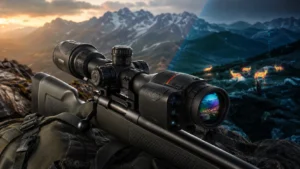
Digital day/night scopes with integrated rangefinders—such as those from Pulsar and ATN—add thermal or near-IR sensor capability to the ranging function. The trade-off is fundamental: sensor resolution, typically 384×288 or 640×480 pixels, cannot match the resolving power of quality optical glass in daylight. However, at night or through fog and smoke, thermal sensors detect targets that are invisible through any glass optic.
Refresh rate matters for moving-target engagement. A 30 Hz sensor produces smoother tracking than a 9 Hz unit, but consumes battery power proportionally faster. For law enforcement surveillance applications, the lower refresh rate combined with active laser rangefinder capability may be adequate. For dynamic interdiction scenarios, the higher refresh rate justifies the power consumption penalty. Procurement specifications should define the minimum acceptable refresh rate based on the intended engagement profile.
| Optic Class | Daytime Resolution | Night Capability | Typical Battery Life | Procurement Consideration |
|---|---|---|---|---|
| Premium Optical LRF (Swarovski, Burris) | Excellent—optical glass limited | Dependent on ambient light | 2,000+ ranging cycles | Highest initial cost; best long-range daylight performance |
| Digital Day/Night LRF (ATN) | Good—sensor limited | IR illuminator dependent | 8-16 hours continuous | Versatile day/night use; requires IR illuminator for total darkness |
| Thermal LRF (Pulsar Thermion) | Moderate—thermal sensor limited | Excellent—detects heat signatures | 4-10 hours continuous | Surveillance and night operations; daytime target ID may require glass confirmation |
Note: Battery life figures are manufacturer-stated estimates under standard test conditions. Actual runtime varies with temperature, display brightness settings, and ranging frequency. Buyers should verify performance under their operational temperature range before finalizing procurement.
Rangefinding Rifle Scope Procurement Checklist and Selection Matrix
Sourcing departments should run candidate optics through a formal pre-purchase evaluation matrix comparing recoil ratings, battery chemistry, water-ingress protection, and sensor latency before finalizing procurement. The checklist below addresses the failure points we most commonly see overlooked in fleet purchasing processes.
Operational Metric Selection Matrix
| Evaluation Parameter | Minimum Threshold | Preferred Specification | Verification Method |
|---|---|---|---|
| Recoil rating (Gs or caliber) | Rated for .300 Win Mag | Rated for .338 Lapua Magnum | Request manufacturer test data |
| Water ingress protection | IPX4 (splash resistant) | IPX7 (1m submersion, 30 min) | Request IP certification documentation |
| Battery chemistry | CR123A lithium | 18650 Li-ion rechargeable | Confirm field-replaceable without tools |
| Laser classification | Class 1 (eye-safe) | Class 1M (extended range) | Verify laser safety label on unit |
| Ranging latency | Under 1 second | Under 0.5 seconds | Field test with stopwatch protocol |
Note: Specifications above represent general procurement guidance based on common operational requirements. Individual agency or organizational standards may require higher or lower thresholds. All specifications should be confirmed directly with the manufacturer before inclusion in a purchase order.
Sourcing and Mounting Integration Checklist
Before issuing a purchase order or requesting volume pricing, verify these items with the manufacturer or distributor:
- Warranty terms: Does the warranty cover electronic components for the same duration as optical components? Is calibration drift covered or excluded?
- Mount compatibility: Does the scope require proprietary mounting hardware, or will it fit standard Picatinny rings? What is the minimum recommended ring spacing?
- Caliber restrictions: Is the warranty voided if mounted on specific magnum calibers? Request the official recoil-rating datasheet in writing.
- Software requirements: Does the onboard ballistic solver require a smartphone app for initial setup or profile loading? Can all functions be accessed without Bluetooth pairing?
- Battery access: Can the battery be replaced without removing the scope from the rifle? Does battery removal reset stored ballistic profiles?
- Export classification: Request the ITAR or EAR classification and any export license requirements for international deployment or cross-border training exercises.
- Sample unit availability: Can a demo or T&E (test and evaluation) unit be provided for field assessment before fleet commitment?
For precision applications, buyers should also evaluate how the scope handles rifle scope numbers and specifications such as magnification range, objective diameter, and tube size—all of which affect mounting height, cheek weld, and overall rifle balance. A high-power rifle scope in the 10-40×56 class demands different mounting geometry than a compact 3-12×44 rangefinding unit, and the integrated electronics add further dimensional constraints.
Evaluating Sourcing and Fleet Deployment Timelines
Custom fleet integration, specialized mounting configurations, and volume discounts require detailed technical consultation prior to placement of purchase orders. We recommend gathering the following technical parameters from your operations teams before contacting a sales engineer:
- Rifle calibers and action types across the fleet
- Existing mounting rail format (Picatinny, Weaver, dovetail) on each platform
- Typical operational temperature range—not just the seasonal average, but the extreme minimum
- Average and maximum target engagement distances for each operational scenario
- End-user experience level and training time available for new equipment transition
- Battery charging infrastructure availability in the field or at forward operating bases
Having this data organized before an engineering consultation shortens the evaluation cycle and ensures the recommended configuration matches operational reality. We regularly assist procurement teams with selecting the best rifle scope for their specific application profile, and the rangefinder integration decision is most productive when informed by real operational data rather than generalized specifications.
For agencies and commercial operations ready to move from evaluation to deployment, we recommend scheduling a technical consultation to discuss fleet configuration, volume pricing, and field-test sample unit availability. Contact our engineering team through the VisionKing product lineup page to begin the specification process.
Frequently Asked Questions
Are laser rangefinding scopes legal for hunting?
Legality varies significantly by region. Several US states and international territories prohibit laser-emitting devices or restrict electronic scopes for big-game hunting and primitive-weapon seasons, so buyers must verify state-level and destination-country regulations before deploying a rifle scope with rangefinder for hunting operations.
How long do batteries last in digital rangefinding scopes?
Battery life typically ranges from 10 to 30 hours of continuous active laser use under nominal conditions but drops significantly in sub-zero environments. We recommend manual mechanical backup ranging capability or USB-C rechargeable battery configurations for extended remote deployments.
Do rangefinding rifle scopes require specialized mounting systems?
Yes. Due to non-standard dimensions, integrated battery compartments, and weights often exceeding 30 ounces, many rangefinding scopes require heavy-duty Picatinny-compatible mount bases or proprietary integrated mounts rather than standard 30mm or 34mm rings.
Can you use a rangefinding scope on high-recoil rifles?
Check the manufacturer’s official recoil rating, typically expressed in G-force or specific caliber compatibility such as .50 BMG or .338 Lapua Magnum. Electronic assemblies and laser emitters are more sensitive to shock-wave damage than traditional optical-only scopes.
What is the difference between active and passive rangefinders?
Active systems emit a physical laser beam to measure absolute distance via time-of-flight calculation. Passive systems rely on the shooter manually estimating target size against etched reticle markings—a method that requires no batteries but introduces human estimation error, particularly under stress or at extended ranges.