When a shooter dials an elevation turret and the turret tracking performs correctly, every click moves the reticle the exact advertised amount and returns to zero without drift. In a video game, a turret’s ability to swivel and hit a fast target depends on its tracking speed in radians per second. Whether validating a rifle scope with a Box Test or tuning a PID controller on a robotic mount, the same core concept applies: the precision and speed at which a mounted system aligns its payload to a target. This guide breaks down how tracking works in optics, gaming, and engineering, what metrics matter, and how to test and improve it.
Defining Turret Tracking Across Technical Disciplines
Turret tracking refers to the mechanical and algorithmic ability of a rotating mount to move its payload—be it a riflescope reticle, a gaming turret, or a camera—so that its aim point consistently matches a target’s position. In precision optics, tracking means the internal erector system moves the reticle in exact correlation with turret clicks, with repeatability across a full range of adjustment. In competitive gaming and robotics, tracking is defined by angular velocity and the system’s capacity to maintain a lock as a target changes its position relative to the turret.
The terminology shifts with the domain, but the underlying problem is the same. A scope that “tracks” well will place a bullet where the reticle indicates after multiple dial corrections. An automated turret that tracks well minimizes the error between where it’s pointed and where the target actually moves. For anyone working with rotating platforms, understanding which metric matters—mechanical precision or angular velocity—is the first step toward solving tracking problems.
Turret Tracking in Precision Optics: Mechanical Accuracy
In a riflescope, turret tracking is the internal system’s ability to translate rotational input (clicks) into a linear movement of the erector tube that holds the reticle, moving the point of impact (POI) by a consistent angular value and returning precisely to the original zero after adjustments are reversed. This is a mechanical, not digital, problem—any hysteresis, backlash, or inconsistent thread pitch in the adjustment mechanism will directly degrade accuracy.
The Mechanics of Elevation and Windage
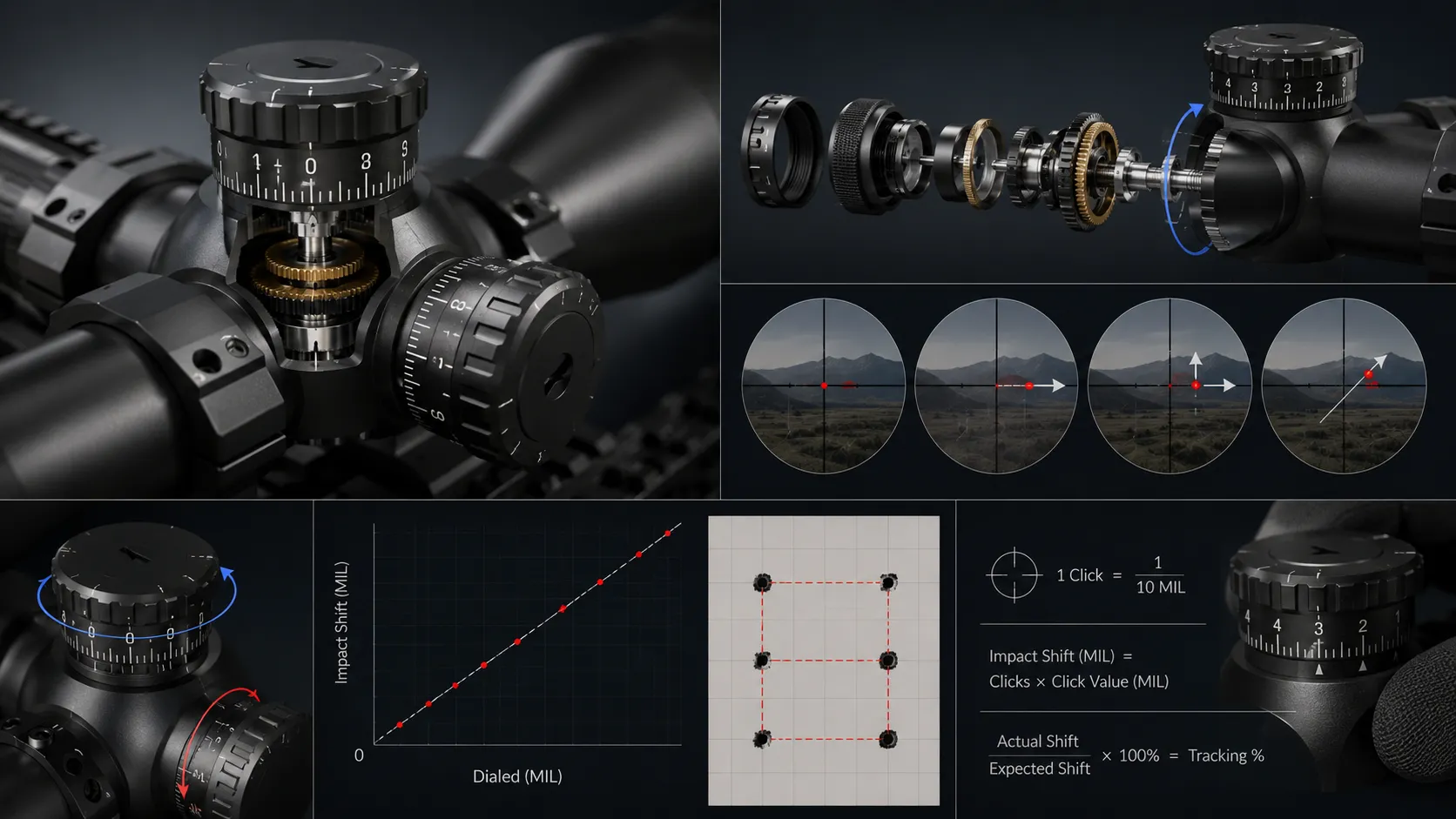
Elevation and windage turrets work by pushing or pulling the erector tube against a spring-loaded detent system. When you turn the turret a specific number of clicks, a spindle moves a set distance, tilting the erector assembly inside the scope tube. The tracking quality depends on thread consistency, spring tension uniformity, and the absence of free play between moving parts. Even tiny amounts of backlash can cause the reticle to lag behind the click value. We often see tracking errors increase near the extreme ends of the adjustment range, where spring forces are weakest or most inconsistent.
Precision shooters should test tracking not just at one distance but across the full adjustment envelope. If a scope is new, running the turrets through their full range several times before adjusting your rifle scope can help seat internal components and reveal any sticky spots. After setup, zeroing your turrets correctly at a known distance provides the reference point from which all tracking is measured.
Understanding “Honest” Adjustments (MOA vs. Mils)
An “honest” scope is one where the click values—whether 1/4 MOA or 0.1 Mil—truly move the reticle that amount. In practice, scopes often deviate. A common test is to dial 10 Mil up and measure the actual reticle movement against a calibrated grid or tall target. If the movement is only 9.8 Mil, the turret has a tracking error of 2%. Such errors accumulate and become critical at long range, where even small discrepancies push impacts far off target. For buyers who need to verify this, we recommend scopes that specify their turret adjustment increments clearly and have proven internal designs. Our Visionking 2.5-20×50 scope, for example, uses a zero stop and precise machining to maintain click integrity across its travel, though any shooter should still confirm their particular unit’s tracking with a live-fire test.
The Box Test: Validating Scope Tracking Performance
The Box Test is a straightforward live‑fire diagnostic that checks whether a scope’s turrets move the point of impact the exact commanded amount and return to zero without drift. It reveals tracking inconsistencies that simple single‑group testing cannot—if the reticle does not move cleanly in right‑angle steps, the scope has a mechanical tracking fault.
To perform the test: After sighting in your scope and establishing a solid zero on a target at a known distance (100 yards is typical), fire a baseline group. Then dial the elevation turret up 2‑4 MOA (or 0.6‑1.2 Mil) and the windage turret right the same amount, and fire another group at the same point of aim. Next, dial elevation down the same amount (windage remains right) and fire a group. Then dial windage left the original amount (elevation stays at zero offset) and fire. Finally, return both turrets to the original zero setting and fire a final group. If the scope tracks correctly, the groups will form a square box on the target, and the final group will land directly on top of the first group.
Interpreting failures is diagnostic. If the box shape appears tilted, the scope’s reticle may be canted relative to the bore—this is a mounting issue, not necessarily the turret’s own tracking. If the groups drift progressively away from the expected positions, internal friction or backlash is preventing the erector from settling consistently. If the final group does not return to the original zero, the turrets have mechanical hysteresis; the spring assembly isn’t pushing the erector tube back to the same spot. In some cases, the box test exposes that the click values themselves are off—the groups move 0.9 inches when 1 inch was commanded. Repeating the test at multiple distances and with different adjustment magnitudes helps isolate whether the error is proportional (a scaling problem) or random (a mechanical slop problem).
For scopes destined for long‑range work, we consider the box test essential during initial initial turret setup to confirm the system is mechanically honest before you trust it on distant targets.
The Mathematics of Tracking: Angular Velocity and Rads/Sec
In gaming and robotics, tracking speed is measured in radians per second (rads/sec)—a unit that directly describes how fast a turret can rotate to keep its aim aligned with a moving target’s changing angular position. Unlike degrees, radians simplify the physics of circular motion because the arc length a target traverses equals radius times angle in radians.
The core formula used in many targeting simulations is: Tracking Speed = Transversal Velocity / Distance. Transversal velocity is the component of the target’s velocity perpendicular to the line of sight. If a target moves sideways at 300 meters per second at a distance of 5000 meters, its angular velocity is 300 / 5000 = 0.06 rads/sec. A turret with a tracking speed lower than that value will lag behind the target; one with a higher speed can keep its crosshair or weapon locked on. In games like EVE Online, this math is central: the game calculates hit probability based on whether your turret’s tracking speed exceeds the target’s angular velocity, adjusted by factors like signature radius versus turret resolution.
The signature radius concept deserves attention. In a digital simulation, a target’s apparent size (signature radius) is compared to the turret’s scan resolution. A small, fast target with low signature radius makes tracking harder even if the raw angular velocity is within limits. The effective chance to hit often becomes a function of (tracking speed / angular velocity) squared when signature radius and resolution come into play. Understanding this relationship helps gamers fit the right weapon systems and helps roboticists appreciate why a sensor’s update rate and resolution effectively set the maximum tracking accuracy.
Although riflescopes do not use radians per second in their operation, the same angular math underlies the challenge: a target moving at a constant lateral speed presents a decreasing angular velocity as distance increases, which is why tracking ability at long range is less about raw speed and more about precise, repeatable adjustments.
Automated Turret Tracking in Robotics and Engineering
Automated turret tracking systems use sensor feedback to continuously compare the turret’s current pointing direction with a target’s predicted trajectory, then apply motor commands to minimize the tracking error. The real‑time loop turns a stationary mount into an active system that can follow moving objects with precision limited only by mechanical play and processing latency.
Motion Tracking Sensors and Computer Vision
Vision‑based systems typically use a camera (or lidar) to detect a target and compute its coordinates in the turret’s frame. Edge detection, color filtering, or neural‑network object detection can all identify the target, but the key metric is the update rate. If the sensor provides a new position only 10 times per second, the turret will be blind to path changes between updates. For smooth tracking of fast or erratically moving objects, frame rates of 60 Hz or higher are common in hobbyist projects using microcontrollers like Raspberry Pi with OpenCV. The raw image data translates into angular error—the difference between the current boresight and the target’s bearing—which is fed into the control loop.
Control Systems: PID Loops and Disturbance Rejection
The most common algorithm for turret tracking is a PID (Proportional–Integral–Derivative) controller. Proportional gain drives the motor proportionally to the current error; integral gain accumulates past error to eliminate steady‑state offset; derivative gain anticipates future error based on the rate of change. Tuning these gains is critical: too aggressive, and the turret overshoots and oscillates; too sluggish, and it lags. Robotics projects often combine PID with a feedforward term that uses predicted target motion (from a Kalman filter, for example) to pre‑position the turret, improving tracking of fast objects.
Disturbance rejection—the ability to stay on target despite wind buffeting, mechanical imbalance, or vibration—depends heavily on the mechanical design and the integral term of the PID loop. For hobbyists building motorized camera gimbals or sentry guns, the selection of brushless motors with precise encoders and minimal gear backlash directly parallels the precision required in a riflescope’s mechanical adjustments. Though the domain shifts from clicks to PWM signals, the core challenge of translating a desired angle into a physical movement without error remains the same.
Comparison of Turret Tracking Parameters
The table below summarizes how turret tracking is defined, measured, and tested across optics, gaming, and robotics. While the language changes, each domain struggles with the same fundamental problem: converting a target’s angular position into a repeatable mechanical or digital response.
| Domain | Primary Metric | Core Challenge | Primary Test Method |
|---|---|---|---|
| Precision Optics | Repeatability (MOA/Mil deviation) | Mechanical backlash, spring inconsistency | Box Test (live fire) |
| Gaming (EVE Online) | Rads/Sec tracking speed vs. target angular velocity | Transversal velocity & signature radius mismatch | Hit probability formula simulation |
| Robotics & DIY | Error signal margin (degrees) & settling time | Sensor latency, gear play, PID tuning | Motion capture & step response analysis |
Values depend on specific models and system configurations; always verify performance for your particular setup or refer to manufacturer specifications.
Factors Affecting Turret Tracking Precision
Tracking precision degrades when mechanical, environmental, or algorithmic factors introduce an unanticipated offset between commanded and actual position. Even a well‑designed system can underperform if these variables are not addressed.
Mechanical: Backlash is the most common culprit. In riflescopes, any gap between the turret spindle and the erector contact point means the reticle does not move until the slack is taken up, leading to a dead zone. Friction from poorly lubricated threads or grit can cause erratic jumps. Thermal expansion affects metals unequally; in extreme conditions, a scope body can expand enough to shift the optical axis, changing the zero and the effective click value. For robotic turrets, gear train backlash and belt stretch create similar issues.
Environmental: Target distance directly changes the required angular precision—an error of 0.1 Mil at 1000 yards translates to a much larger impact shift than at 100 yards. Atmospheric refraction, while subtle, can bend the apparent position of a distant target, especially near the ground on hot days, causing a tracking system (whether human‑aimed or camera‑based) to chase a mirage rather than the actual object.
Algorithmic: In automated systems, the latency between when a sensor captures a frame and when the motor receives a command limits tracking speed. If a target moves 0.05 radians in the time it takes to process one cycle, the turret will always lag by at least that amount. Similarly, poor PID tuning can introduce overshoot that masquerades as tracking error. Even in a manual riflescope, the human operator’s reaction time when dialing moving target leads acts as a latency that no mechanical precision can overcome—tracking, in that sense, is both a mechanical and human factors problem.
For shooters, parallax misadjustment can mimic tracking failure. If the reticle appears to move on the target when the eye shifts, the scope’s parallax setting is not corrected for the distance, causing aiming errors that can be mistaken for turret tracking problems. Verifying parallax and turret accuracy separately helps isolate the true source of missed impacts.
Frequently Asked Questions
What does it mean if a scope “won’t track”?
It means the internal mechanical movement does not match the advertised click values—dialing 1/4 MOA might move the point of impact by a different amount, or the reticle may not return to the original zero after adjustments are reversed.
Why is tracking speed measured in radians instead of degrees?
Radians simplify the relationship between angular displacement and the arc length of a target’s path; one radian is the angle subtended when the arc length equals the radius, making velocity‑to‑angular‑rate calculations direct without conversion factors.
Does turret tracking affect accuracy or precision?
Tracking primarily affects accuracy over a range of dial adjustments—the ability to place a shot exactly where the turret says—while precision (group size) is more influenced by barrel quality, ammunition, and shooter consistency.
What is “tracking error” in robotics?
It is the real‑time angular difference between the turret’s current bore‑sight orientation and the target’s measured bearing; minimizing this error through feedback control is the goal of any automated tracking system.