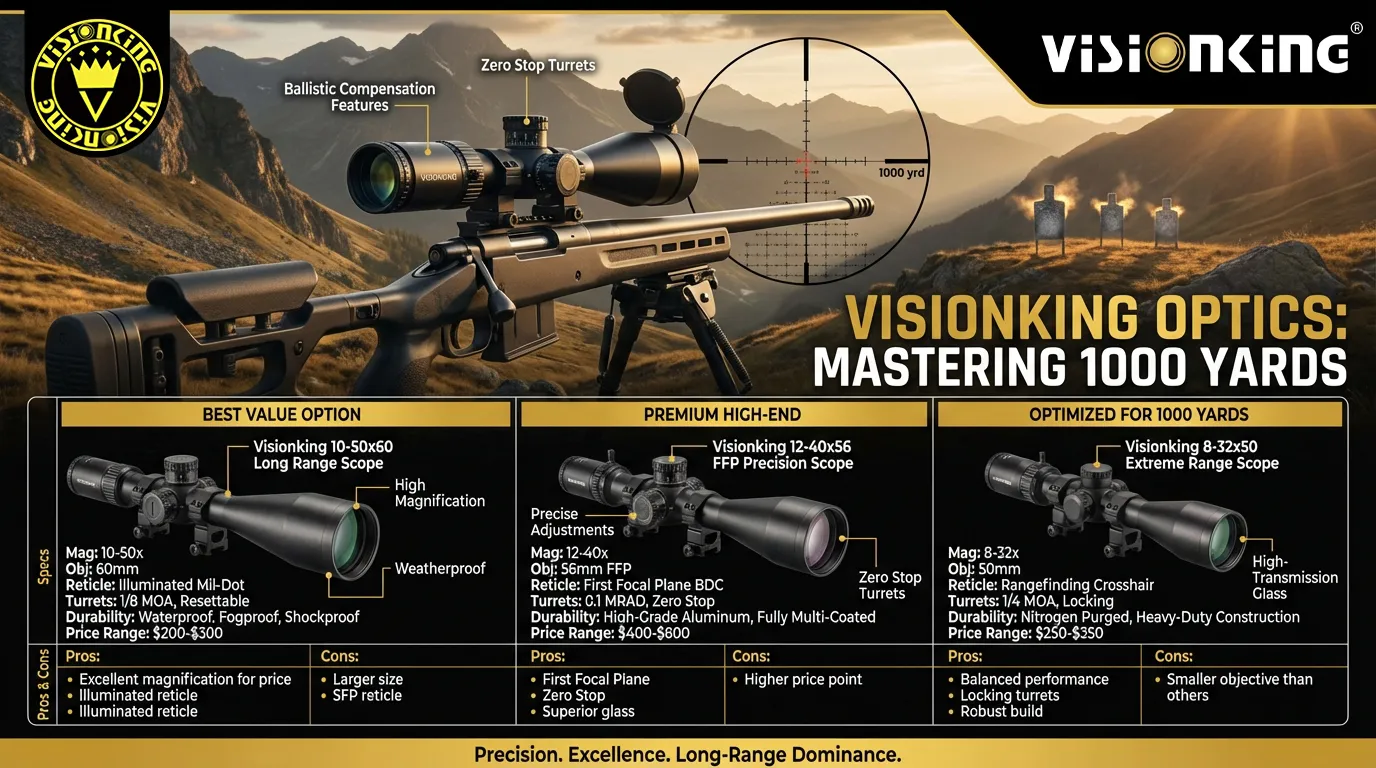
Understanding the Requirements for 1000-Yard Shooting
Reaching out to 1000 yards requires more than just a steady hand; it demands an optical system engineered to handle extreme distances. The best rifle scope for 1000 yard shooting serves as the bridge between your rifle\’s mechanical accuracy and the target, ensuring that atmospheric conditions and bullet drop are calculated with absolute precision.
What Defines a Long-Range Precision Scope?
A standard hunting optic cannot reliably perform at this distance. A true long-range optics system is defined by its ability to maintain mechanical integrity while providing the magnification necessary to see bullet holes on paper or steel impacts at over half a mile.
To qualify for 1000-yard use, a scope must possess specific mechanical and optical traits:
- High Magnification: A minimum top-end magnification of 18x to 25x is recommended to identify targets clearly.
- Turret Reliability: Exposed turrets with tactile clicks and a Zero Stop mechanism are essential for dialing large elevation adjustments and returning to zero instantly.
- Internal Travel: Large tube diameters (30mm or 34mm) are required to provide enough internal elevation travel to compensate for significant bullet drop.
- Reticle Type: A First Focal Plane (FFP) reticle is preferred, ensuring holdover points remain accurate regardless of the magnification setting.
Is 1000-Yard Shooting Practical for Beginners?
Entering the world of precision rifle shooting can be daunting, but the right equipment significantly flattens the learning curve. While skill is paramount, attempting 1000-yard shots with inferior glass leads to frustration due to an inability to see misses and correct them.
For beginners, investing in a scope with forgiving eye relief and a distinct \”eye box\” allows for longer shooting sessions without fatigue. Modern optics often feature intuitive reticles (like the EBR-7C or G3) that assist new shooters in calculating windage and elevation holds without complex math, making the 1000-yard milestone achievable with practice.
The Importance of Optical Clarity and Light Transmission
At maximum magnification, the exit pupil of a scope shrinks, naturally darkening the image. This makes glass quality the single most critical factor for long-range target identification. If the glass cannot resolve detail, high magnification simply results in a larger, blurrier image.
Top-tier scopes utilize Extra-low Dispersion (XD) glass and fully multi-coated lenses to maximize light transmission. This ensures the target remains sharp and high-contrast, even during dawn or dusk.
| Feature | Standard Scope | 1000-Yard Precision Scope |
|---|---|---|
| Objective Lens | 40mm – 44mm | 50mm – 56mm (Max Light Gathering) |
| Glass Quality | Standard Optical Glass | HD / ED Glass (Color Fidelity) |
| Coatings | Single or Multi-Coated | Fully Multi-Coated (90%+ Transmission) |
| Resolution | Good at 100 yards | Razor Sharp at 1000+ yards |
Key Features to Look For in a 1000-Yard Rifle Scope
To successfully engage targets at extreme distances, your optic needs specific mechanical and optical capabilities. A standard hunting scope often lacks the adjustment range and clarity required for precision work. Here is what defines the best rifle scope for 1000 yard shooting.
Minimum Magnification for Long-Range Targets
You cannot hit what you cannot see. For 1000-yard applications, optical clarity is paramount, but magnification power does the heavy lifting. While experienced shooters can hit targets with lower power, I recommend a maximum magnification of at least 18x to 25x.
High magnification allows you to see bullet splash on steel targets, which is critical for making corrections. However, the low end of the range matters too. A scope starting at 5x or 6x provides a wider field of view, making it easier to locate the target before zooming in for the shot.
- Recommended Range: 5-25x or 6-24x
- Objective Lens: 50mm to 56mm (for maximum light transmission at high zoom)
First Focal Plane (FFP) vs. Second Focal Plane (SFP)
For long-range precision, the First Focal Plane (FFP) is the professional standard. In an FFP scope, the reticle grows or shrinks as you change magnification. This means the hash marks (subtensions) for windage and elevation holdovers remain accurate at any zoom level.
In contrast, Second Focal Plane (SFP) reticles are only accurate at one specific magnification (usually the highest). If you are dialing back your zoom to manage mirage or find a target, SFP math becomes complicated. For dynamic shooting, using FFP rifle scopes with zero stop ensures your holdovers are always correct, speeding up your engagement time significantly.
Elevation Travel and Turret Reliability
Gravity is a major factor at 1000 yards. Depending on your caliber, you may need 30 to 40 MOA (or 9 to 12 MILs) of elevation adjustment just to reach the target.
- Internal Adjustment: Look for a 30mm or 34mm main tube, which allows for greater internal travel range.
- Tracking: The turrets must be mechanically precise. If you dial 10 clicks up, the point of impact must move exactly that amount.
- Zero Stop: This feature allows you to physically stop the turret at your zero setting. After dialing for a long shot, you can blindly rotate the turret back until it stops, returning you perfectly to your 100-yard zero without looking.
Reticle Selection: MOA vs. MRAD
The choice between Minute of Angle (MOA) and Milliradian (MRAD or MIL) is largely personal preference, but consistency is non-negotiable. You must ensure your turret adjustments match your reticle measurements (e.g., MIL turrets with a MIL reticle).
| Feature | MOA (Minute of Angle) | MRAD (Milliradian) |
|---|---|---|
| Unit Size | 1 MOA ≈ 1.047 inches at 100 yards | 0.1 MIL = 1 cm at 100 meters (0.36\” at 100 yards) |
| Popularity | Common in the US among hunters | Standard for military and PRS competition |
| Math | Base 10 system (Imperial approximation) | Base 10 system (Metric/Decimal) |
| Best For | Shooters used to inches/yards | Shooters communicating with spotters |
For most long-range optics, MRAD is becoming the dominant choice because the base-10 math is faster for on-the-fly corrections. However, if you think in inches, MOA is perfectly capable of 1000-yard precision.
Best Overall 1000-Yard Rifle Scopes for 2026
When pushing out to 1000 yards, optical quality and mechanical precision are non-negotiable. You need a system that tracks perfectly and provides enough clarity to see impacts at extreme distances. Based on rigorous testing and field use, these three optics represent the pinnacle of long-range performance for the coming year.
Nightforce ATACR 7-35×56: The Professional Choice
For shooters who demand absolute reliability under the harshest conditions, Nightforce remains the gold standard. The ATACR series is built for professional use, offering a massive magnification range that allows for precise target identification at extended ranges. Its 56mm objective lens ensures excellent light transmission, which is critical during dawn or dusk operations.
- Durability: Engineered to withstand heavy recoil and field abuse without losing zero.
- Turrets: Tactile and audible clicks ensure you can dial adjustments confidently without looking.
- Glass Quality: ED glass provides distinct contrast, helping you spot trace and impacts.
If your budget allows for premium gear, this is the best rifle scope for 1000 yard shooting when failure is not an option.
Vortex Razor HD Gen III 6-36×56: Most Durable Performance
Vortex has solidified its place in the precision rifle series (PRS) community with the Razor HD Gen III. This optic balances high-end features with a warranty that is hard to beat. The 6-36x magnification range is incredibly versatile, allowing for a wide field of view at the low end and extreme detail at the top end.
Key Advantages:
- Optical Clarity: Delivers edge-to-edge sharpness that rivals much more expensive European glass.
- Zero Stop System: Returns to your original zero instantly, a must-have for competition stages.
- Reticle: The First Focal Plane (FFP) reticle ensures your holdovers are accurate at any magnification setting.
This scope is a heavy hitter, designed for stationary precision rather than lightweight mountain hunting.
Leupold Mark 5HD 5-25×56: Lightweight Precision
Leupold distinguishes itself by offering professional-grade performance in a significantly lighter package. The Mark 5HD is a favorite for those who need to carry their rifle over long distances but still require the capability to engage targets at 1000 yards.
Unlike the heavier options above, the Mark 5HD utilizes a 35mm main tube to maximize elevation travel while keeping weight down. When mounting this optic, ensuring you have high-quality Visionking rifle scope rings 35 mm is essential to maintain alignment and handle the torque of heavy calibers.
- Weight: Significantly lighter than the ATACR or Razor, making it ideal for dual-role hunting and target rifles.
- Low Light Performance: Features Leupold’s light management system to extend shooting time.
- Ergonomics: The throw lever and turret designs are optimized for fast adjustments in the field.
Top Recommendations by Specific Use Case
When choosing the best rifle scope for 1000 yard shooting, the \”right\” choice depends entirely on your mission. A heavy benchrest optic won\’t help you in the mountains, and a lightweight hunting scope might drift as the barrel heats up during a rapid-fire match. Based on field performance and technical specs, here is how the top contenders stack up for specific applications.
Best for Competition and PRS Shooting
In the Precision Rifle Series (PRS) and other long-range competitions, speed and mechanical reliability are everything. You need a scope that tracks perfectly when dialing elevation and offers a First Focal Plane (FFP) reticle for instant holdovers.
The Vortex Viper PST Gen II 5-25×50 stands out here as the overall best performer. It strikes the perfect balance for competitors who need high-end features without spending $3,000. The EBR-7C reticle is a \”Christmas tree\” style design, which is essential for competition; it allows you to hold for wind and elevation simultaneously without touching the turrets.
- Why it wins: The RZR Zero Stop mechanism is solid, ensuring you can return to zero by feel alone during a timed stage.
- Key Feature: The glass quality (XD lens elements) provides the resolution needed to spot bullet trace at 1000 yards.
- Trade-off: It is heavier than hunting scopes, but in competition, that extra weight helps mitigate recoil.
For those prioritizing reticle design specifically, the Bushnell Elite Tactical with the G3 reticle is another heavy hitter in this space. The G3 reticle provides a clean sight picture while giving you precise holdover points, making it a favorite for shooters who prefer holding over dialing.
Best for Long-Range Hunting Applications
Hunting at extended ranges requires a completely different set of priorities. You are likely hiking into position, so weight savings are critical, and you need optical performance that excels during the \”golden hour\”—dawn and dusk.
The Leupold VX-3i LRP 6.5-20×50 is the clear winner for this category. It is significantly lighter than its tactical counterparts, making it much easier to carry on a stalk. More importantly, Leupold’s Twilight Max Light Management System is designed specifically to enhance contrast in low-light conditions. When you are trying to distinguish a buck from the brush at 800 or 1000 yards in fading light, this coating technology makes a massive difference.
- Durability: Despite being lightweight, it is shockproof and fully fog-proof, handling the rough conditions of the field.
- Precision: It offers the magnification needed for ethical shot placement at long distances.
To ensure your first shot counts, pairing your optic with a reliable Visionking 6×25 laser range finder is essential for calculating the exact distance and angle compensation before getting behind the glass.
Best Tactical and Duty-Grade Optics
For tactical applications, durability is not just a feature; it is a requirement. These optics must withstand drops, rough handling, and harsh environments while maintaining zero.
The Nightforce NXS 5.5-22×56 is the undisputed king of this category. It is built like a tank, with thicker tube walls and a construction process that focuses on absolute reliability. This scope is a favorite among military and law enforcement snipers because it simply does not fail.
- Build Quality: The NXS is heavy, but that mass translates to bombproof protection for the internal glass and erection system.
- Turrets: The adjustments are distinct and tactile, allowing for precise changes even when wearing gloves.
- Capability: With 100 MOA of internal adjustment, it has the travel necessary to push standard cartridges out to 1000 yards and beyond.
If you are looking for a versatile optic that bridges the gap between tactical durability and hunting usability, a Visionking 2-16×44 side focus scope offers a robust Mil-Dot reticle and wide magnification range suitable for dynamic tactical environments. However, for pure 1000-yard duty use, the Nightforce remains the gold standard for its proven track record in the field.
Best Budget 1000-Yard Scopes (Value Picks)
Getting into precision rifle shooting doesn\’t require a second mortgage anymore. A few years ago, budget optics were unreliable for long-range work, but manufacturing technology has caught up. Today, you can find a rifle scope for 1000 yard engagements that tracks true and offers decent glass without breaking the bank. If you are looking for high value, these options deliver the necessary mechanical reliability to get hits at distance.
Bushnell Match Pro ED 5-30×56: Best Performance for the Money
The Bushnell Match Pro ED has essentially set the standard for what an entry-level competition scope should be. It is widely considered the best rifle scope for 1000 yard shooting in the sub-$1000 category. The \”ED\” stands for Extra-low Dispersion glass, which significantly reduces chromatic aberration (color fringing) at high magnification. This clarity is critical when you are trying to spot bullet splash on steel plates at a kilometer.
Why it stands out:
- 34mm Main Tube: Provides ample elevation travel for long-range dial-ups.
- Easy-Set Zero Stop: You won\’t get lost on your turrets after dialing for distance.
- Illuminated Reticle: The Deploy MIL 2 reticle is excellent for holdovers and wind calls.
This optic bridges the gap between budget plinkers and professional glass, making it a top choice for Production Class PRS shooters.
Athlon Helos BTR Gen II: Top Entry-Level Option
If you need a robust scope that can handle field abuse, the Athlon Helos BTR Gen II is a solid contender. It features locking windage and elevation turrets, a feature usually reserved for much more expensive long-range optics. The glass is clear enough to identify targets at 1000 yards, and the tracking is reliable, which is the most important factor in this game.
To make the most of this scope, accurate distance measurement is non-negotiable. Pairing your optic with a precise Visionking 6×25 solar power range finder ensures that the data you dial into your turrets is correct, eliminating the guesswork before you pull the trigger.
Key Highlights:
- Locking Turrets: Prevents accidental adjustments during transport or movement.
- First Focal Plane (FFP): The reticle subtensions remain accurate at any magnification.
- Forgiving Eye Box: Easier to get behind the scope quickly compared to other budget models.
Arken Optics EP5: Features Beyond Its Price Point
The Arken EP5 5-25×56 has gained a massive following because it offers features that usually cost three times as much. It is built like a tank and is known for having incredibly tactile and audible turret clicks. When you dial 10 MOA, you feel and hear every click, giving you confidence in your adjustments.
While it is heavier than the others, the glass quality is surprising for the price. The VPR reticle is clean and useful for long range rifle scope 1000 yard applications. It utilizes Japanese ELD glass (assembled in China) to provide a crisp image.
Quick Comparison of Value Picks:
| Feature | Bushnell Match Pro ED | Athlon Helos BTR Gen II | Arken Optics EP5 |
|---|---|---|---|
| Magnification | 5-30×56 | 2-12×42 / 4-20×50 | 5-25×56 |
| Tube Diameter | 34mm | 30mm / 34mm | 34mm |
| Turret Feel | Crisp, Non-Locking | Good, Locking | Very Tactile, Zero Stop |
| Best Use | PRS Competition | Hunting / Tactical | Benchrest / Long Range |
| Weight | 32.1 oz | 27.6 oz | 39.2 oz |
Choosing any of these three will get you on target at 1000 yards. They prove that mechanical precision is now accessible to everyone. If you are building a rig on a budget, prioritize the tracking reliability of these models over fancy brand names.
Buyer’s Guide: How to Choose Your Long-Range Optic
Selecting the best rifle scope for 1000 yard shooting isn\’t just about buying the most expensive glass; it\’s about finding the right mechanical match for your rifle\’s capabilities. When I evaluate optics for extreme distances, I focus on how the mechanical system interacts with the ballistics of the cartridge.
Matching Your Scope to Rifle Caliber and Ballistics
Your scope must have enough internal adjustment to compensate for the bullet drop of your specific caliber. A .308 Winchester drops significantly more at 1000 yards than a 6.5 Creedmoor, meaning you need more elevation travel in your turrets to dial the shot.
If your scope runs out of \”clicks\” before you reach your target distance, the optical clarity doesn\’t matter. I always check the total elevation adjustment range—usually measured in MOA or MRAD. For 1000-yard shooting, you generally need a scope that offers at least 60-100 MOA of internal travel, depending on your base and ballistics.
- Flat Shooting Calibers (e.g., 6.5 PRC): Require less elevation travel, allowing for more flexibility in scope choice.
- Heavy Drop Calibers (e.g., .308 Win): Demand scopes with massive internal adjustment ranges to reach out to 1000 yards.
Understanding Tube Diameter and Mounting Solutions
The main tube diameter is critical because it dictates the range of motion for the internal erector system. A standard 1-inch tube simply restricts the elevation travel too much for long-range applications.
For 1000-yard precision, I recommend a minimum of a 30mm tube, with 34mm becoming the standard for professional long-range optics. This larger diameter allows for greater windage and elevation adjustments. Even a durable 30 mm rifle scope designed for shorter ranges benefits from this increased structural integrity, but for long-range shooting, that extra internal space is vital for dialing shots without bottoming out the turret.
Tube Diameter Comparison:
| Tube Size | Internal Adjustment | Light Transmission Potential | Recommended Use |
|---|---|---|---|
| 1-inch | Limited | Standard | Short to Mid-Range Hunting |
| 30mm | High | Excellent | 1000-Yard Precision |
| 34mm | Extreme | Maximum | ELR (Extreme Long Range) |
The Role of Eye Box and Eye Relief in Long-Range Comfort
At high magnifications like 25x, the \”eye box\”—the area behind the scope where you can see the full image—naturally tightens. A forgiving eye box is essential because it allows you to spot your trace and impact without struggling to maintain a perfect head position.
Eye relief is equally important, especially if you are shooting high-caliber rifles with heavy recoil. I look for scopes offering at least 3.5 to 4 inches of eye relief. This ensures that when the rifle kicks, the scope doesn\’t strike your brow, while also reducing eye fatigue during long sessions behind the glass. Premium glass with quality coatings (like the XD glass found in Vortex Vipers or Twilight Max in Leupold) significantly improves the eye box experience by maintaining edge-to-edge clarity.
Frequently Asked Questions
What is the Best Caliber for Shooting 1000 Yards?
Picking the right cartridge is just as important as finding the best rifle scope for 1000 yard shots. You need a round that remains supersonic past that 1k mark to maintain stability and accuracy.
- 6.5 Creedmoor: Currently the gold standard for precision rifle shooting. It offers low recoil, high ballistic coefficient, and is widely available.
- .300 Win Mag: A powerhouse that bucks wind exceptionally well, though it comes with heavier recoil and cost.
- .308 Winchester: The classic standby. It can make the shot, but it is harder to drive accurately at this distance compared to modern 6.5mm cartridges.
- .338 Lapua: Excellent for extreme distances, but overkill for targets inside a mile and very expensive to feed.
Do I Need a 20 MOA Rail for 1000-Yard Shooting?
For most people, yes. Standard mounts often don\’t leave enough internal adjustment in your scope to dial the elevation needed for 1000 yards.
- Why you need it: Gravity drops the bullet significantly at long range. You have to dial the turret \”up\” a lot.
- How it works: A 20 MOA rail tilts your long-range optics downward slightly. This mechanically adds elevation travel, ensuring you don\’t run out of clicks before you get on target.
How Much Should I Spend on a Long-Range Scope?
A common rule of thumb is to spend at least as much on your glass as you did on the rifle. Cheap scopes often lose zero or fail to track correctly when you start dialing turrets up and down repeatedly.
- Entry-Level ($500 – $900): You can find capable scopes here, but you might sacrifice some glass clarity at max magnification.
- Mid-Range ($1,000 – $2,000): The sweet spot. You get reliable tracking, good glass, and durable build quality.
- High-End ($2,500+): Professional grade with perfect optical clarity.
Don\’t forget to save budget for essential accessories. At these distances, seeing bullet splash can be tough through the rifle optic alone, so keeping a high-performance spotting scope nearby is often necessary to confirm impacts and read the wind mirage.