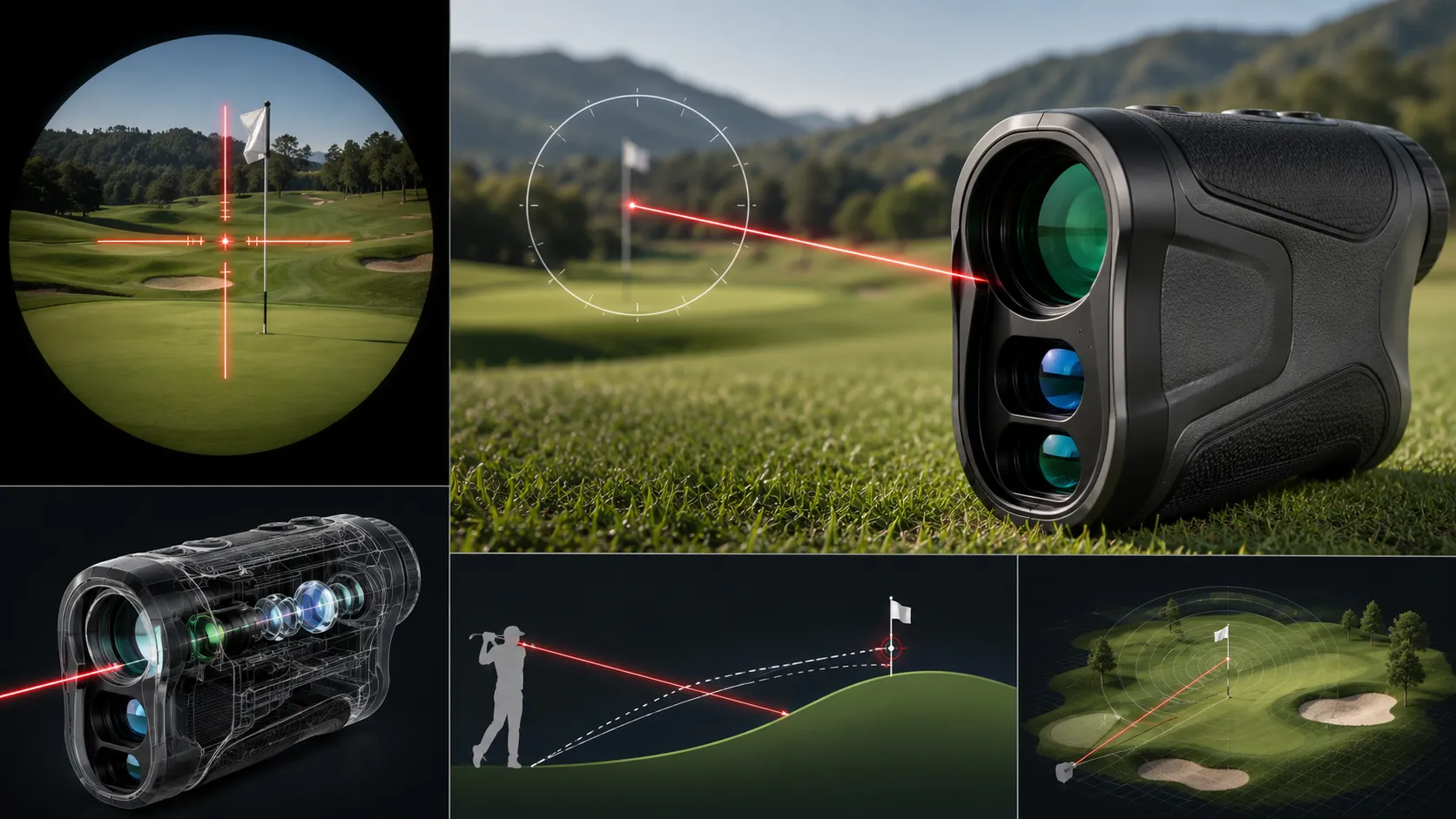
An active laser rangefinder changes how you read a golf hole. Instead of staring down the fairway and guessing what lies between you and the flag, a quick glance at a vivid touchscreen shows you hazard carries, green contours, and slope-adjusted distances all at once. This isn’t just a distance tool—it’s a portable course strategist.
That combination of precision laser optics and real-time GPS mapping is what makes these devices “active.” The screen actively updates as you move, showing you what a standard laser never can. For any golfer who has been burned by a hidden bunker or misread a triple-tier green, the appeal is immediate.
Our guide walks you through the technology, the features that matter most, and how to pick a model that fits your game without paying for capabilities you’ll never use. By the end, you’ll know exactly what an active rangefinder can do—and whether it deserves a spot in your bag.
What is an Active Laser Rangefinder?
An active laser rangefinder is a hybrid golf distance measuring device that merges a precise laser with an integrated GPS engine and digital display. Traditional lasers bounce a beam off the flag and give you a single number; an active unit overlays hole layout graphics, front/center/back distances, hazard data, and even green undulation maps onto that single view.
Think of it as two tools fused into one. When you look through the eyepiece, you’re not just seeing the target—you’re seeing a smart course map that updates as you aim. The “active” designation refers to the constant processing of GPS position data alongside laser measurements. This means the device can calculate compensated yardages that factor in elevation change, automatically filter out background trees with pin tracer technology, and show you the shape of the green before you reach it.
Compared to a standard unit like the Visionking 6×25 laser rangefinder, the active variant sacrifices a bit of battery runtime for a much richer information layer. That trade-off makes sense when you encounter courses with blind approach shots or complex green complexes—the active rangefinder replaces note‑taking and memory with instant on‑screen confirmation.
The Benefits of Active Hybrid Technology on the Course
The real payoff of an active laser rangefinder appears the moment you face an approach shot where the flag isn’t enough information. With active hybrid technology, you see danger points before they become penalty strokes, and you get green topography that a pure laser could never deliver.
Beyond the Pin: GPS Hazards and Layouts
Standard lasers tell you nothing about the fairway bunker on the left or the creek cutting across on the right. Active rangefinders display a course layout graphic right on the screen, pinpointing the distances to hazards and layup zones. Many units let you tap touchscreen hotspots to get exact numbers to the front edge of a bunker or the carry over water. This is what turns an active rangefinder into a full-on tactical planning tool rather than a simple pin seeker.
GPS‑powered layout overlays also show you the true shape of the hole long before you walk off the tee. When you can see that the fairway narrows dramatically at 280 yards, you know immediately whether driver is the right call. That kind of visual information speeds up decision-making and removes much of the uncertainty that leads to forced errors.
Mastering the Green with Undulation Mapping
Misreading a 45‑foot putt because the green tilts more than it appears costs strokes fast. Active rangefinders with green undulation mapping solve this by presenting a heat‑map‑style layer over the surface: warm colors show high points, cool colors show low areas, and arrows often indicate slope direction. Even when you’re standing 150 yards away, you can plan your approach to leave an uphill putt.
This feature is often called “GPS green reading.” It works by loading pre‑mapped topographic data for thousands of courses and aligning it with your GPS position. Some models even let you touch a spot on the screen to get a precise distance to a ridge or a false front. The result is fewer three‑putts and smarter approach lines.
Key Features to Look For in an Active Rangefinder
The difference between a frustrating round and a confident one often comes down to three things: how fast the rangefinder locks onto the flag, how clearly the screen shows course details, and how intelligently it adjusts for slopes. When comparing active rangefinders, give these elements the most weight.
Pin-Locking and Vibration Feedback
Modern active rangefinders use pin tracer technology to isolate the flagstick from trees, poles, and background clutter. A fast processor analyzes multiple laser returns and confirms the closest stable target. When lock is achieved, the device pulses a short vibration alert—you feel it in your hand even if you’re looking through the eyepiece—so you know the number is real without taking your eye off the target.
In our testing, units that pair vibration with a visual lock indicator on the screen reduce second‑guess re‑shoots significantly. If you’ve ever stood over a shot wondering whether the laser grabbed the tree behind the green, this feature alone is worth the price difference.
High-Resolution Touchscreen Integration
Not all screens are equal. Entry‑level active rangefinders may use a basic LCD overlay, while top‑tier models feature a high-resolution touchscreen—often color OLED—that remains readable in bright sunlight. The touch capability lets you tap on a hazard icon or a green map element to pull exact distances instantly. That kind of interactivity feels natural and cuts the messing around with buttons.
Screen quality also affects how well the GPS information blends with the live optical view. A crisp, high‑contrast display makes the data layer feel like it belongs there, not like a cheap sticker pasted on the lens. Pay attention to resolution and brightness specs; they directly impact battery consumption and usability during midday rounds.
Slope Compensation and Environmental Adjustments
Slope compensation turns a raw laser distance into a “plays‑like” number that accounts for uphill and downhill elevation changes. An active rangefinder typically does this automatically by combining the laser’s angle measurement with GPS elevation data. That added intelligence helps club selection feel surer, especially on courses with heavy elevation change where a flat 160 yards might play 145 or 175.
Another crucial detail is the tournament mode. Almost every active rangefinder includes a slope disable switch (often an external toggle) that turns off compensation features to make the device legal under USGA rules. Look for a model where this mode is quick to activate and clearly indicated, so there’s no confusion during competition.
Comparing Popular Active Laser Rangefinder Models
The active rangefinder market breaks into clear tiers. At the entry level, you get the fundamental hybrid benefit—GPS course graphics on a screen—without deep green analysis. Step up to an advanced model, and you add green undulation mapping and a responsive touchscreen. The premium tier pushes display quality, processor speed, and slope sophistication even further.
The table below distills the key differentiators you’ll encounter when comparing models. Use it as a quick reference during your research.
| Model Category | Magnification | Screen Type | Green Undulation | Slope Feature |
|---|---|---|---|---|
| Standard Active Rangefinder | 6x | LCD overlay | No | Basic auto‑slope; tournament mode |
| Advanced Active Rangefinder | 7x | Color touchscreen | Yes (basic heatmap) | Advanced slope with altitude reading |
| Professional Active Rangefinder | 7x or higher | High‑resolution OLED touchscreen | Yes (detailed undulation mapping) | Dynamic slope compensation; pin assist filtering |
Specifications listed above represent typical product configurations in the active rangefinder category. Actual features, accuracy, and battery life vary by manufacturer. Always verify technical details against the latest product documentation or consult the manufacturer before purchasing.
When looking at a standard active unit, you’ll notice that the hybrid GPS integration already drastically improves course awareness compared to a laser‑only device. The advanced tier sweetens the deal with green undulation and touch controls, which is where most dedicated golfers will see the biggest score impact. The professional tier adds faster refresh rates and richer data layers, making it the choice for tournament players who want to physically tap a spot on the green and see the exact break in feet.
A practical selection tip: if your home course greens rarely change pin positions in complex ways, a standard active rangefinder may deliver all the value you need. But if you play a rotation of courses with severe contours, the jump to an advanced model with green mapping will repay itself in saved strokes quickly.
Active Laser vs. Traditional Laser: Which is Right for You?
If your main goal is to get a fast, accurate number to the flag and nothing else, a traditional laser like the golf laser rangefinder will do that reliably with longer battery life and a simpler operation. The active rangefinder exists for players who want the complete picture—not just the pin distance, but the full green topography and hazard layout.
To make the comparison concrete, here are the strengths and trade‑offs you’ll face when choosing between the two:
- Pros of active laser rangefinders: Full‑hole intelligence with GPS‑overlaid course maps, green undulation data, front/center/back distances in a single glance, hazard identification, and built‑in slope compensation that works without a separate device.
- Cons of active laser rangefinders: Noticeably higher price point, reduced battery life per charge (typically lasting one to three rounds), slightly larger form factor, and screens that can be difficult to read in very bright sun if the backlight doesn’t compensate well.
- Pros of traditional laser rangefinders: Simple, fast operation; long battery life often spanning seasons; compact and lightweight; highly accurate pin‑to‑pin distance; no need for GPS signal or course mapping.
- Cons of traditional laser rangefinders: No data on invisible hazards, no green slope information, no front/center/back without multiple readings, and pure line‑of‑sight only—if you can’t see it, a traditional laser can’t measure it.
For the player who walks a course with a well‑worn yardage book, the traditional laser is a fine companion. But if you want to level the information advantage that caddies provide, the active category is the logical next step.
Choosing the Right Model for Your Game
Start with the course types you play most often. If heavy undulation, multi‑tiered greens, and blind tee shots are common, an advanced active rangefinder with green mapping will change how you approach every hole. On flatter, more open layouts, a standard active unit still gives you hazard awareness without the extra cost of detailed green graphics.
Skill level matters too. Weekend golfers who value pace of play often favor the immediate hazard and front/center/back readouts of an active rangefinder—it cuts down the need to pace off yardages or consult phone apps. Tournament competitors, on the other hand, will appreciate the detailed green undulation layers and rapid slope switching that keep the device compliant with rules while still informing practice rounds. If you’re willing to manage a USB rechargeable laser rangefinder between rounds, that convenience can offset the active model’s higher power draw.
Visionking’s optical expertise gives golfers confidence in the laser’s core accuracy, while our custom rangefinder solutions let you specify the active features you value most—whether that’s a specific screen type, enhanced green mapping, or a rugged rain‑sealed build. To see the full lineup of precision golf optics, visit our product range and compare specifications side by side.
Frequently Asked Questions
Are active hybrid rangefinders legal for tournament play?
Most active rangefinders include a dedicated tournament mode that disables slope compensation and green undulation mapping. With that mode enabled, the device complies with USGA and R&A local rule G‑5, which allows distance‑measuring devices as long as they do not gauge elevation or other conditions that might assist the player beyond pure distance. Always confirm the specific model’s tournament mode status before stepping onto the course in competition.
Do I need a subscription for the GPS features?
No subscription is required for the vast majority of active hybrid rangefinders. Manufacturers typically pre‑load course maps for thousands of courses worldwide, and map updates are often downloadable for free via a companion app or USB connection. Check the product details to verify that no hidden fees apply to the model you’re considering.
How long does the battery last on an active rangefinder?
Because an active rangefinder powers both a laser and a GPS‑driven color screen, battery life tends to be shorter than a standard laser—usually between one and three full rounds per charge. Some models offer a solar‑powered laser rangefinder approach to extend runtime, but for most active units a pre‑round charge habit or a small power bank in the bag is a practical solution.
Can I use it without the GPS function?
Yes. Every active laser rangefinder can operate as a standard laser if you turn off the GPS overlay or if you’re on an unmapped course. The laser measurement works independently, so you can still get precise distance to any visible target without any GPS data being displayed.