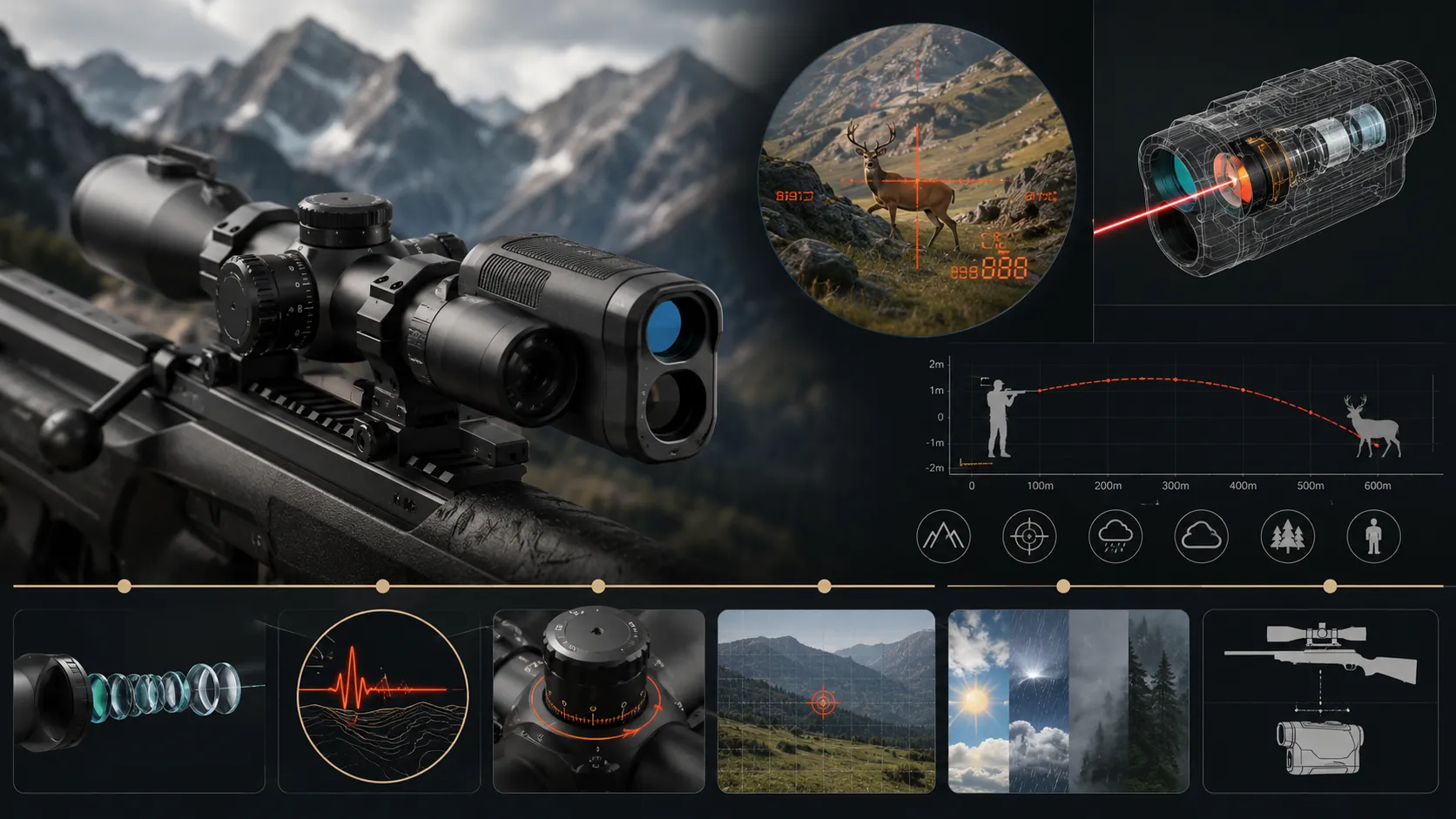
Buying a laser rangefinding riflescope is not just about magnification or lens coating — it is a decision about how fast you can convert a range into an accurate shot. Unlike traditional optics, these integrated systems combine a laser rangefinder, environmental sensors, and a ballistic calculator directly into the scope body. That means you never have to drop a handheld rangefinder to shoulder your rifle.
For hunters and long-range sport shooters, that speed matters. A mule deer standing at 600 yards will not wait while you swap gear. The right LRF scope gives you an instant, angle-compensated aiming point, but only if you understand which technical trade-offs you are accepting. This guide walks through the features, real-world performance limits, and selection factors that should drive your choice.
Understanding the Laser Rangefinding Riflescope
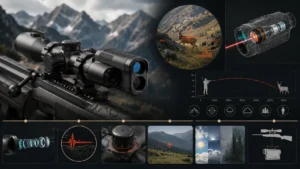
A laser rangefinding riflescope integrates a digital laser rangefinder, an environmental sensor suite, and an onboard ballistic calculator directly into a single optical housing. Its core job is to eliminate the gap between ranging a target and placing a shot: you range the target with a button press, the scope’s computer calculates bullet drop based on your cartridge profile and the measured distance and angle, and the reticle instantly displays the corrected aiming point — usually as an illuminated dot or holdover mark on a heads-up display (HUD).
The workflow is direct. Press the ranging button; the internal laser pulses to the target and back, measuring time-of-flight to determine distance. That yardage, combined with incline data from tilt sensors, feeds into the ballistic engine. In under a second, the system adjusts the visible reticle point. For a hunter in open terrain or a precision shooter on steel plates, this removes the mental math and extra motion that often cause a miss. Many shooters first learn about ranging with a laser range finder, but the integrated scope takes the final step of automatically moving your aim point — it is not just a measurement tool, it is a firing solution.
Choosing an LRF Riflescope: Key Technical Profiles
Decision rule: When comparing laser rangefinding scopes, buyers must weigh ranging capabilities against physical weight and digital integration. A scope that ranges past 1,500 yards but weighs over 40 ounces will feel very different on a backcountry hunt than a compact model optimized for 800-yard deer shots.
To help you quickly identify the right category, the table below compares typical profiles of LRF scopes on the market. These are not specific model ratings; they represent the real-world technical clusters you will encounter as you shop.
| Optical / Digital Profile | Max Ranging Distance (Reflective / Deer) | Typical Magnification Range | Reticle Type & HUD Style | Ballistic Calculator Integration | Average Weight (oz / g) |
|---|---|---|---|---|---|
| High-Magnification Precision | 1,800–2,500 yds / 1,200–1,500 yds | 5–25x or 6–30x | Glass-etched with illuminated HUD dot | App-driven with custom profiles | 38–52 oz / 1,080–1,475 g |
| Compact Hunting | 1,000–1,600 yds / 600–1,000 yds | 3–18x or 4–20x | Duplex or BDC with LED–projected point | Onboard presets with app option | 28–38 oz / 795–1,080 g |
| Digital Day/Night | 800–1,200 yds / 500–900 yds | Variable digital zoom (e.g., 3–24x) | Digital reticle on screen, full HUD | Fully integrated, video-capable | 32–46 oz / 905–1,305 g |
Note: Ranging distances depend on target reflectivity and environmental conditions. Weight and features vary by model; always verify the latest specifications with the manufacturer.
These profiles align with real hunting styles. A western backcountry hunter covering miles each day will care deeply about shaving ounces and may lean toward a compact hunting profile, even if it means giving up some maximum range. A tree-stand or blind hunter, less concerned with weight, might choose high magnification and longer ranging capability for those open-field shots. If your hunting extends into low-light hours, digital profiles offer day/night flexibility, but they come with battery dependency you must manage carefully. Many of the same optical fundamentals apply here as when evaluating the best rifle scopes for standard use, but the added electronics change the weight and reliability equation.
Ranging Performance: Theoretical Limits vs. Real-World Yards
Buyer warning: While many manufacturers advertise a maximum ranging distance of 2,000 yards or more, a target’s reflectivity and the ambient lighting conditions dictate actual field performance. The number printed on the box is almost always a best-case scenario on a highly reflective, flat object in good light.
The laser inside these scopes works by bouncing a light pulse off a surface and measuring its return time. A bright white metal plate or a smooth rock face reflects strongly, returning a clean signal. A dark-furred deer, a soft grassy bank, or a bedded elk absorb and scatter far more of that pulse. In practical terms, that 2,000-yard specification often translates to a reliable deer-sized target range of 800 to 1,200 yards for most consumer-level LRF riflescopes. If you expect to take ethical shots beyond 1,200 yards on game, you must verify the specific model’s performance on non-reflective targets, not just the headline number.
Environmental interference plays a large role. Bright midday sunlight floods the sensor with ambient infrared, making it harder to discriminate the return pulse. Rain, fog, and heavy snow scatter the laser’s photons — sometimes to the point where ranging fails beyond 400 yards regardless of the target. Mirage rising off sun-heated ground also degrades beam coherence. The key takeaway: maximum range claims are measured in ideal conditions. In the field, expect the usable ranging distance to drop by 20–40% when targeting live animals in less-than-perfect weather.
Ballistic Calculators, Windage, and Trajectory Compensation
Technical takeaway: Modern rangefinding scopes use built-in ballistic engines that calculate real-time drop compensation from the target’s distance, angle, and the specific cartridge data you load into the system. The more precise your profile data, the more accurate the aiming point will be at extended yardage.
Most current LRF scopes pair with a companion smartphone app. You enter your bullet weight, ballistic coefficient, muzzle velocity, and sometimes even your scope height over bore. The app then syncs these profiles to the scope’s internal memory via Bluetooth. Once in the field, you can often switch between multiple saved profiles — for example, a .308 Winchester load for deer and a 6.5 Creedmoor for range work — without re-pairing the phone. For shooters who need zeroing a scope to match a specific cartridge, this digital pairing makes the process repeatable across calibers.
The visual feedback is immediate. Once a range is taken, the heads-up display (HUD) projects an illuminated dot or a blinking reticle element at the correct holdover. This eliminates the need to count hash marks or dial turrets unless you choose to do so. However, it is critical to understand that this automatic compensation primarily covers elevation drop. Windage remains a manual estimate. The scope cannot read crosswinds; it can only calculate drop based on known data. You must still read the wind speed and direction yourself and hold or dial accordingly. Some advanced systems offer built-in wind sensors or allow you to manually input wind values, but that adds complexity and is not universal.
Optical Glass Quality vs. Digital Sensor Performance
Best-fit scenario: In a laser rangefinding riflescope, the choice between traditional high-end optical glass with an overlayed digital HUD and a fully digital sensor system defines how you will see the target — and what happens when the power runs out.
In glass-first designs, the primary image comes through a traditional lens and prism system, with a beamsplitter sending a small portion of light to a sensor for the rangefinding and display. This preserves the bright, high-contrast image that premium high-power hunting scopes are known for, and it means that even if the battery dies, the physical reticle is still visible. The trade-off is that adding the digital layer slightly reduces light transmission — perhaps 3–7% — which may be noticeable during the last minutes of legal shooting light when every photon counts.
Fully digital or thermal-based scopes replace the optical path with a camera sensor and an electronic display. This opens up day/night capability, onboard video recording, and the ability to display rich digital reticles with data overlays. But they are entirely dependent on batteries; when the battery fails, the screen goes black. For a hunter who must rely on the scope for safe identification and shot placement, that total dependency is a serious consideration. The choice often comes down to your tolerance for digital risk versus your need for extended low-light performance or recorded proof of the shot.
Field Durability: Weight, Mounting, and Recoil Management
Buyer warning: The added technology inside an LRF riflescope results in a heavier, bulkier optic that requires robust mounting systems and reliable power. Ignoring these infrastructure needs can lead to zero shifts and dead batteries when you need the scope most.
Weight is the most immediate change. Traditional 3–15x scopes often weigh 18–24 ounces; a comparable LRF scope can easily tip the scale at 32 to 52 ounces. That extra pound or more can shift your rifle’s balance point forward, making offhand shooting awkward. On a mountain hunt where every ounce counts, you must decide whether the ranging speed is worth the weight penalty. Some shooters mitigate this by choosing compact LRF models specifically built for lightweight hunting rifles, using carbon-fiber stocks and shorter barrels to compensate.
Mounting requirements can also surprise new buyers. Many LRF scopes feature larger main tube diameters — 34mm or even 40mm — to house the electronics, laser module, and battery compartment. This may force you to upgrade from standard 1-inch or 30mm rings to scope rings designed for larger tubes or proprietary bases. Some scopes use integrated rail mounts that bypass traditional ring setups entirely. For rifles with limited rail space, a cantilever mount may be needed to get proper eye relief. Before purchasing, verify the mounting interface and check that your rail or receiver can accommodate the required ring height without interfering with bolt throw or shell ejection.
Recoil durability is non-negotiable. The scope’s internal laser module, circuit boards, and connectors must survive repeated impacts from high-recoil calibers. If you shoot a .300 Winchester Magnum, .338 Lapua, or big-bore lever action, confirm that the manufacturer rates the scope for those recoil impulses. Lightweight hunting rifles in hard-kicking calibers amplify the stress on electronics. Battery life is equally critical: cold weather can cut lithium battery output by half. Always carry fresh spare CR123 or CR2 batteries, and test your unit’s runtime in the conditions you expect to hunt. A scope that runs 2,000 ranges in warm weather may drop to 800 in freezing temperatures.
Pros and Cons of Integrating Your Rangefinder
Integrating your rangefinder into the riflescope offers unmatched speed in the field, but it introduces a single point of failure that requires careful management. The list below captures the real-world trade-offs hunters and precision shooters face.
Pros:
- Eliminates the need to handle two separate devices; you range and shoot from the same hold.
- Instant, angle-compensated firing solutions reduce calculation errors under time pressure.
- Fewer loose items to drop, lose, or snag on brush when moving quickly.
- Ballistic profiles can be pre-loaded for multiple rifles, making the scope adaptable.
Cons:
- Weight and bulk penalty compared to a standard scope, especially on ultralight hunting rifles.
- Higher upfront cost; the electronics add hundreds of dollars over a non-ranging optic.
- Reliance on batteries — if the unit fails to power on, the ranging and HUD features are lost.
- Mounting complexity can require additional investment in specialized rings or bases.
Selecting Your Ideal Rangefinding Optic
Finding the right balance of glass quality, weight, and digital features depends on your primary shooting application and your rifle platform. A Western spot-and-stalk hunter who covers 8 miles a day will value a compact, lighter profile even if the max range tops out at 1,000 yards on deer. A stand hunter overlooking a powerline cut may want the highest magnification and longest ranging ability to make precise shots at extreme distance. If you are serious about fine-tuning your system, custom rifle scopes can be built to match your exact cartridge trajectory, reticle preferences, and mounting constraints — including integrated LRF configurations tailored to your action.
We encourage you to review our precision optics lineup or contact our customer support team. By providing your cartridge data, typical shooting distances, and rifle platform, we can help you match a laser rangefinding riflescope that fits your setup without overloading your rifle or your budget. Whether you need a dedicated custom laser rangefinder solution or a complete integrated system, getting the specifications right before purchase avoids costly mismatches.
Frequently Asked Questions
Can I use a laser rangefinding scope on an air rifle or rimfire?
Yes, but you must ensure the onboard ballistic calculator or companion app supports low-velocity projectiles and has matching velocity tables for lightweight pellets or .22 LR rounds. Not all LRF scopes include drop data for sub-1,100 fps trajectories, so check the app’s bullet library before buying.
What happens if the battery dies while I am in the field?
For glass-based optical LRF scopes, a physical reticle is typically still visible, allowing you to shoot using traditional manual holdovers or turret adjustments. For fully digital or thermal scopes, a dead battery results in a black screen, rendering the scope unusable until power is restored. Always carry spare batteries in a sealed, moisture-proof case, and swap them before critical hunts if temperatures are below freezing.
How do I program my specific cartridge into the ballistic calculator?
Most modern systems connect to a smartphone via Bluetooth. You enter your bullet weight, muzzle velocity, and ballistic coefficient into the companion app, along with your zero distance and scope height. The app then uploads the custom profile to the scope’s internal memory. Once saved, the scope can use that profile without the phone being present.
Do rangefinding scopes work well in heavy fog or rain?
Fog, rain, and heavy snow scatter the laser’s light pulses, which can significantly reduce the maximum ranging distance or prevent the sensor from getting a reading entirely. In these conditions, it is critical to know your physical reticle holdovers and not rely solely on the laser for an aiming solution.
Do these scopes require special mounting rings?
Yes, many LRF scopes feature non-standard main tube diameters — such as 34mm or 40mm — or require proprietary integrated rail mounts due to their built-in laser and battery compartments. Before ordering, check the tube diameter and any bracket system included with the scope. You may need to purchase new scope adjustment-friendly rings that provide enough height for the enlarged housing and adequate eye relief.