
Hitting steel at 1,000 yards isn\’t just about luck. It’s about math, mechanics, and your optic.
But selecting the right long range rifle scope is often a minefield of marketing hype.
You’ve likely debated First Focal Plane (FFP) versus Second Focal Plane.
You’re trying to decide between MIL vs MOA.
And you are wondering if you really need to spend a mortgage payment to get reliable turret tracking accuracy.
In this guide, we’re cutting through the noise.
We are going to break down exactly what features—from zero stop turrets to ED glass—are non-negotiable for precision shooting, and which ones are just expensive fluff.
Here is how to choose professional-grade glass without the massive brand tax.
Let’s get on target.
Turret Tracking and Mechanics: The Engine of the Scope
When I pick up a new long range rifle scope, the first thing I do isn’t look through the glass—I twist the turrets. Why? Because while crystal-clear glass helps you identify the target, it is the internal mechanics that actually allow you to hit it. You can have the best optical clarity in the world, but if your turrets don\’t track true, that expensive optic is nothing more than a heavy spotting scope. The tracking mechanism is the engine of your optic, and for 1000-yard shooting, that engine needs to be precision-tuned.
The Importance of the Box Test for Accuracy
Have you ever dialed a firing solution, taken the shot, missed, and immediately blamed the wind? Before you blame your environmental calls, you need to verify your gear. The \”Box Test\” is the ultimate lie detector for Turret Tracking Accuracy. It proves whether a single click on the turret actually moves the point of impact exactly as much as the manufacturer claims.
Here is how we verify a long range rifle scope using the Box Test:
- Establish Zero: Fire a group at the center of the target.
- Dial Up and Right: Adjust your Windage and Elevation (e.g., 5 MILs Up, 5 MILs Right) and fire.
- Dial Down: Adjust Elevation down (5 MILs Down) and fire.
- Dial Left: Adjust Windage left (5 MILs Left) and fire.
- Return to Start: Dial Elevation up to the original setting.
If the mechanics are sound, your final group will land exactly on top of your first group, forming a perfect square. If the box isn\’t square or the final group has shifted, the internal tracking is flawed.
Ensuring Repeatability in Elevation and Windage
For precision shooters, repeatability is non-negotiable. When engaging targets at varying distances, you are constantly dialing your Windage and Elevation knobs up and down. A high-quality long range rifle scope must return to the exact same point of aim every single time you return the dial to zero.
If I dial 12 MILs of elevation to reach out to a mile and then dial back down to my 100-yard zero, the reticle must physically return to the exact starting position. Even a 1% error in tracking can result in a miss measured in feet at extreme distances. We prioritize scopes that undergo rigorous \”jump testing\” to ensure the erector system doesn\’t settle or shift under heavy recoil.
Understanding Zero Stop Turrets
In the heat of a Precision Rifle Series (PRS) match or a high-pressure hunt, getting lost in your turret revolutions is a real disaster. This is where Zero Stop Turrets become essential. A Zero Stop provides a mechanical hard stopping point at your sight-in distance.
Regardless of how many revolutions you have dialed up for a long shot, you can blindly rotate the turret clockwise until it stops dead. This instantly returns you to your initial zero without looking at the markings or counting clicks. For a long range rifle scope, this feature isn\’t a luxury; it is a requirement for speed and confidence.
Internal Brass and Steel Erector Systems
What separates a budget optic from a professional tool is often hidden inside the main tube. The erector system is the component that physically moves the reticle when you turn the turrets.
- Cheap Scopes: Often use plastic or soft aluminum components that wear down, leading to \”mushy\” clicks and wandering zeros.
- Precision Scopes: Utilize Internal Brass and Steel Erector Systems.
We rely on metal-on-metal contact—specifically distinct brass and steel designs—because they offer superior durability and tactile feedback. When you turn the turret, you want a crisp, audible, and tactile click. This indicates that the steel teeth are engaging precisely, ensuring that the scope will hold zero despite the recoil of heavy calibers like .300 Win Mag or .338 Lapua.
First Focal Plane (FFP) vs. Second Focal Plane (SFP)
The Distinction Between FFP and SFP
When we design a long range rifle scope, the placement of the reticle dictates how the optic performs in the field. It’s not just jargon; it changes your shooting process.
- First Focal Plane (FFP): The reticle is placed in front of the erector system. As you increase magnification, the reticle grows along with the image.
- Second Focal Plane (SFP): The reticle is placed behind the magnification lenses. The crosshair size remains static and does not change when you zoom in or out.
Why FFP Wins for Long Range Shooting
For dynamic 1000-yard shooting and tactical applications like the Precision Rifle Series (PRS), FFP is the undisputed king. The primary advantage is the consistency of your reticle subtensions.
- Constant Values: A 1 MIL hashmark is exactly 1 MIL at 5x, 12x, or 25x magnification.
- Speed: You can use your holdover reticle for windage and elevation corrections instantly at any zoom level without doing mental math.
- Range Estimation: Ranging targets using the reticle works at any power setting.
When SFP Makes Sense for Benchrest
While FFP dominates the tactical market, SFP still holds ground in precision benchrest and F-Class competitions. Since the reticle stays the same size, the crosshairs remain incredibly thin even at maximum magnification. This allows shooters to aim at a specific bullet hole or a tiny dot on a paper target without the reticle lines obscuring the view. If you are shooting at a known distance and rarely change magnification, SFP offers a cleaner sight picture.
Scaling Reticles and Holdover Accuracy
The biggest risk with SFP in a long range rifle scope is holdover error. On an SFP optic, your hashmarks are only accurate at one specific magnification setting (usually the highest power). If you dial your scope down to locate a target and forget to dial back up, your holdovers will be wrong, leading to a miss. FFP eliminates this variable entirely, ensuring that the relationship between the target image and the reticle scale is always synchronized.
Optical Clarity and Light Transmission
When we talk about a long range rifle scope, the glass is just as critical as the mechanics. You can have the best tracking in the world, but if the image looks like you are looking through a dirty milk jug at 1000 yards, you aren\’t hitting the target. Light transmission and resolution are what separate a high-end optic from a budget tube. We focus on ensuring that the image remains crisp from edge to edge, minimizing chromatic aberration—that annoying purple fringing you see in cheaper optics.
Evaluating Glass Quality and Resolution
To spot bullet holes on paper or see steel impacts at extreme distances, you need ED Glass (Extra-low Dispersion). High-density glass improves resolution and contrast, which is vital when you are trying to read mirage or identify a target in shadows. In my experience, glass clarity is often more valuable than raw magnification. A clear image at 15x is far superior to a blurry image at 25x.
Objective Lens Diameter: 50mm vs 56mm
The size of the objective lens dictates how much light enters the scope.
- 50mm: The industry standard. It balances light gathering with a manageable profile, allowing for lower mounting rings.
- 56mm: The go-to for the best long range rifle scope setups intended for low-light conditions. It gathers significantly more light but requires higher mounting and adds bulk.
If your shooting style involves carrying gear over long distances, you might prefer a lightweight rifle scope with a 50mm objective to save on weight without sacrificing too much brightness.
Tube Diameter: 30mm vs 34mm for Elevation Travel
Many shooters mistake tube size for light transmission, but its primary function is internal adjustment range.
- 30mm Tube: Common and sufficient for mid-range, but often runs out of elevation adjustment for extreme distances.
- 34mm Tube: The standard for long distance rifle scope engineering. The wider tube provides more room for the erector assembly to move, giving you the necessary elevation travel to dial for 1000 yards and beyond.
Exit Pupil and Low-Light Performance
The exit pupil is the circle of light you see in the ocular lens. You calculate it by dividing the objective lens diameter by the magnification. A larger exit pupil makes the scope more forgiving to get behind and significantly brighter in low light. At high magnification, the exit pupil shrinks, which is why a large objective lens is critical for maintaining brightness during dawn or dusk operations.
Reticle Selection for Precision Shooting
When selecting a long range rifle scope, the reticle acts as your primary interface with the target. It is not just a crosshair for aiming; it is a ruler for measurement and correction. I always prioritize reticles that offer a functional balance between comprehensive ballistic data and a clear, unobstructed field of view.
Understanding the Christmas Tree Design
The \”Christmas Tree\” reticle has become the gold standard for 1000-yard shooting and tactical applications. This design features a grid of dots or hash marks extending below the center horizontal crosshair, widening as it goes down to account for wind drift at longer distances.
- Simultaneous Correction: It allows you to hold for windage and elevation at the same time without needing to touch the turrets.
- Follow-up Shots: If you miss, you can instantly measure the distance of the bullet splash using the reticle subtensions and adjust your hold visually for an immediate second shot.
Windage and Elevation Holds Without Dialing
While mechanical turret tracking accuracy is vital, there are scenarios where dialing is simply too slow. In dynamic shooting environments like the Precision Rifle Series (PRS) or hunting situations, holding over is often superior. By understanding your ballistics in MOA vs MIL, you can engage multiple targets at varying distances rapidly. You simply look through the glass, find the corresponding hash mark for that drop and wind call, and fire. This technique relies heavily on a precision holdover reticle that matches your math perfectly.
Balancing Reticle Cleanliness with Ballistic Information
A common pitfall is choosing a reticle that is too \”busy\” or thick. Heavy lines can obscure small targets at extreme distances, essentially wasting the benefits of high-end glass clarity.
- Floating Dot: I prefer a floating center dot, which provides a precise aiming point without covering the bullseye.
- Fine Stadia Lines: Thinner lines ensure you can see the target and the bullet trace clearly.
- Visibility: The goal is to have enough information for corrections without blocking light transmission or your view of the impact.
Magnification Range Strategies
When selecting a long range rifle scope, it is easy to fall into the trap of thinking \”more is better.\” However, magnification is a tool that must be balanced against environmental factors and optical physics. The goal is not just to make the target look bigger, but to see it clearly enough to place a precise shot.
Debunking the High Magnification Myth
There is a common misconception among new shooters that you need 40x or 50x magnification to hit targets at extreme distances. In reality, excessive magnification often works against you.
- Darker Images: As magnification increases, the exit pupil gets smaller, significantly reducing the amount of light reaching your eye.
- Unforgiving Eye Box: High power creates a very tight eye box, meaning if your head alignment isn\’t perfect, you lose the sight picture.
- Amplified Movement: At 40x, every heartbeat, muscle tremor, and subtle vibration is magnified, causing the reticle to dance erratically over the target.
Dealing with Mirage and Heat Waves
The biggest limitation for 1000-yard Shooting is often the atmosphere, not the optic. On warm days, or even cool days with ground heating, mirage (shimmering heat waves) becomes a major issue.
If you crank your scope to maximum power during heavy mirage, you are simply magnifying the distortion. The target will look like a blurry, dancing blob. To counter this, experienced shooters dial the magnification down. Lowering the power minimizes the visual noise of the mirage, allowing you to see a cleaner, sharper image of the target through the atmospheric disturbance.
Why 5-25x is the Sweet Spot for 1000 Yards
For the vast majority of long-range applications, a magnification range of 5-25x is considered the \”sweet spot.\” This range offers the versatility needed for dynamic shooting scenarios.
- Low End (5x): Provides a wide field of view, essential for scanning the area and locating targets quickly.
- High End (25x): Offers enough power for target identification and zeroing, but is rarely used for the actual shot in field conditions.
- Mid-Range (15x-18x): This is where most work gets done. It offers the best balance of Glass Clarity, light transmission, and stability.
When you are looking for the best rifle scope for 1000 yard shooting, prioritize the quality of the glass and the reliability of the tracking over the highest magnification number on the box. A clear image at 15x is infinitely better than a blurry one at 30x.
Weight, Durability, and Material Science
When you hold a best long range rifle scope in your hands, the first thing you notice is the heft. In the world of precision optics, weight is often a sign of reliability rather than a burden. We aren\’t building these for casual plinking; we are engineering them to survive the harsh conditions of the field and the violent physics of high-caliber recoil.
The Trade-off Between Weight and Internal Quality
There is a direct correlation between the weight of an optic and the quality of its internal components. To achieve precise turret tracking accuracy and repeatable clicks, the erector system inside needs to be made of brass or steel, not plastic.
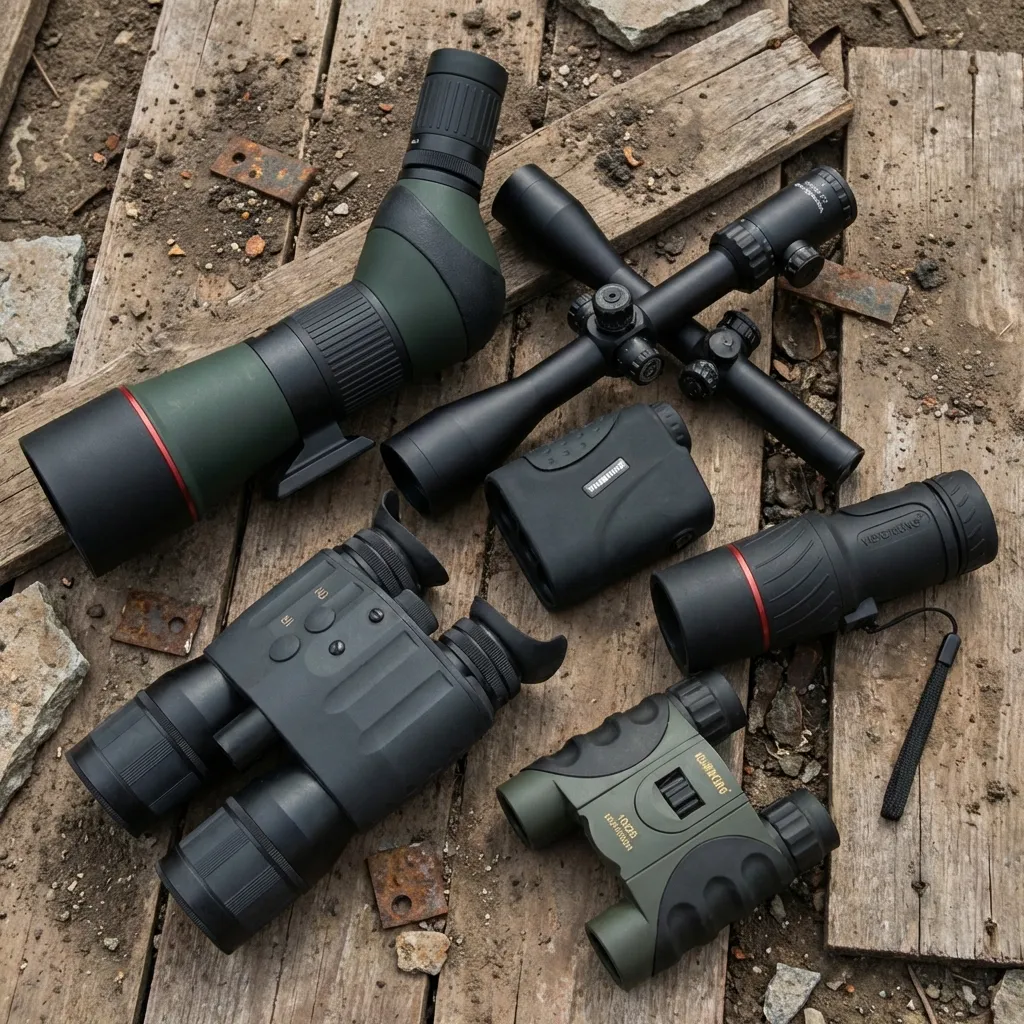
If a long range rifle scope feels suspiciously light, it likely cuts corners with internal materials that will wear down over time. I always advise shooters to accept the extra ounces. When you are hauling gear to the firing line, including your rifle and a high-performance Visionking 25-75×70 MAK waterproof spotting scope, weight adds up, but that extra mass in your rifle scope ensures your zero stays put after hundreds of dial adjustments.
Aircraft-Grade Aluminum Construction
The chassis of a reliable long distance rifle scope is almost exclusively built from a single piece of aircraft-grade aluminum (usually 6061-T6 or stronger). This material offers the perfect balance of strength and weight management.
- Rigidity: A single-piece tube prevents alignment issues between the ocular and objective bells.
- Tube Size: Whether you choose a 30mm vs 34mm tube, the wall thickness of the aluminum is critical for resisting crushing forces from scope rings.
- Protection: The metal housing acts as armor for the delicate glass clarity and lens coatings inside.
Nitrogen Purging and Shock Proofing for Recoil
Durability isn\’t just about surviving a drop; it\’s about surviving the shot. A long range rifle scope mounted on a .300 Win Mag or .338 Lapua must withstand massive G-forces in two directions—backward recoil and the forward \”whiplash\” of the muzzle brake.
To ensure performance in all environments, we utilize nitrogen or argon purging. This process removes all internal air and replaces it with dry inert gas, sealed tight with O-rings.
Why this matters for 1000-yard shooting:
- Fog Proofing: Prevents internal fogging when moving from a warm truck to a freezing range.
- Waterproof: Protects against rain and accidental submersion.
- Shock Proof: Keeps the reticle and erector system aligned even under heavy recoil.
If the scope isn\’t properly purged and shock-proofed, even the best ED glass won\’t save you when the lenses fog up or the reticle shifts mid-match.
High Performance vs. High Value
There is a massive misconception in the shooting community that you need to spend thousands of dollars to get a reliable long range rifle scope. While top-tier glass has its place, modern manufacturing technology has significantly narrowed the gap between budget-friendly options and premium optics. We focus on bridging the gap between affordability and precision, ensuring that shooters do not have to compromise on turret tracking accuracy or glass clarity just to stay within budget. You can find high-quality optical products that rival big-name competitors because we prioritize the internal build over the marketing budget.
Engineering Over Brand Tax
When you purchase from established industry giants, a significant portion of that price tag is often \”brand tax\”—you are paying for their massive advertising campaigns, sponsorships, and legacy overhead. We take a different approach by investing directly in the materials that matter, such as ED Glass, robust internal erector systems, and precise parallax adjustment mechanisms. A long distance rifle scope should be valued for its engineering, not its logo.
Here is where we focus our resources to ensure performance:
- Material Quality: We utilize aircraft-grade aluminum and brass internals ensuring durability, rather than the plastic components often found in cheap alternatives.
- Optical Performance: By prioritizing light transmission and resolution, we deliver the best long range rifle scope experience for low-light conditions without the extreme markup.
- Consistency: The true test of a scope is its ability to hold zero and track perfectly. We ensure our scopes are ready for the Precision Rifle Series (PRS) or field work right out of the box.
Whether you are shooting steel or hunting at extended distances, the goal is simply to put rounds on target consistently. By cutting out the middleman and focusing strictly on engineering, we deliver best long-range rifle scopes 1000 yards plus capable performance directly to the user. If you are unsure which specifications best fit your shooting style, reviewing a guide on the best rifle scope options can help clarify the balance between cost and necessary capability.
Frequently Asked Questions About Long Range Scopes
Navigating the technical specs of a long range rifle scope can be tricky, especially with so many acronyms and measurements involved. Here, I break down the most common questions we receive to help you make an informed decision for your precision setup.
Is a First Focal Plane (FFP) scope necessary for 1000 yards?
While you can shoot long distances with a Second Focal Plane (SFP) optic, a First Focal Plane (FFP) scope is widely considered the standard for 1000-yard shooting. In an FFP system, the reticle grows and shrinks with your magnification. This means your holdover points for windage and elevation are accurate at any magnification level, not just the maximum setting.
If you are shooting in dynamic environments like the Precision Rifle Series (PRS) where you might need to dial back magnification to find a target, FFP is essential. However, if you are strictly bench shooting at a known distance with max zoom, SFP can still work. For a deeper dive into selecting the right specifications for your needs, check out our guide on custom rifle scope features.
How much elevation travel do I need for long-range shooting?
The amount of elevation travel required depends heavily on your caliber and how far you intend to shoot. As a general rule for reaching 1000 yards with standard cartridges like .308 Winchester or 6.5 Creedmoor, you need a scope with significant internal adjustment.
- Tube Size Matters: Look for 30mm or 34mm tubes, which physically allow for more internal movement of the erector system compared to 1-inch tubes.
- Minimum Travel: Aim for a scope that offers at least 60 to 70 MOA (approx. 18-20 MILs) of total elevation travel.
- Canted Rails: You will likely need a 20 MOA rail base to utilize the full range of the scope\’s elevation.
What is the difference between MIL and MOA?
This is the classic debate in the shooting world. Neither is inherently more accurate; they are just different units of angular measurement.
- MOA (Minute of Angle): 1 MOA is approximately 1.047 inches at 100 yards. Most shooters round this to 1 inch. Adjustments are usually in 1/4 MOA clicks. This allows for very fine tuning.
- MIL (Milliradian): 1 MIL is 10 centimeters at 100 meters (or 3.6 inches at 100 yards). Adjustments are typically 0.1 MIL clicks.
MIL is currently the dominant choice for tactical and competitive shooting because the base-10 math is faster to calculate on the fly. MOA remains popular in the US for hunting and benchrest shooting. The most important rule is to ensure your turret clicks match your reticle (MIL/MIL or MOA/MOA) to avoid confusion when you sight in a rifle scope.
Do I need ED glass for long range shooting?
If you are looking for the best long range rifle scope, ED (Extra-low Dispersion) glass is a game-changer. At high magnification (20x and above), standard glass often suffers from chromatic aberration, which looks like purple or yellow fringing around the edges of your target.
Glass clarity is critical when trying to spot bullet impacts on steel or read mirage at 1000 yards. ED glass sharpens the image, increases contrast, and improves light transmission, allowing you to see details that get washed out in cheaper optics. While not strictly mandatory to pull the trigger, it significantly reduces eye fatigue and improves hit probability.