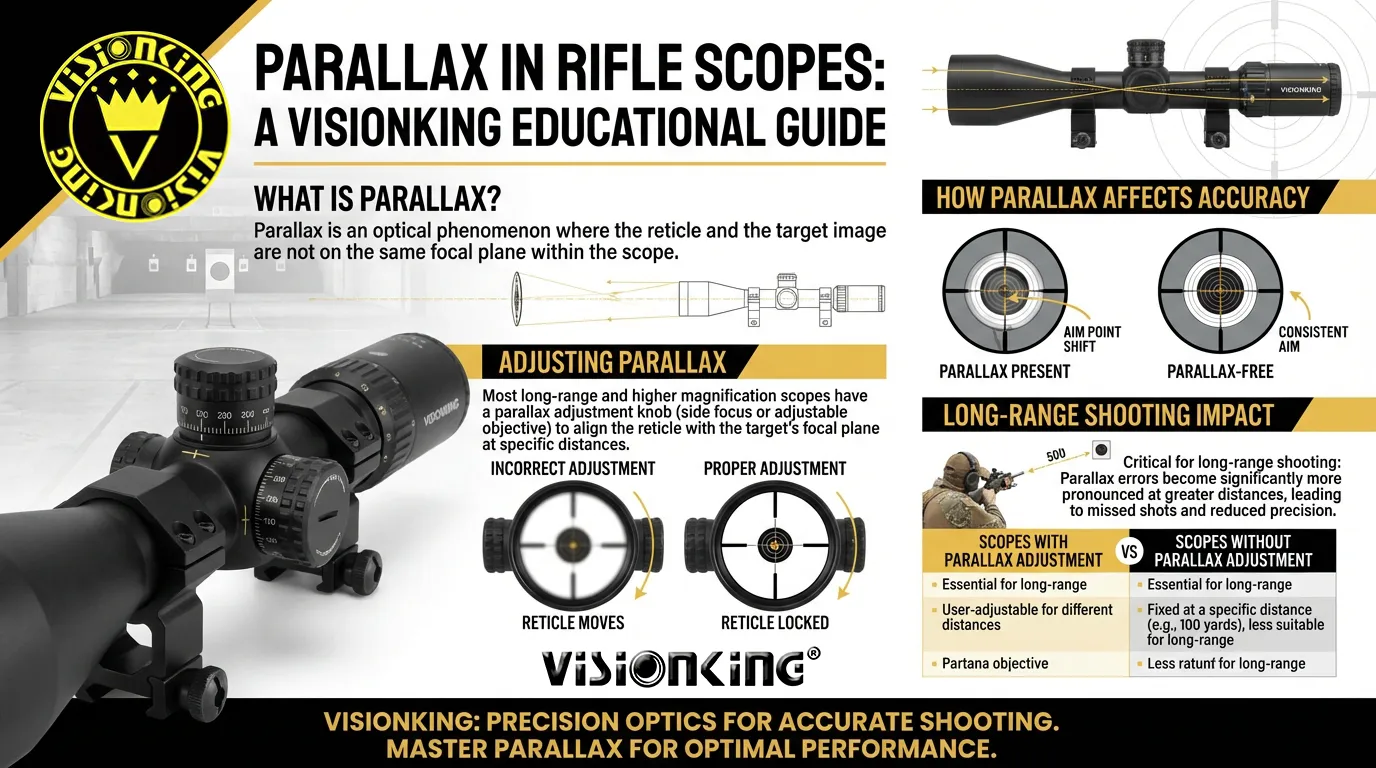
The Science Simplified: Why Parallax Happens
Parallax in a rifle scope is essentially an optical illusion that creates a disconnect between where you are aiming and where the bullet will actually impact. Technically, this phenomenon occurs when the target image and the reticle are not on the same focal plane. When I look through a scope, I am aligning three specific points: the shooter\’s eye, the reticle, and the target. If the internal optics are not adjusted for the specific distance of the shot, the target\’s image forms either in front of or behind the reticle, rather than directly on top of it. This misalignment creates a line of sight error that can cause missed shots, even with a steady hand.
The Focal Plane Concept
To understand what is parallax on a rifle scope, we must look at the internal mechanics. Light enters the objective lens and focuses at a specific point inside the tube. For absolute precision, this focal point must coincide exactly with where the crosshairs are physically located. This is called focal plane alignment.
If a scope is fixed-focused for 100 yards, but the target is at 300 yards, the image of the target will form at a slightly different depth inside the scope than the reticle. Because they are physically separated by depth, they appear to move independently of one another. The result is that the crosshair appears to float or swim over the target rather than sticking to it.
The \’Thumb Test\’ Analogy
The most effective way to visualize this aiming error without complex physics is the \”Thumb Test.\” You can do this right now:
- Step 1: Hold your thumb up at arm\’s length.
- Step 2: Focus on a distinct object in the background (like a light switch or a tree) while looking past your thumb.
- Step 3: Close one eye and move your head side-to-side while keeping your thumb perfectly still.
You will notice your thumb appears to shift across the background object, even though your arm has not moved. In this analogy, your thumb is the reticle and the background is the target. Because there is distance between them, changing your eye position changes their apparent alignment. In a rifle scope, this reticle shift means that if your cheek weld isn\’t perfectly consistent, you will miss the bullseye because the crosshair is not actually pointing where you think it is.
Does Parallax Actually Affect Accuracy?
Yes, absolutely. Parallax creates an optical illusion where the crosshair appears to float or swim over the target image. If you move your head slightly and the reticle moves across the target, you are experiencing reticle shift. This leads to a direct aiming error, meaning where you think you are aiming isn\’t actually where the barrel is pointing. If the target image and the reticle are not on the same focal plane, your point of impact will shift depending on where your eye is positioned behind the scope.
Short Range vs. Long Range Impact
The severity of the error depends heavily on distance.
- Short Range: At standard hunting distances (under 100 yards), the error caused by parallax is usually negligible—often less than an inch. This is why many rimfire and standard hunting optics are fixed parallax scopes, permanently set to be parallax-free at 100 yards.
- Long Range: As you extend the distance, the angle of error increases. For long-range precision, a small shift in eye position can result in missing the target by several inches or even feet. Before taking a long shot, it is crucial to verify the exact distance with a tool like a Visionking 6×25 laser range finder to determine if you are pushing beyond your scope\’s fixed capabilities.
The \’Cheek Weld\’ Factor
Here is the catch: if your eye is perfectly centered in the line of sight directly behind the ocular lens every single time, parallax technically does not affect your accuracy. A consistent cheek weld acts as a physical anchor to ensure alignment.
However, perfect alignment is rare in real-world scenarios. Adrenaline, awkward shooting angles, and fatigue often cause your head position to drift. So, what is parallax adjustment on a rifle scope actually doing for you? It acts as insurance. By adjusting the parallax to place the reticle and target on the same plane, you ensure that even if your cheek weld is sloppy or your eye is slightly off-center, the crosshair stays locked on the target.
Types of Parallax Compensation in Scopes
When asking what is parallax adjustment on a rifle scope, the answer depends heavily on the specific hardware you are using. Not every optic handles this optical alignment the same way. Manufacturers generally provide three distinct methods to manage or eliminate parallax error, ranging from factory presets to user-adjustable turrets.
Fixed Parallax Scopes
Many standard hunting scopes feature a fixed parallax scope design. In this configuration, the factory permanently sets the parallax free distance—typically at 100 yards for centerfire rifles, 50 yards for rimfire, or sometimes 150 yards for high-power optics.
- Pros: Ideally suited for \”set it and forget it\” hunting scenarios; fewer moving parts mean less weight and higher durability.
- Cons: If you shoot at distances significantly different from the factory setting, you may experience reticle shift.
Because you cannot adjust the internal lenses, it is even more critical to sight in your rifle scope carefully at the specific fixed distance to ensure your point of impact is reliable.
Adjustable Objective (AO)
You can identify an Adjustable Objective (AO) by the large rotating ring located on the objective bell (the front lens housing). By twisting this ring, you physically move the objective lens assembly to focus the target image on the same plane as the reticle.
- Precision: capable of very fine adjustments.
- Drawback: You must reach all the way to the front of the rifle to make changes, which forces you to break your shooting position.
Side Focus (Side Parallax)
This is the preferred method for modern long-range and tactical shooters. A side focus turret is located on the left side of the scope\’s central saddle, usually opposite the windage knob.
This design allows you to adjust for parallax while maintaining your cheek weld and looking through the optic. It is faster, more ergonomic, and solves the problem of what is a parallax adjustment on a rifle scope for shooters who need to engage multiple targets at varying distances rapidly.
The Critical Difference: Parallax vs. Focus
One of the most common mistakes I see shooters make is confusing the ocular focus with the parallax adjustment. While both knobs make the image look sharper, they perform two completely different mechanical functions. Understanding what is parallax adjustment on a rifle scope versus simple ocular focus is the key to consistent accuracy.
Ocular Focus (Diopter)
The ocular focus is the ring located at the rear of the scope, closest to your eye (the ocular lens). Its sole purpose is to focus the reticle for your specific eyesight.
Think of this as a \”set and forget\” adjustment. You are essentially calibrating the optic to your eye\’s prescription.
- How to set it: Look at a plain background (like a blue sky or white wall).
- Action: Turn the diopter ring until the crosshairs appear crisp and sharp black.
- Result: Once the reticle is sharp, lock it down or leave it alone. You do not touch this when changing target distances.
If you are looking for optics with reliable mechanics for this calibration, check out our range of precision rifle scopes designed for long-term stability.
Parallax Adjustment
So, what is a parallax adjustment on a rifle scope actually doing? While the diopter focuses the reticle, the parallax knob (often a side focus turret or Adjustable Objective) focuses the target image.
Mechanically, this adjustment moves internal lenses to ensure the target image falls on the exact same focal plane as the reticle.
- Purpose: To eliminate aiming error caused by head movement.
- Usage: You adjust this every time the distance to your target changes significantly.
- Goal: To ensure the target is in focus and the reticle does not swim when you move your head.
The Trap: Clarity vs. Alignment
Here is where the trap lies: Target image resolution (clarity) does not always mean the parallax is eliminated. It is possible to have a clear image but still have a reticle shift if your eye moves off the center line of sight.
Many shooters dial the side knob until the image looks pretty, assuming the error is gone. However, clarity is just a byproduct of the adjustment, not the confirmation. You must prioritize alignment over perfect clarity.
Quick Comparison: Diopter vs. Parallax
| Feature | Ocular Focus (Diopter) | Parallax Adjustment |
|---|---|---|
| What it focuses | The Reticle (Crosshairs) | The Target Image |
| Primary Goal | Match scope to your eyesight | Align focal planes to stop error |
| When to adjust | Once (Set and forget) | Every time distance changes |
| Location | Rear (Eyepiece) | Side Turret or Front Objective |
Don\’t let the optical illusion of a clear picture fool you. Always trust the mechanics of the focal plane alignment over just how sharp the trees look in the background.
Step-by-Step: How to Adjust Parallax Correctly
Understanding what is parallax adjustment on a rifle scope is one thing, but executing it in the field is where shots are made or missed. Many shooters mistakenly believe that simply turning the knob until the image looks clear is enough. While image clarity is part of it, the true goal is focal plane alignment—ensuring the reticle and the target occupy the exact same plane within the optic. To eliminate aiming error and ensure long-range precision, follow this specific sequence every time you set up behind the gun.
Step 1: Focus the Reticle First
Before you even look at a target, you must calibrate the scope to your eye. This is done using the Ocular lens focus (Diopter) at the rear of the scope. If your reticle is blurry, no amount of parallax adjustment will fix your sight picture.
- Point the rifle at a neutral background, like a clear blue sky or a white wall.
- Look away for a few seconds to relax your eye, then look through the scope.
- Adjust the diopter ring until the crosshairs appear crisp and sharp immediately.
- Once set, lock it down. You generally do not need to touch this again unless your eyesight changes.
Step 2: Dial the Distance
Now, identify your target and estimate the range. Whether you are using a Side focus turret or an Adjustable Objective (AO) on the bell of the scope, dial the knob to the corresponding yardage number. For example, if your target is 300 yards away, turn the dial to the \”300\” mark.
- Note: The numbers on the dial are often approximations. They get you close to the parallax free distance, but they are rarely exact due to atmospheric conditions.
- For tactical applications, gear like the Visionking 1-10×28 Rifle Scope provides accessible turrets that make these quick adjustments intuitive in the field.
Step 3: Fine Tune for Clarity
With the dial set to the approximate distance, look through the scope at your target. You want to maximize target image resolution. Slowly rotate the parallax adjustment knob back and forth until the target image is as sharp as possible.
- This step aligns the target image with the reticle.
- Be careful not to confuse this with the ocular focus from Step 1.
- At high scope magnification, the depth of field is shallow, meaning the \”sweet spot\” for clarity will be very precise.
Step 4: The \’Head Bob\’ Test
This is the most critical step to verify what is a parallax adjustment on a rifle scope actually doing for your shot. Even if the image is clear, parallax might still exist.
- Secure the rifle so it does not move (use a bipod or sandbag).
- Without touching the rifle, move your head slightly up and down, then left and right behind the scope.
- Watch the reticle against the target.
- If the reticle floats or shifts across the target while your head moves, you still have reticle shift. Adjust the parallax knob slightly until the crosshair stays \”glued\” to the specific spot on the target, regardless of head movement.
- Once the head bob test shows no movement, your line of sight is error-free, and you are ready to fire.
When Do You Need a Parallax Adjustable Scope?
Deciding whether you need a scope with a side focus turret or Adjustable Objective (AO) comes down to your specific shooting discipline. Not every shooter needs to worry about what is a parallax adjustment on a rifle scope; for many, a standard fixed scope works perfectly fine. However, as distance increases and targets get smaller, that adjustment knob becomes essential for eliminating aiming error.
General Hunting Scenarios
For the average big game hunter, parallax is rarely a deal-breaker. Most standard hunting scopes are fixed parallax scopes, usually set at the factory to be parallax-free at 100 yards (or 150 yards for some models).
If you are hunting deer or elk at typical ranges (50 to 250 yards) with low to medium scope magnification (3x-9x), the reticle shift caused by parallax is negligible. The error might only be an inch or two, which is well within the \”kill zone\” of a large animal. In these high-stress situations, having one less knob to fiddle with allows you to focus on your line of sight and the shot itself.
Target Shooting and Varminting
This is where the game changes. If you are shooting at small targets—like prairie dogs, squirrels, or paper bullseyes—at varying distances, you absolutely need adjustment capabilities.
- Precision is Key: Varminting often involves hitting a target the size of a soda can at 300+ yards. A slight optical illusion caused by parallax can cause a complete miss.
- Clarity: You need high target image resolution. If the target is blurry because the focal plane alignment is off, you cannot aim precisely.
For shooters pushing the limits of accuracy, using a high-performance optic like the Visionking 2.5-20×50 FFP Rifle Scope allows you to dial in the exact parallax free distance, ensuring the crosshair stays pinned on the target regardless of eye position.
High Magnification Requirements
There is a direct link between magnification and the severity of parallax. As you increase magnification, the depth of field becomes much shallower, making focus errors more obvious and reticle shift more pronounced.
- Under 10x: Parallax is usually not noticeable enough to affect accuracy significantly.
- Over 12x: Parallax adjustment becomes mandatory. Without it, the target will look out of focus, and the reticle will appear to float.
If you are investing in high-magnification optics for long-range precision, understanding what is parallax adjustment on a rifle scope is critical. You cannot effectively use a 20x or 30x scope without correcting for parallax.
Quick Guide: Do You Need Adjustment?
| Scenario | Magnification | Target Size | Parallax Adjustment Needed? |
|---|---|---|---|
| Deer Hunting (Woods) | 1x – 6x | Large (8\”+) | No (Fixed is fine) |
| General Hunting | 3x – 9x | Medium | Optional |
| Varmint / Long Range | 12x – 25x+ | Small (< 2\”) | Yes (Essential) |
| Competition | High Power | Tiny | Yes (Critical) |
Frequently Asked Questions About Scope Parallax
What distance is parallax usually set at?
If you own a fixed parallax scope, the manufacturer has permanently set the parallax free distance at the factory. For most standard centerfire hunting scopes, this is typically set at 100 yards (or sometimes 100 meters). This covers the majority of big game hunting scenarios.
However, scopes designed for shotguns, muzzleloaders, or rimfire rifles are usually set closer, often at 50 yards or 75 yards. This is because the expected engagement distance for these firearms is much shorter. If you are shooting exactly at the factory-set distance, your image will be sharp and your reticle will be stable.
Can I use a rimfire scope on a centerfire rifle?
Technically, yes, you can mount it, but I generally advise against it for two main reasons:
- Parallax Error: Since rimfire scopes are parallax-set for 50 yards, shooting at 200 or 300 yards with a centerfire rifle will result in significant aiming error. The target image may appear out of focus, and the reticle will shift if your eye alignment isn\’t perfect.
- Durability: Many rimfire scopes aren\’t built to withstand the heavy recoil of high-caliber rounds.
If you do decide to swap optics across platforms, ensuring a rock-solid connection is vital to maintaining zero under recoil. Using high-quality 30mm tube mount picatinny rings can help secure the optic, but you will still have to contend with the optical limitations at longer ranges.
Why are the yardage numbers on my parallax knob not exact?
It is very common for the markings on a side focus turret or Adjustable Objective (AO) to not perfectly match the actual distance to your target. You might range a target at 200 yards, but your knob reads 225 yards when the image is sharpest.
This happens for a few reasons:
- Atmospherics: Temperature, humidity, and air density affect how light travels, shifting the focal point.
- Diopter Settings: How you set your ocular lens focus impacts the internal focal plane alignment.
- Depth of Field: At lower magnification, a wider range of distances appears in focus.
Treat the yardage numbers as a rough reference, not a ruler. Always trust your eyes. Adjust the knob until the target image resolution is crisp and the reticle passes the head bob test, regardless of what number the dial points to.