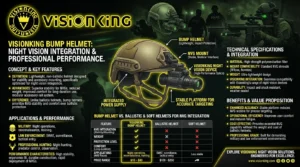
What is a Bump Helmet and Why Choose it for NVG?
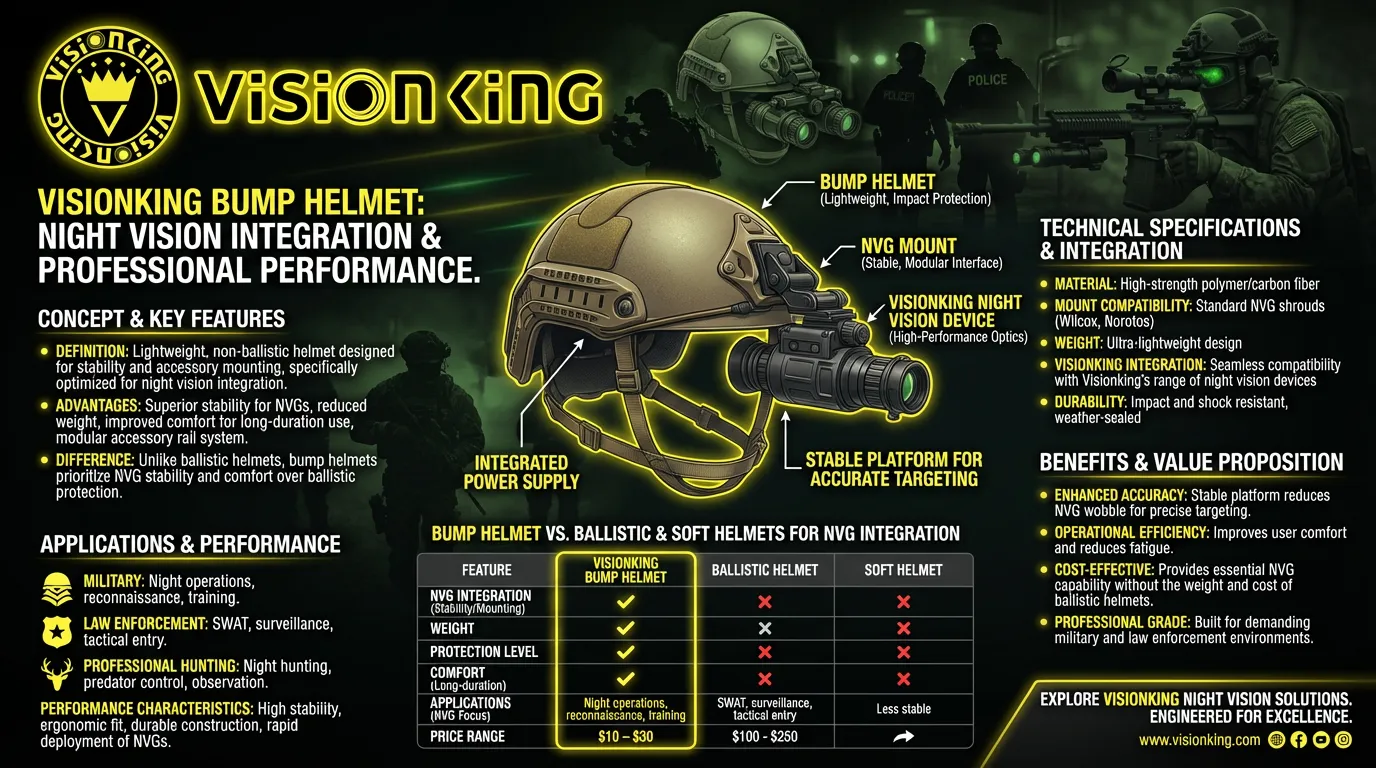
When you are gearing up for a mission that doesn\’t involve direct ballistic threats, carrying the extra weight of a ballistic shell is a rookie mistake. A bump helmet for night vision is the professional\’s choice for recce, training, and search-and-rescue operations. These helmets are purpose-built to provide a stable, rigid platform for your Night Vision Goggles (NVGs) without the neck-crushing bulk of Kevlar or ballistic composites.
Defining \”Bump\” Protection: Blunt Force vs. Ballistic
Let\’s get the definitions straight. A non-ballistic tactical helmet, often called a \”bump\” helmet, is designed to protect against blunt force trauma. We are talking about protection from knocking your head on low doorframes, vehicle interiors, or taking a hard fall on rocky terrain. Unlike ballistic counterparts designed to stop shrapnel and bullets, a bump shell focuses on high-level impact protection.
- Ballistic: Stops bullets/fragmentation (NIJ rated).
- Bump: Stops impact/concussion (BS EN 1385 or Whitewater standards).
The Weight Advantage: Lightweight Night Vision Setup
Gravity is the enemy when you have a pound of electronics hanging off your forehead. A standard ballistic helmet can easily exceed 3 lbs before you even mount your tubes. In contrast, a high-end bump option like the Team Wendy EXFIL LTP weighs in at a featherlight 1.6 lbs (Size 1) or 1.7 lbs (Size 2).
Why Weight Matters:
- Reduced Fatigue: Less strain on the trapezius and neck muscles during long operations.
- Stability: A lighter shell has less inertia, meaning your NVGs wobble less when you turn your head quickly.
- Agility: High-cut designs allow for maximum mobility and easier integration with ear protection.
Cost-Efficiency and Airflow
Budget allocation is a tactical skill. High-tier ballistic helmets, such as the Ops-Core FAST SF, command prices upwards of $1,300. A top-tier bump helmet typically lands in the $300 – $600 range. By choosing a polymer bump shell, you save significant capital that can be reinvested where it counts: better tubes or high-performance Visionking optics.
Furthermore, tactical helmet ventilation is superior in bump models. Because the shell doesn\’t need to maintain ballistic integrity, manufacturers can integrate aggressive vent ports. This airflow is critical for keeping your head cool and preventing goggle fog during high-exertion activities.
| Feature | Ballistic Helmet | Bump Helmet |
|---|---|---|
| Primary Protection | Bullets / Shrapnel | Blunt Impact / Falls |
| Average Weight | 3.0+ lbs | ~1.5 – 1.7 lbs |
| Ventilation | Minimal / None | High Airflow Vents |
| Cost | High ($1,000+) | Moderate ($300 – $600) |
| Best Use | Combat / Direct Action | NVG Recce / Training |
Critical Features for a Night Vision Platform
When building a bump helmet for night vision, the shell is just the beginning. The real performance comes from the hardware that keeps your optics aligned and your head comfortable. A plastic skate helmet won\’t cut it; you need a purpose-built chassis designed to manage the specific physics of headborne systems.
The Shroud: The Anchor of Your System
The shroud is where your night vision goggle (NVG) mount interfaces with the helmet. For a stable night vision setup, you generally have two choices: molded or bolted.
- Molded Shrouds: Integrated directly into the helmet shell (common on Team Wendy EXFIL LTP). These are lightweight and eliminate the risk of screws loosening over time.
- Bolted Shrouds: Allow for modularity and replacement.
Regardless of the type, NVG shroud compatibility with industry standards like the Wilcox L4 series is non-negotiable. A loose shroud leads to \”wobble,\” which ruins the effectiveness of high-end optics. For those configuring a complete setup, understanding the custom night vision systems guide is essential to ensure your mount and shroud play nicely together.
Suspension & Retention: Locking It Down
If your helmet shifts, your night vision shifts. This is why a dial-based helmet retention system is critical.
- Worm Dial (Ops-Core): Uses a worm gear for precise fit adjustments, tightening the liner band around the circumference of your head.
- Boa Fit System (Team Wendy): Uses a cam-lock dial to evenly distribute pressure. This micro-adjustability is vital for counteracting the front-heavy weight of NVGs, ensuring the helmet doesn\’t slide down your forehead.
Chin Strap and Impact Liners
A standard bicycle strap cannot support the leverage of a PVS-14 or dual tubes. You need a 4-point chin strap geometry. By anchoring at four points, the harness prevents the helmet from tipping forward under the weight of the device.
Inside the shell, the impact protection liner dictates how long you can operate without a headache.
- Zorbium Foam: Found in Team Wendy models, this material conforms to the head and manages moisture effectively.
- EPP (Expanded Polypropylene): Often used in Ops-Core and Galvion helmets, offering robust multi-impact protection.
Accessory Rails: ARC vs. M-LOK
Finally, a tactical bump helmet serves as a mounting rack for secondary gear.
- ARC Rails: The standard for Ops-Core. Extensive ecosystem for attaching comms adapters and lights.
- M-LOK/EXFIL Rails: Used by Team Wendy. Offers a sleek profile and compatibility with Magpul accessories.
Quick Feature Comparison for NVG Use:
| Feature | Function | Benefit for Night Vision |
|---|---|---|
| Shroud | Mount Interface | Ensures night vision goggle stability and alignment. |
| Retention Dial | Fit Adjustment | Prevents forward sag caused by device weight. |
| 4-Point Strap | Stabilization | Stops the helmet from rotating or tipping. |
| Rail System | Accessory Mount | Holds ARC rail accessories like IR illuminators and ear pro. |
Top Contenders in the Market
When you are looking for the best bump helmet for night vision, the market generally splits into two heavyweights and a sea of budget alternatives. Choosing the right platform is less about brand loyalty and more about how the helmet retention system interacts with your specific head shape and mission requirements. Here is how the top options stack up.
The Gold Standard: Team Wendy EXFIL LTP
For many professionals, the Team Wendy EXFIL LTP represents the perfect balance of cost, comfort, and stability. The magic here lies in the impact protection liner. Team Wendy utilizes a Zorbium foam liner that offers exceptional impact absorption without creating hot spots during long movements.
When you strap on a lightweight night vision setup, stability is king. This helmet features the CAM FIT Retention System with a Boa dial. This allows for micro-adjustments that tighten the suspension evenly around your head, locking the helmet in place so your NVGs don\’t droop or wobble when you run.
- Key Feature: Zorbium Foam Liner for impact protection.
- Retention: CAM FIT system with Boa dial for instant tightening.
- Rail System: EXFIL Rail 3.0 (proprietary, but robust).
- Best For: Users prioritizing comfort and a \”set it and forget it\” fit.
The Modular Choice: Ops-Core FAST High Cut
If modularity is your priority, the Ops-Core FAST high cut ecosystem is hard to beat. While the source reference highlights the high-end SF Super High Cut, the architecture remains consistent across their bump options. The defining feature here is the ARC rail system. Because Ops-Core set the standard, almost every accessory on the market—from lights to ear pro adapters—is designed to fit these rails natively.
The Ops-Core FAST high cut typically utilizes a Vented Lux Liner paired with their Worm Dial Fit System. Unlike the Boa dial which tightens a perimeter band, the Worm Dial adjusts the fit band height and tension for a very rigid lock, which is critical for heavier dual-tube setups.
| Feature | Team Wendy EXFIL LTP | Ops-Core FAST Series |
|---|---|---|
| Rail Style | EXFIL Rail 3.0 | ARC Rail (Industry Standard) |
| Liner Type | Zorbium Foam (Comfort focus) | Vented Lux Liner (Airflow focus) |
| Retention | CAM FIT (Boa Dial) | Worm Dial Fit System |
| NVG Shroud | Integrated Aluminum Insert | Modular Bungee Shroud |
Budget & Entry Level Options
Not everyone has the budget for top-tier tactical headborne systems, leading many to investigate polymer clones. If you are going this route, you must be cautious.
Reliable polymer clones can serve as a decent bump helmet for night vision if you are just hiking or filming, but you need to watch out for NVG shroud compatibility. Cheap helmets often have out-of-spec shrouds that introduce wobble or, worse, release your expensive night vision device unexpectedly. If you buy a budget shell, I highly recommend swapping the shroud and the internal pads for genuine hardware to ensure your gear stays secure.
Balancing Your Rig: The Art of Counterweights
The Physics of NVDs
Mounting goggles on the front of your bump helmet for night vision creates a fulcrum effect that works against you. Even with a lightweight night vision setup, that extra weight hanging off your forehead shifts the center of gravity forward. Without proper balance, you are looking at significant neck strain and a helmet that constantly slides down over your eyes during rapid movement. Just as you would choose a lightweight rifle scope to reduce arm fatigue, balancing your headgear is critical to maintaining endurance in the field.
Counterweight Pouches
The solution isn\’t just tightening the retention dial until you have a headache; it is adding ballast to the rear. A dedicated night vision counterweight pouch is essential for stabilizing tactical headborne systems.
- Functional Weight: Don\’t just use dead weight like lead shot. Pack the pouch with spare AA or CR123 batteries, giving you a functional counterbalance that keeps your electronics running.
- Secure Placement: Attach the pouch firmly to the rear Velcro field of the helmet cover to perfectly offset the frontal load of the NVDs.
Cable Management
Loose wires are a major snag hazard in dense vegetation or tight quarters. Whether you are running a remote battery pack or communication downleads, proper routing is non-negotiable.
- Route Cleanly: Run cables under the helmet cover or through the integrated shell bungees found on high-end rails.
- Lock It Down: Use Velcro ties or the helmet\’s existing bungee system to keep wires tight against the shell, preventing them from catching on gear or branches.
Visionking’s Professional Advice: Pairing Optics with Helmets
As experts in optical precision, we know that even the highest quality glass is useless if your mounting platform is unstable. When setting up a bump helmet for night vision, the interface between the optic and your eye is where the magic happens—or where it fails. Proper alignment is just as critical here as it is when configuring custom monoculars, ensuring you get the full field of view without straining your neck.
Eye Relief and Optical Alignment
Getting the distance right between your eyes and the NVD (Night Vision Device) is non-negotiable. If the unit is too close, you risk lens fogging from body heat or impact injury during sudden movements. If it is too far, you lose the image circle.
- Adjust the Mount: Use the fore-and-aft adjustment on your mount to find the sweet spot where the image fills your vision naturally.
- Check the Tilt: Ensure the optical axis aligns perfectly with your pupils to prevent eye strain.
The \”Shake Test\” for Rigidity
Before any mission or training session, you must verify night vision goggle stability. A loose helmet means a bouncing image, which leads to nausea and disorientation.
- Don the Helmet: Buckle the chin strap and tighten the retention system (like the Worm Dial on Ops-Core or CAM FIT on Team Wendy) until it is snug but comfortable.
- Mount the NVD: Lock your device into the shroud.
- Shake Vigorously: Shake your head side-to-side and up-and-down. The helmet and optic should move as one unit with your head. If you feel shifting or hear rattling at the shroud, tighten the retention further or check the mount tolerances.
Essential Maintenance for Longevity
Your gear takes a beating, and sweat is the enemy. The salt in perspiration can degrade the materials in your liner over time, whether you are running the Zorbium foam in a Team Wendy or the Vented Lux Liner in an Ops-Core.
- Clean the Liner: Regularly remove pads and rinse them with fresh water and mild soap to maintain hygiene and comfort.
- Check the Hardware: The vibration from use can loosen the screws securing your NVG shroud. Check these bolts periodically to ensure your expensive optics don\’t disconnect unexpectedly in the field.