Are you tired of being told you need to spend $500 just to get an accurate reading in the field?
Finding the best cheap rangefinder for bow hunting can feel like a gamble. You want to save money, but you absolutely cannot afford to sacrifice accuracy when a buck steps into your lane.
As an optics expert, I know that a high price tag doesn\’t always guarantee the best performance for your specific needs.
The truth is, you don\’t need military-grade specs to fill your tag. You need reliable Angle Range Compensation (ARC), fast target acquisition, and clear glass—without the premium markup.
In this guide, I’m cutting through the marketing noise to show you the top budget-friendly units that actually deliver results.
Let’s dive right in.
The \”Must-Haves\”: What a Bowhunter Actually Needs
Finding the best cheap rangefinder for bow hunting isn\’t just about saving money; it\’s about ensuring the gear works when that buck steps into your lane. I\’ve tested enough optics to know that while you don\’t need a $500 unit for archery ranges, you absolutely cannot compromise on specific core features. If a budget unit lacks these essentials, it’s just a paperweight in the field.
Angle Range Compensation (ARC) and Treestand Physics
If you hunt from a treestand or in steep terrain, standard line-of-sight (LOS) measurements will cause you to miss. Gravity acts on the arrow only over the horizontal distance, not the angled path.
- The Tech: You need a unit with Angle Range Compensation (ARC) or \”slope\” technology.
- Budget Reality: Models like the Halo XL450-7 use \”Angle Intelligence\” to calculate the true horizontal distance, ensuring your pin gap is accurate. Similarly, the Gogogo Sport Vpro integrates slope functions typically reserved for golf, making it highly effective for calculating archery shots on an incline.
Priority and Target Modes for Brush and Moving Game
Bow hunting often happens in thick cover. A basic rangefinder might ping a branch five yards in front of you instead of the deer at thirty yards.
- Scan Mode: This is non-negotiable. It allows you to hold the button down and pan across the area, continuously updating the distance. The Tidewe Hunting Rangefinder and AOFAR HX-700N excel here, offering fast scan modes that help you distinguish between the animal and the background brush.
- Pin-Seeker/Vibration: Features like the vibration pulse on the Gogogo Sport Vpro confirm when you\’ve locked onto a solid target, giving you confidence that you aren\’t ranging a ghost branch.
Magnification and Optical Clarity Standards
You need to see where you are aiming, but too much zoom makes it hard to locate a target at close range (15-30 yards).
- The Sweet Spot: 6x magnification is the industry standard for the under-$100 category, found in the Wosports, Tidewe, and Gogogo models. This level provides enough zoom to judge antler size or spot obstructions without narrowing your field of view so much that you lose the animal in the lens.
- Focus: Look for a \”fast focus\” eyepiece, like the system on the Wosports Hunting Rangefinder, which lets you sharpen the image instantly with a quick twist.
Size, Ergonomics, and One-Hand Operation
When you are at full draw or holding a bow in your non-dominant hand, your rangefinder must be operable with a single hand.
- Portability: The best cheap rangefinder for hunting is one that disappears into a pocket until needed. The AOFAR HX-700N and Wosports models are specifically designed to be lightweight and compact.
- Grip and Control: You want a textured, ergonomic grip that won\’t slip in damp weather. Simple two-button interfaces (Mode and Measure) are superior in the field because they reduce the chance of fumbling settings when your heart rate spikes.
Top Contenders: Best Cheap Rangefinders for Bow Hunting
Finding the best cheap rangefinder for bow hunting doesn\’t mean you have to sacrifice performance. The market has shifted, and reliable technology is now available under the $100 mark. I’ve broken down the top models that deliver the accuracy and features necessary for a successful hunt without breaking the bank.
The Best All-Round Value: Gogogo Sport Vpro
If you need versatility, the Gogogo Sport Vpro is a standout performer in the budget category. Its primary strength lies in its integrated slope function, which is essentially Angle Range Compensation (ARC). This is critical for bow hunters who need the true horizontal distance rather than the line of sight (LOS) when shooting from an elevated position or up a steep hill.
- Key Features:
- Vibration Flag-Lock: Gives a tactile pulse when locked onto the target, ensuring you aren\’t ranging the tree behind the deer.
- Magnification: Standard 6x magnification optics provide a clear view of game out to 650-900 yards.
- Dual Mode: Easily switches between hunting and golf modes, maximizing value.
The Best for Treestands: Wosports Hunting Rangefinder
For hunters who spend their season in a tree, speed is everything. The Wosports model is designed with a fast focus system, allowing for rapid target acquisition speed. When a buck steps into a shooting lane, you don\’t have time to fumble with complex settings.
- Why it works for treestands:
- Auto-Shutoff: To save battery life during long sits, it shuts down after 10 seconds of inactivity.
- Compact Design: It is lightweight and fits easily in a pocket or pouch, keeping your setup streamlined.
- Fog-Proof Lens Coating: Helps maintain visibility during those damp, early morning hunts.
The Eco-Friendly Choice: TideWe HR-F700
The TideWe HR-F700 solves one of the biggest annoyances in the field: dead batteries. Unlike most units that rely on expensive CR2 batteries, this model features a built-in rechargeable battery via USB. This makes it a top pick for the bow hunting gear budget conscious user who wants to save on long-term running costs.
- Durability Specs:
- Waterproof IP54 Rating: It can handle rain and splashes, making it reliable in unpredictable weather.
- Scan Mode Technology: Allows you to continuously range moving targets or scan the perimeter of a field effectively.
- Range: Capable of hitting targets from 700 to 1000 yards depending on reflectivity.
The Long-Range Crossover: AOFAR H-100
AOFAR is well-regarded for producing durable, no-nonsense optics. While specific model numbers like the H-100 or HX-700N vary slightly, the core technology focuses on ruggedness and precision. This unit typically features advanced scan mode technology, which is essential for tracking an animal moving through brush.
- Performance Highlights:
- Accuracy: Delivers yardage accuracy within +/- 1 yard, which is the gold standard for ethical bow shots.
- Construction: Built with a durable body that can withstand the bumps and drops associated with spot-and-stalk hunting.
- Modes: Offers Range, Speed, and Scan modes to cover various hunting scenarios.
The Optical Specialist: Visionking High-Value Models
As someone deeply invested in optical precision, I know that optical glass quality is often where budget manufacturers cut corners—but not us. We focus on delivering superior light transmission and clarity, which is vital for low-light performance during dawn and dusk.
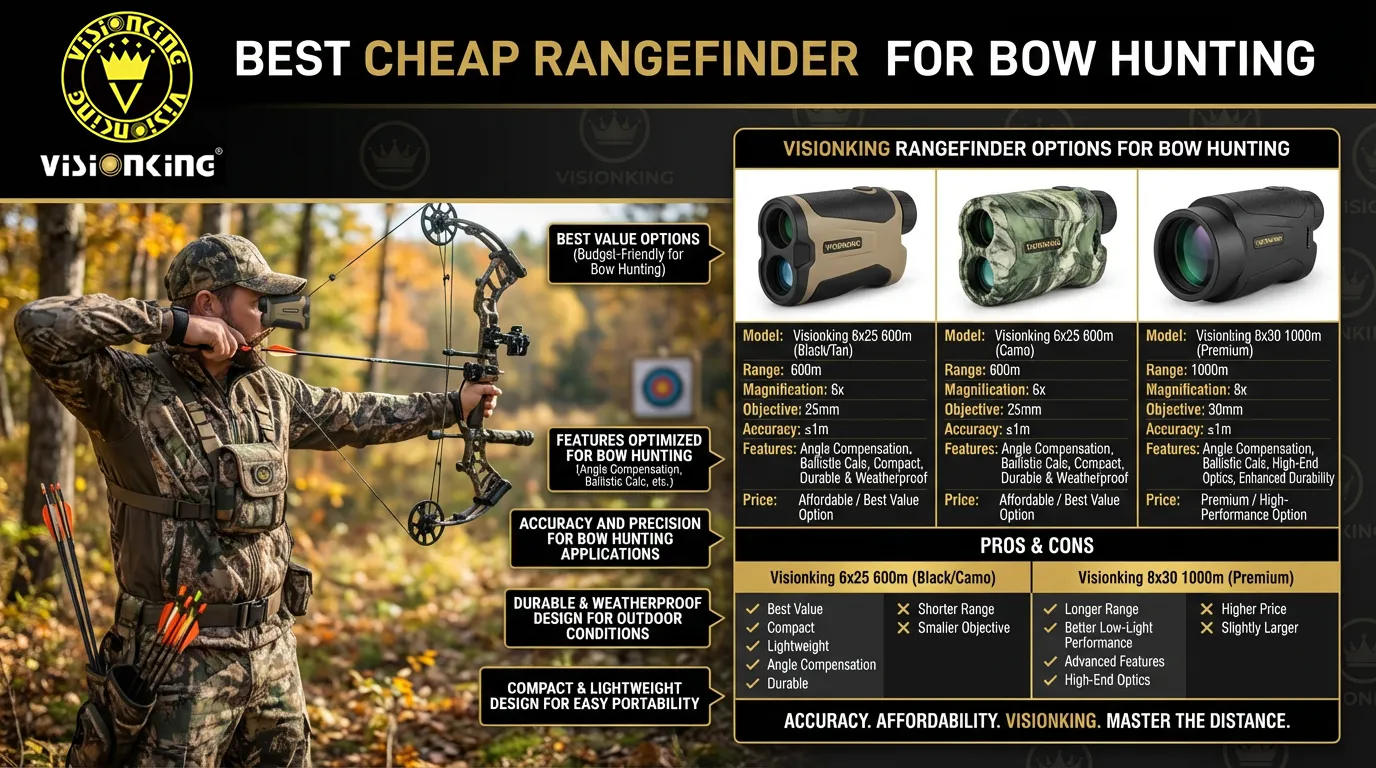
For hunters who need reliable measurements in varying weather conditions, our Visionking 6×25 laser range finder is engineered to provide crisp images and fast readings up to 600 meters. If you are looking for energy efficiency to match your outdoor lifestyle, we also offer innovative solar-powered range finder options that ensure you are never left without power in the field. These models prioritize the essential mechanics of optics—clarity and precision—over unnecessary gimmicks.
\”Cheap\” vs. \”Value\”: Where Manufacturers Cut Costs
When we talk about the best cheap rangefinder for bow hunting, we aren\’t looking for inferior gear; we are looking for optimized utility. Manufacturers in the $60 to $100 bracket keep costs down by focusing strictly on the features hunters actually use—like speed and portability—while skipping the luxury add-ons found in four-figure optics. Understanding these trade-offs ensures you get a tool that performs when the moment of truth arrives.
Evaluating Glass Quality and Low-Light Performance
In the budget category, you generally won\’t find Extra-low Dispersion (ED) glass, but that doesn\’t mean you are looking through a fishbowl. Models like the Wosports and Gogogo Sport Vpro utilize standard optical glass quality paired with 6x magnification, which is the sweet spot for archery. The trade-off usually occurs during the very last minutes of legal shooting light.
While a premium unit might gather slightly more light at dusk, affordable options like the Visionking 6×25 Hunting Laser Rangefinder are designed to provide crisp, clear images during the prime hunting hours. To maximize performance, look for units with a fast-focus eyepiece system. This allows you to sharpen the reticle instantly, ensuring that even if the light is fading, your target acquisition remains solid.
Understanding Laser Beam Divergence in Budget Units
Laser beam divergence refers to how much the laser spreads out as it travels. High-end long-range shooters need tight beams to hit steel at a mile. However, for a bowhunter, extreme long-range precision is less critical than short-range consistency.
Budget-friendly units like the Halo XL450-7 or AOFAR HX-700N are engineered to deliver yardage accuracy of +/- 1 yard. While their beam might be wider at 800 yards compared to a military unit, they are pinpoint accurate at the 20 to 60-yard distances that matter for archery. This focus on \”effective range\” over \”theoretical max range\” is how you get high value without the high cost.
Durability and Waterproof Ratings (IP54 vs IP67)
One of the main areas where costs are managed is in the weather sealing certification.
- IP67: Fully submersible (often found in very expensive electronics).
- IP54: Resistant to dust and water splashes (Standard for value rangefinders).
Most affordable models, such as the Tidewe Hunting Rangefinder, come with a waterproof IP54 rating. This means the device can handle rain, fog, and damp mornings in the treestand without failure. Unless you plan on dropping your gear into a river, an IP54 rating provides sufficient protection for real-world hunting scenarios. By using lightweight, durable polymers instead of heavy magnesium alloys, these brands deliver a rugged tool that is easy to carry all day.
Buying Guide: How to Choose the Right One for You
Finding the best cheap rangefinder for bow hunting isn\’t just about picking the lowest price tag; it is about matching specific features to your hunting style. Since most budget models under $100 share similar core specs, the difference often lies in specialized modes and build quality.
Matching Terrain to Rangefinder Capabilities
Your hunting environment dictates which technology you need. If you hunt from a treestand or in steep, mountainous terrain, standard line of sight (LOS) measurements will cause you to shoot high. You absolutely need a unit with Angle Range Compensation (ARC) or \”Angle Intelligence,\” like the technology found in the Halo XL450-7 or the slope function in the Gogogo Sport Vpro. These units calculate the true horizontal distance, which is critical for archery accuracy.
Conversely, if you hunt flat farmlands, you can prioritize max range and scan speed over angle logic. When evaluating specs for a custom rangefinder or a standard budget model, ensure the laser beam divergence is tight enough to pick up a deer against a tree line, rather than just the trees behind it.
Considerations for Eyesight and Diopter Adjustments
Optical clarity is often where budget manufacturers cut costs, but decent options exist. Most affordable units, including the Wosports and Tidewe models, offer 6x magnification. This is the sweet spot for bow hunting—enough zoom to verify antler size, but not so much that you lose your target in the viewfinder at close range.
For hunters with less-than-perfect vision, look for models with a fast focus system. The Wosports Hunting Rangefinder is notable for its adjustable eyepiece, allowing you to sharpen the reticle quickly. If you wear glasses, check the eye relief specs to ensure you can see the full field of view without pressing the optic against your lenses.
Weather Resistance Needs for Your Region
Electronics and moisture do not mix. If your hunts involve early morning dew, fog, or rain, a basic water-resistant coating isn\’t enough. You need a verified ingress protection rating.
- Dry/Fair Weather: Basic \”water-resistant\” models (like the standard AOFAR units) are sufficient for light mist or damp hands.
- Wet/Unpredictable Weather: Look for an IP54 rating. The Tidewe Hunting Rangefinder specifically lists IP54 protection, meaning it is sealed against dust and splashing water from any direction.
Quick Selection Matrix:
| Primary Need | Recommended Feature | Top Budget Contender |
|---|---|---|
| Treestand / Hills | Angle Intelligence / Slope Mode | Halo XL450-7 or Gogogo Sport Vpro |
| Rain / Snow | IP54 Water Resistance | Tidewe Hunting Rangefinder |
| Shaky Hands | Fast Focus & Lightweight | Wosports Hunting Rangefinder |
| Dense Brush | Scan Mode | AOFAR HX-700N |
FAQ: Common Questions from Budget Hunters
When you are trying to stretch your bow hunting gear budget, it is normal to have a few doubts before pulling the trigger on a new optic. I’ve fielded these questions countless times from hunters trying to balance cost with performance. Here is the straight talk on what you actually need to know.
Do I really need a rangefinder for bow hunting?
In my experience, absolutely. While rifle hunters have a margin for error due to high velocity, bow hunting is a game of inches. The trajectory of an arrow is steep; guessing a target is at 30 yards when it is actually at 35 can result in a clean miss or, worse, an unethical wound.
An archery laser rangefinder provides the precise yardage accuracy required to place a shot in the vitals. Even if you are great at judging distance by eye, fatigue and \”buck fever\” can mess with your perception. For the price of a best cheap rangefinder for bow hunting, the peace of mind is worth every penny.
How long do batteries last in budget models?
Most budget units run on CR2 batteries and are surprisingly efficient. You can typically expect:
- Standard Usage: 3,000 to 5,000 actuations per battery.
- Scan Mode: Continuous scanning drains power faster, but still lasts through a season.
- Cold Weather: Low temps zap lithium batteries quickly.
Always carry a spare battery in your pack. I also recommend checking if the unit has an auto-shutoff feature, which saves juice during long sits. Note that using the backlight for low-light performance frequently will reduce lifespan, so use it only when necessary.
Can I use a golf rangefinder for hunting?
Technically yes, but I strongly advise against it for serious treestand hunting. Here is why they are different:
- Target Priority: Golf rangefinders use \”First Target Priority\” (often with Vibration flag-lock) to pick up a flagstick against a background of trees. Hunting requires \”Distant Target Priority\” (or Brush Mode) to ignore the leaves and branches in front of your deer.
- Angle Compensation: Many cheap golf units only give Line of sight (LOS) distance. Bowhunters need Angle Range Compensation (ARC) or horizontal distance calculation to account for the steep angles from a tree stand.
- Durability: A golf unit might not have the waterproof IP54 rating or fog-proof lens coating needed to survive a rainy morning in the woods.
If you use a golf unit, you risk ranging a branch five yards in front of you instead of the buck at forty. Stick to a dedicated hunting unit.