The Engine Room – What You Are Actually Paying For
When you look at the price tag of affordable gen 3 night vision, you have to ask: where is that money actually going? It isn’t the housing or the glass that drives the cost up; it is the engine inside—the Image Intensifier Tube (IIT). To understand why even \”budget\” Gen 3 units cost thousands, you have to look at the chemistry that separates them from the rest of the pack.
Understanding the Gallium Arsenide (GaAs) Photocathode
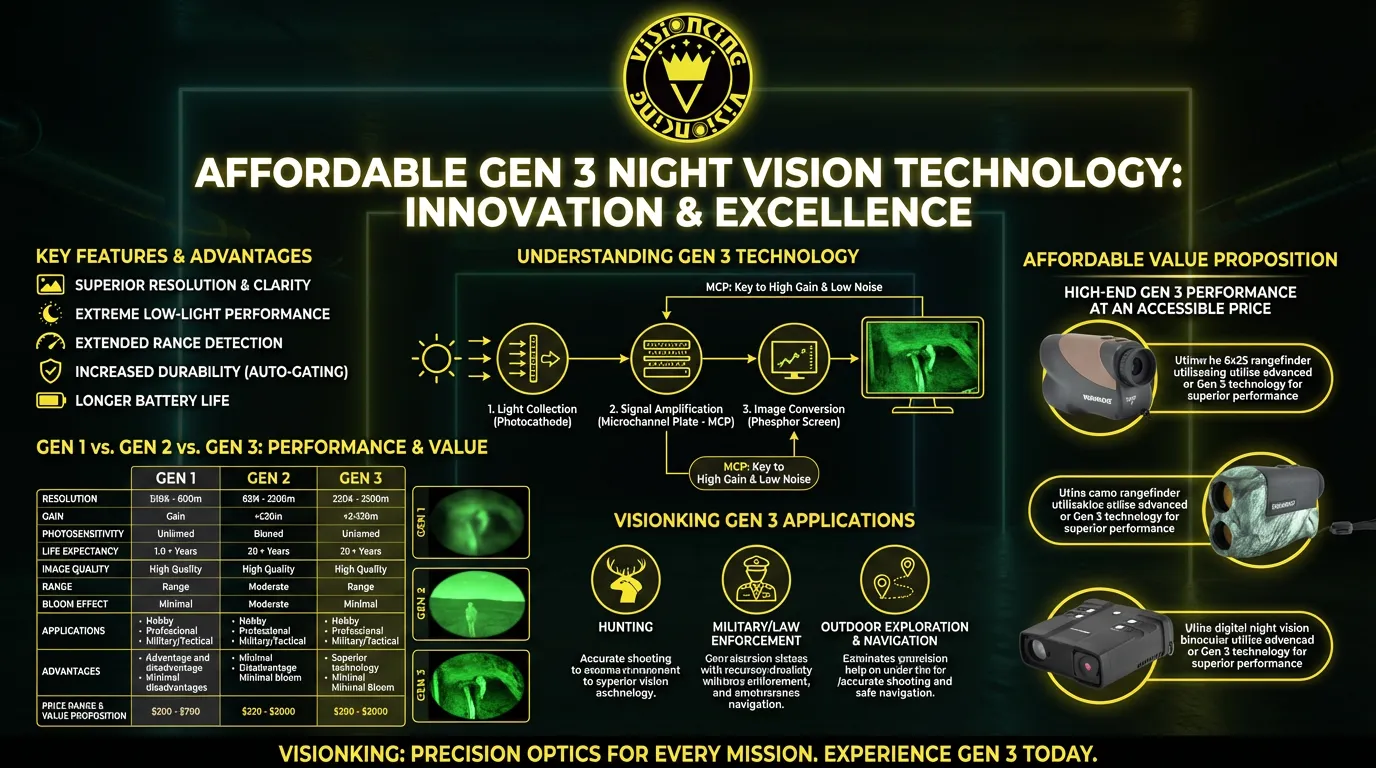
The defining feature of Generation 3 technology is the Gallium Arsenide Photocathode. Unlike Gen 2 tubes that use a Multi-Alkali composition, Gen 3 tubes utilize GaAs to achieve significantly higher photosensitivity. This semiconductor material is what allows these units to operate passively.
Here is the reality: Gen 2+ often requires an IR illuminator to see in the darkest conditions. A Gen 3 tube with a GaAs photocathode amplifies light so effectively that you can often operate without giving away your position with IR light. You are paying for the ability to see in near-total darkness when others can\’t.
The Ion Barrier Film: Protecting Your Investment
If you are worried about durability, you need to know about the ion barrier film. In Gen 3 tubes, high-energy electrons can bounce back and damage the photocathode—a process called ion poisoning. To prevent this, manufacturers add a microscopic film to the Micro-Channel Plate (MCP).
While this film slightly inhibits the flow of electrons (technically reducing the signal slightly compared to unfilmed tubes), it is critical for the Night Vision Tube Lifespan.
- Gen 2 Life Expectancy: Approximately 2,500 to 5,000 hours.
- Gen 3 Life Expectancy: Approximately 10,000 hours.
That film is the difference between a tube that degrades after a few years of heavy use and one that lasts a lifetime.
Translating Tech to Benefits
So, what does this chemistry and engineering actually look like through the eyepiece? It comes down to Соотношение сигнал-шум (SNR) and resolution. Because the GaAs photocathode is so efficient at converting photons into electrons, the image has far less \”snow\” or static (scintillation) in low-light environments.
- Low-Light Sensitivity: You get a crisp image at 400+ yards without artificial illumination.
- Noise Reduction: High SNR values (typically 20:1 to 24:1 on standard Gen 3) mean better target identification and less eye fatigue.
When you buy Gen 3, you are securing a device that balances raw power with the longevity required for a long-term tactical investment.
Strategies to Find \”Affordable\” Gen 3 (How to Lower the Cost)
Finding affordable gen 3 night vision doesn\’t mean you have to settle for junk; it means you need to be strategic about which specifications you prioritize. The price gap between a \”Bravo\” grade unit and a top-tier \”Alpha\” unit can be thousands of dollars, yet the actual performance difference in the field is often negligible for most hunters and shooters. Here is how I break down the cost without sacrificing the core capability of the device.
Strategy A: Green Phosphor (GP) vs. White Phosphor (WP)
If you want to save money immediately, stick to Green Phosphor. White Phosphor (WP) is currently the industry darling because it looks more like natural black-and-white contrast, which some users find less fatiguing. However, Green Phosphor vs White Phosphor is largely a preference choice rather than a raw performance one. Both use the same Gallium Arsenide photocathode technology to detect light. By choosing the classic green view, you can often shave hundreds of dollars off the final price tag while maintaining the same high resolution and signal-to-noise ratio found in pricier WP units.
Strategy B: Commercial Spec vs. Mil-Spec
This is where understanding \”Zones\” saves you the most cash. Manufacturers grade tubes based on cosmetic blemishes—tiny black spots caused by the manufacturing process.
- Zone 1: The absolute center of the image. You generally want this clear.
- Zone 2 & 3: cURL Too many subrequests.
cURL Too many subrequests.
cURL Too many subrequests.
cURL Too many subrequests. cURL Too many subrequests. cURL Too many subrequests. cURL Too many subrequests. cURL Too many subrequests.
cURL Too many subrequests.
cURL Too many subrequests. affordable gen 3 night vision, cURL Too many subrequests. cURL Too many subrequests. cURL Too many subrequests. Монокуляр cURL Too many subrequests. cURL Too many subrequests. cURL Too many subrequests.
cURL Too many subrequests.
cURL Too many subrequests. cURL Too many subrequests.. cURL Too many subrequests.
- cURL Too many subrequests. cURL Too many subrequests. cURL Too many subrequests. cURL Too many subrequests.
- cURL Too many subrequests. cURL Too many subrequests.
- cURL Too many subrequests. cURL Too many subrequests.
Manual Gain Control
cURL Too many subrequests. Manual Gain Control. cURL Too many subrequests., cURL Too many subrequests. cURL Too many subrequests.
cURL Too many subrequests.
cURL Too many subrequests.
cURL Too many subrequests. affordable gen 3 night vision, cURL Too many subrequests. cURL Too many subrequests. cURL Too many subrequests.
cURL Too many subrequests.
cURL Too many subrequests. Соотношение сигнал-шум (SNR) cURL Too many subrequests.
cURL Too many subrequests.
- Gen 2+ Lifespan: Typically rated for 2,500 to 5,000 hours.
- Gen 3 Lifespan: Rated for approximately 10,000 hours.
Even if the initial cost is higher, the night vision tube lifespan of a Gen 3 device ensures it remains operational for years longer than its predecessors.
The importance of optical glass quality in the housing
You can have the most advanced intensifier tube on the market, but if it is paired with inferior optics, that performance is wasted. The quality of the objective lens and eyepiece is critical for ensuring that the optical resolution (lp/mm) generated by the tube actually reaches your eye without distortion. Cheap plastic lenses reduce light transmission, which kills performance in low-light scenarios. Whether you are building a tactical setup or using a portable monocular with high-quality glass lenses, investing in superior glass ensures you get the maximum clarity your night vision device is capable of producing.
Critical Specs: How to Read a Data Sheet Before You Buy
When you are hunting for affordable Gen 3 night vision, the marketing label on the box isn\’t enough. You need to look at the data sheet. The difference between a \”Bravo\” grade tube and a premium \”Pinnacle\” tube often comes down to three specific numbers. Understanding these metrics is the only way to ensure you are getting the performance you are paying for.
Signal-to-Noise Ratio (SNR): The Metric for Low Light
If I had to pick one stat to prioritize, it is the Соотношение сигнал-шум (SNR). This number tells you how \”quiet\” or clean the image will be in near-total darkness.
- Low SNR: The image looks like static on an old TV (lots of \”snow\”).
- High SNR: The image is crisp, allowing you to detect movement deep in the shadows.
For a worthwhile Gen 3 unit, you should look for an SNR of 24.1 or higher, though some entry-level units may sit around 20.1. This is the defining factor that separates high-end Gen 2+ from true Gen 3 performance.
Resolution (lp/mm) and Figure of Merit (FOM) Explained
Optical Resolution (lp/mm) measures detail clarity, specifically how many line pairs per millimeter the device can resolve. Standard Gen 3 tubes typically offer 64 to 72 lp/mm. While resolution is important for identifying specific features (like antlers vs. branches), it must be balanced with SNR.
To simplify this, the industry uses the cURL Too many subrequests.. This is a calculation derived by multiplying Resolution by SNR.
- Formula: Resolution (lp/mm) × SNR = FOM
- Target: A solid, budget-friendly Gen 3 tube often lands around an FOM of cURL Too many subrequests..
cURL Too many subrequests. cURL Too many subrequests., cURL Too many subrequests.
cURL Too many subrequests.
cURL Too many subrequests. cURL Too many subrequests.
cURL Too many subrequests.
cURL Too many subrequests.
cURL Too many subrequests. affordable gen 3 night vision, cURL Too many subrequests. Gallium Arsenide Photocathode cURL Too many subrequests. Optical Resolution (lp/mm) cURL Too many subrequests.
cURL Too many subrequests.
cURL Too many subrequests. cURL Too many subrequests. cURL Too many subrequests. Night Vision Tube Lifespan. cURL Too many subrequests.
cURL Too many subrequests.
- cURL Too many subrequests. cURL Too many subrequests.
- cURL Too many subrequests. cURL Too many subrequests. cURL Too many subrequests. cURL Too many subrequests.
- cURL Too many subrequests. cURL Too many subrequests. Соотношение сигнал-шум (SNR) or cURL Too many subrequests., cURL Too many subrequests.
cURL Too many subrequests.
cURL Too many subrequests.
cURL Too many subrequests.
cURL Too many subrequests., cURL Too many subrequests. cURL Too many subrequests. Green Phosphor vs White Phosphor cURL Too many subrequests.
cURL Too many subrequests.
cURL Too many subrequests. cURL Too many subrequests. cURL Too many subrequests..
- Разрешение: cURL Too many subrequests.
- cURL Too many subrequests. cURL Too many subrequests.
cURL Too many subrequests.
Can I mount a PVS-14 on a rifle?
Yes, the cURL Too many subrequests. is famous for its versatility. It can be handheld, helmet-mounted, or weapon-mounted behind a red dot sight. However, because it is a monocular and not a dedicated scope, you need to ensure you have the correct rail adapter. When building out custom night vision systems, keep in mind that the PVS-14 is rated for recoil, but generally up to 5.56 caliber. For heavier calibers, a dedicated scope is safer for the internal tube components.
How long do Gen 3 tubes actually last?
This is where the extra cost justifies itself. A Night Vision Tube Lifespan for Gen 3 devices is rated at approximately 10,000 hours.
- Gen 2/2+: Typically lasts 2,500 to 5,000 hours.
- Gen 3: Lasts up to 10,000 hours thanks to the ion barrier film protecting the photocathode.
Even if you use the device for 10 hours a week, a Gen 3 tube can last practically a lifetime. This longevity makes it a better long-term investment compared to cheaper alternatives that degrade faster.