The Engine Room – What You Are Actually Paying For
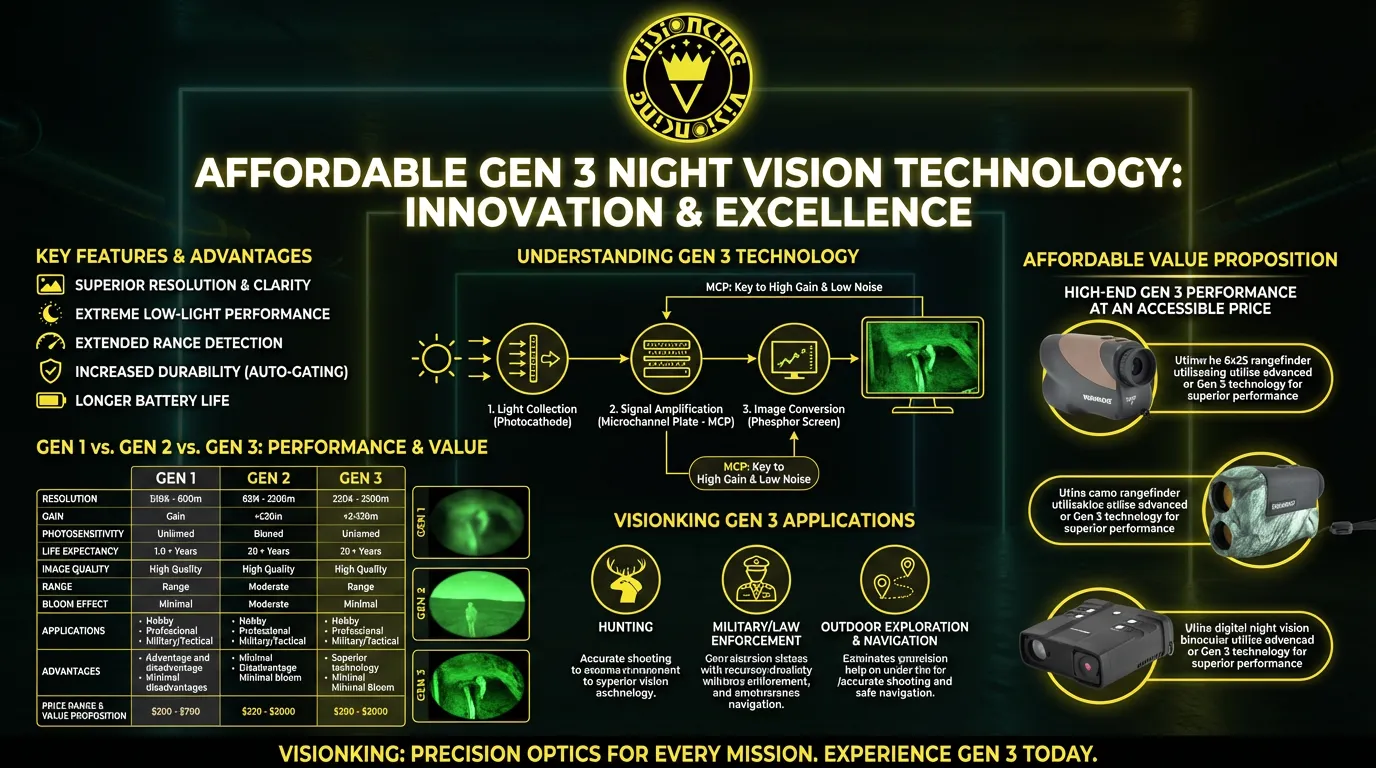
When you look at the price tag of affordable gen 3 night vision, you have to ask: where is that money actually going? It isn’t the housing or the glass that drives the cost up; it is the engine inside—the Image Intensifier Tube (IIT). To understand why even \”budget\” Gen 3 units cost thousands, you have to look at the chemistry that separates them from the rest of the pack.
Understanding the Gallium Arsenide (GaAs) Photocathode
The defining feature of Generation 3 technology is the Gallium Arsenide Photocathode. Unlike Gen 2 tubes that use a Multi-Alkali composition, Gen 3 tubes utilize GaAs to achieve significantly higher photosensitivity. This semiconductor material is what allows these units to operate passively.
Here is the reality: Gen 2+ often requires an IR illuminator to see in the darkest conditions. A Gen 3 tube with a GaAs photocathode amplifies light so effectively that you can often operate without giving away your position with IR light. You are paying for the ability to see in near-total darkness when others can\’t.
The Ion Barrier Film: Protecting Your Investment
If you are worried about durability, you need to know about the ion barrier film. In Gen 3 tubes, high-energy electrons can bounce back and damage the photocathode—a process called ion poisoning. To prevent this, manufacturers add a microscopic film to the Micro-Channel Plate (MCP).
While this film slightly inhibits the flow of electrons (technically reducing the signal slightly compared to unfilmed tubes), it is critical for the Night Vision Tube Lifespan.
- Gen 2 Life Expectancy: Approximately 2,500 to 5,000 hours.
- Gen 3 Life Expectancy: Approximately 10,000 hours.
That film is the difference between a tube that degrades after a few years of heavy use and one that lasts a lifetime.
Translating Tech to Benefits
So, what does this chemistry and engineering actually look like through the eyepiece? It comes down to Signal-to-Noise Ratio (SNR) and resolution. Because the GaAs photocathode is so efficient at converting photons into electrons, the image has far less \”snow\” or static (scintillation) in low-light environments.
- Low-Light Sensitivity: You get a crisp image at 400+ yards without artificial illumination.
- Noise Reduction: High SNR values (typically 20:1 to 24:1 on standard Gen 3) mean better target identification and less eye fatigue.
When you buy Gen 3, you are securing a device that balances raw power with the longevity required for a long-term tactical investment.
Strategies to Find \”Affordable\” Gen 3 (How to Lower the Cost)
Finding affordable gen 3 night vision doesn\’t mean you have to settle for junk; it means you need to be strategic about which specifications you prioritize. The price gap between a \”Bravo\” grade unit and a top-tier \”Alpha\” unit can be thousands of dollars, yet the actual performance difference in the field is often negligible for most hunters and shooters. Here is how I break down the cost without sacrificing the core capability of the device.
Strategy A: Green Phosphor (GP) vs. White Phosphor (WP)
If you want to save money immediately, stick to Green Phosphor. White Phosphor (WP) is currently the industry darling because it looks more like natural black-and-white contrast, which some users find less fatiguing. However, Green Phosphor vs White Phosphor is largely a preference choice rather than a raw performance one. Both use the same Gallium Arsenide photocathode technology to detect light. By choosing the classic green view, you can often shave hundreds of dollars off the final price tag while maintaining the same high resolution and signal-to-noise ratio found in pricier WP units.
Strategy B: Commercial Spec vs. Mil-Spec
This is where understanding \”Zones\” saves you the most cash. Manufacturers grade tubes based on cosmetic blemishes—tiny black spots caused by the manufacturing process.
- Zone 1: The absolute center of the image. You generally want this clear.
- Zone 2 & 3: The middle and outer edges of the view.
\”Commercial\” or \”Bravo\” grade tubes often have a few spots in Zone 2 or 3. These blemishes do not affect the tube\’s reliability or light amplification; they are strictly cosmetic. For a tactical user, a spot might be a distraction, but for a hunter, a small black dot in the periphery is meaningless. Accepting these minor imperfections allows you to access high-performance Gen 3 tech at a significantly lower entry point.
Strategy C: Thin-Filmed vs. Unfilmed
When building a budget setup, the battle of Thin-Filmed vs Unfilmed tubes is critical. Unfilmed tubes (often associated with L3Harris) are the pinnacle of light sensitivity because they lack the ion barrier film, allowing more electrons to hit the phosphor screen. However, they are incredibly expensive. Thin-Filmed tubes (like the Elbit Systems XLSH or standard Pinnacle tubes) retain a very thin ion barrier. While they technically transmit slightly less light than unfilmed models, they are robust, handle recoil exceptionally well, and cost drastically less. For the average user, a high-spec thin-filmed tube provides the best balance of durability and cost-effectiveness.
The \”PVS-14\” – The King of Budget Gen 3
If you are hunting for affordable gen 3 night vision, the PVS-14 platform is almost always the starting line. The reason is simple economics. The Image Intensifier Tube (IIT) is the single most expensive component in any night vision device. Night vision binoculars require two of these high-spec tubes, instantly doubling your manufacturing costs. A Monocular like the PVS-14 uses only one. By sacrificing depth perception, you gain access to top-tier Gallium Arsenide performance for roughly half the price of a dual-tube system. This makes the PVS-14 Monocular Kit the most logical choice for buyers who want military-grade clarity without the five-figure price tag.
Versatility: Handheld, Helmet, and Weapon
The value of the PVS-14 extends beyond just the initial purchase price; it offers a 3-in-1 Tactical Night Vision Setup. You are not locking yourself into a single application.
- Handheld: You can use it for scanning and observation, much like you would use a Visionking lens monocular K10x42 during the day, but with the superpower of seeing in total darkness.
- Helmet-Mounted: This is the standard deployment. It allows for hands-free navigation and interaction with your environment.
- Weapon-Mounted: The PVS-14 is rated to handle recoil. You can mount it behind a red dot sight compatible with night vision for a passive aiming solution.
Manual Gain Control
A critical feature often found on the PVS-14 is Manual Gain Control. While automatic brightness control is standard, Manual Gain lets you fine-tune the tube\’s brightness to match ambient lighting conditions. If you are in an area with high light pollution or changing shadows, dialing down the gain saves your eye from fatigue. This control is essential for preventing temporary night blindness in your aided eye once you look away from the optic.
The \”Gen 3 Killer\” – Is High-End Gen 2+ a Better Buy?
The \”Photonic\” Overlap: When Gen 2+ rivals entry-level Gen 3
When hunting for affordable gen 3 night vision, you inevitably encounter the debate between top-tier Gen 2+ and entry-level Gen 3. There is a distinct performance overlap where High-Spec Gen 2+ technology pushes resolution limits that rival standard Gen 3 units. While Gen 3 relies on the Gallium Arsenide photocathode for superior sensitivity in near-total darkness, premium Gen 2+ tubes often provide incredible clarity in mixed lighting conditions. If you are operating in areas with some ambient light—like starlight or distant urban glow—a high-end Gen 2+ unit can save you significant money while delivering a usable image.
Price vs. Performance: Choosing pristine Gen 2+ over damaged Gen 3
The decision often comes down to image cleanliness versus raw amplification power. I would personally choose a pristine, high-performance Gen 2+ tube over a \”Bravo\” or commercial-grade Gen 3 unit that is riddled with Zone 2 and 3 blemishes. You might get the light amplification benefits of Gen 3, but if the Signal-to-Noise Ratio (SNR) is low and the view is obstructed by black spots, your ability to identify targets suffers.
However, the long-term value proposition still favors Gen 3.
- Gen 2+ Lifespan: Typically rated for 2,500 to 5,000 hours.
- Gen 3 Lifespan: Rated for approximately 10,000 hours.
Even if the initial cost is higher, the night vision tube lifespan of a Gen 3 device ensures it remains operational for years longer than its predecessors.
The importance of optical glass quality in the housing
You can have the most advanced intensifier tube on the market, but if it is paired with inferior optics, that performance is wasted. The quality of the objective lens and eyepiece is critical for ensuring that the optical resolution (lp/mm) generated by the tube actually reaches your eye without distortion. Cheap plastic lenses reduce light transmission, which kills performance in low-light scenarios. Whether you are building a tactical setup or using a portable monocular with high-quality glass lenses, investing in superior glass ensures you get the maximum clarity your night vision device is capable of producing.
Critical Specs: How to Read a Data Sheet Before You Buy
When you are hunting for affordable Gen 3 night vision, the marketing label on the box isn\’t enough. You need to look at the data sheet. The difference between a \”Bravo\” grade tube and a premium \”Pinnacle\” tube often comes down to three specific numbers. Understanding these metrics is the only way to ensure you are getting the performance you are paying for.
Signal-to-Noise Ratio (SNR): The Metric for Low Light
If I had to pick one stat to prioritize, it is the Signal-to-Noise Ratio (SNR). This number tells you how \”quiet\” or clean the image will be in near-total darkness.
- Low SNR: The image looks like static on an old TV (lots of \”snow\”).
- High SNR: The image is crisp, allowing you to detect movement deep in the shadows.
For a worthwhile Gen 3 unit, you should look for an SNR of 24.1 or higher, though some entry-level units may sit around 20.1. This is the defining factor that separates high-end Gen 2+ from true Gen 3 performance.
Resolution (lp/mm) and Figure of Merit (FOM) Explained
Optical Resolution (lp/mm) measures detail clarity, specifically how many line pairs per millimeter the device can resolve. Standard Gen 3 tubes typically offer 64 to 72 lp/mm. While resolution is important for identifying specific features (like antlers vs. branches), it must be balanced with SNR.
To simplify this, the industry uses the Figure of Merit (FOM). This is a calculation derived by multiplying Resolution by SNR.
- Formula: Resolution (lp/mm) × SNR = FOM
- Target: A solid, budget-friendly Gen 3 tube often lands around an FOM of 1600 to 1800.
When evaluating custom monoculars and their key features, understanding these numbers ensures you aren\’t overpaying for underperformance. A high resolution means nothing if the noise level is too high to see clearly.
Auto-Gating: Essential Protection Against Bright Light Damage
Auto-Gating Technology is non-negotiable for tactical environments or urban areas. This feature automatically regulates the voltage to the photocathode, rapidly switching it on and off to protect the tube from sudden bursts of bright light, such as flashlights or muzzle flashes. Without auto-gating, a sudden light source can cause \”blooming\” (a blinding halo effect) or even permanent damage to the tube. If you plan to use your device around artificial light sources, ensure this feature is present.
Common Pitfalls to Avoid
The \”Digital\” Trap: Avoiding Marketing Gimmicks
When searching for affordable gen 3 night vision, the biggest mistake is confusing \”cheap\” with \”value.\” You will often see digital night vision devices marketed with impressive buzzwords, but they fundamentally differ from true analog systems. A digital unit relies on a processor and an LCD screen, heavily depending on an IR illuminator to function in dark conditions. In contrast, a genuine Gen 3 device utilizes a Gallium Arsenide Photocathode to passively amplify existing light, providing superior clarity and battery life without giving away your position. While digital options are inexpensive, they lack the Optical Resolution (lp/mm) and zero-lag performance required for serious tactical or hunting applications.
Risks of the Used Market: Tube Life and Warranty Issues
Buying used or Surplus Omni Tubes is a common strategy to save money, but it comes with significant gambles regarding the Night Vision Tube Lifespan. A pristine Gen 3 tube is rated for approximately 10,000 hours of operation, which is significantly longer than Gen 2 equivalents. However, when purchasing second-hand, you have no way of verifying how many hours the tube has already burned through.
Be wary of the following when looking at the used market:
- Tube Burns and Blemishes: Dark spots or \”burn-in\” from previous misuse can permanently obstruct your view.
- Lack of Warranty: Night vision components are expensive to repair. Buying new from reputable products ensures you are covered if the housing or electronics fail.
- Unknown Specs: Without a data sheet, you cannot verify the Signal-to-Noise Ratio (SNR) or Figure of Merit (FOM), meaning you might pay Gen 3 prices for lower-tier performance.
Sticking to \”Bravo\” grade or commercial spec units from established brands is often safer than rolling the dice on a mystery tube.
Frequently Asked Questions About Affordable Gen 3 Night Vision
Is Green Phosphor just as good as White Phosphor?
For the budget-conscious buyer, Green Phosphor (GP) is often the smarter choice. While White Phosphor (WP) is currently trendy in tactical circles for its perceived contrast resembling black-and-white photography, the underlying performance specs—like resolution and sensitivity—are largely determined by the tube grade, not the color. In the Green Phosphor vs White Phosphor debate, choosing green can save you hundreds of dollars while still delivering that crisp Gen 3 clarity. If your goal is affordable Gen 3 night vision, stick to the classic green; you are paying for performance, not aesthetics.
What is a good FOM for budget Gen 3?
Figure of Merit (FOM) is calculated by multiplying resolution (lp/mm) by the Signal-to-Noise Ratio (SNR). For a solid, entry-level Gen 3 unit, you should look for an FOM range between 1600 and 1800.
- Resolution: Standard Gen 3 tubes typically offer 64 lp/mm.
- SNR: A decent \”Bravo\” grade tube will have an SNR around 22-25.
Don\’t get hung up on chasing \”Unfilmed\” specs (2500+ FOM) unless you have an unlimited budget. A 1600 FOM unit is more than capable for hunting and general observation.
Can I mount a PVS-14 on a rifle?
Yes, the PVS-14 Monocular Kit is famous for its versatility. It can be handheld, helmet-mounted, or weapon-mounted behind a red dot sight. However, because it is a monocular and not a dedicated scope, you need to ensure you have the correct rail adapter. When building out custom night vision systems, keep in mind that the PVS-14 is rated for recoil, but generally up to 5.56 caliber. For heavier calibers, a dedicated scope is safer for the internal tube components.
How long do Gen 3 tubes actually last?
This is where the extra cost justifies itself. A Night Vision Tube Lifespan for Gen 3 devices is rated at approximately 10,000 hours.
- Gen 2/2+: Typically lasts 2,500 to 5,000 hours.
- Gen 3: Lasts up to 10,000 hours thanks to the ion barrier film protecting the photocathode.
Even if you use the device for 10 hours a week, a Gen 3 tube can last practically a lifetime. This longevity makes it a better long-term investment compared to cheaper alternatives that degrade faster.