What Is Generation 0 Night Vision?
Ever wonder where the technology to see in the dark actually began? It didn\’t start with the crisp green images we see in modern movies. It started with Generation 0 night vision, the absolute grandfather of all night optics. Developed in the mid-1930s by the German Army and later utilized by US forces during WWII and the Korean War, this gear represents the very first successful attempt to conquer the dark.
Defining Active Infrared Night Vision
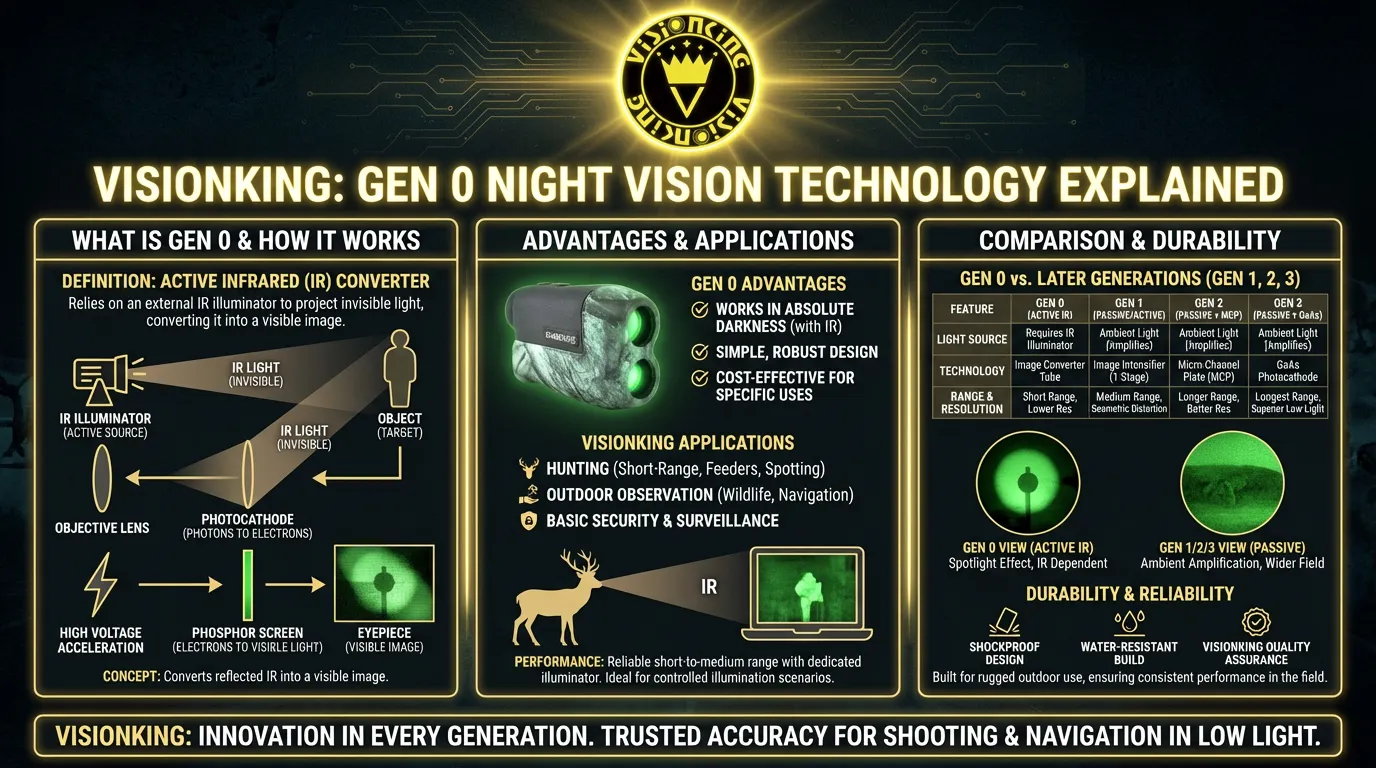
The most critical thing to understand about Gen 0 is that it is active infrared night vision. Unlike the \”passive\” systems we use today that amplify ambient light (like moonlight or starlight), Gen 0 technology cannot function on its own. It is completely reliant on an external light source.
Here is how the core technology works:
- The Infrared Illuminator: The system requires a large IR projection unit attached to the device. This acts like a flashlight that is invisible to the naked eye but visible to the scope.
- The S-1 Photocathode: Inside the device, an image converter tube uses an S-1 photocathode. This component captures the reflected infrared light from the illuminator.
- Electron Conversion: The tube accelerates the electrons from the captured light and converts them into a visible image on the eyepiece.
Without that infrared illuminator, a Gen 0 device is effectively blind. It doesn\’t amplify existing light; it simply converts a projected beam of invisible energy into something you can see.
The History and Evolution of Gen 0 Tech
From German Vampir systems to US Sniperscopes: how WWII changed the dark
The origins of Generation 0 night vision trace back to the mid-1930s, when the German army first developed devices capable of seeing in the dark. This technology fundamentally changed battlefield tactics, leading the United States to develop its own WWII night vision systems by the mid-1940s. These early units were heavy and relied on active infrared technology, requiring a dedicated projection unit to function.
Unlike modern passive systems, Gen 0 devices utilized an S-1 photocathode within an image converter tube. This setup demanded an external Infrared illuminator to light up the target area with invisible beams, which were then converted into a visible image for the user. While primitive by today\’s standards, this early night vision technology saw continued service with the US Navy and Army through the Korean War. For those interested in how these historical components evolved into modern setups, understanding custom night vision systems helps clarify the massive leap in technology we see today.
Key Historical Milestones:
- Mid-1930s: German army initiates development of the first NVDs.
- Mid-1940s: US forces deploy their own active infrared systems during WWII.
- 1950s: Continued usage of Gen 0 night vision in the Korean War by US forces.
How Gen 0 Night Vision Devices Actually Work
To understand gen 0 night vision, you have to look at the fundamental difference between \”passive\” and \”active\” systems. Unlike modern optics that amplify faint starlight, Generation 0 technology is strictly active infrared night vision. This means the device cannot function passively in the dark; it relies entirely on an external light source that is invisible to the naked eye but visible to the sensor.
The Role of the Infrared Illuminator
The most critical component of this early technology is the infrared illuminator. Since the system does not amplify ambient light effectively, it requires a powerful beam of Near-Infrared (NIR) light to \”paint\” the target.
- Projection: A large IR searchlight projects a beam.
- Reflection: The IR light bounces off the target and back to the device.
- Capture: The objective lens gathers this reflected energy.
Without this \”invisible flashlight,\” a Gen 0 unit is effectively blind. While modern devices like the Visionking Night Vision 3×42 Infrared Scope still utilize IR illuminators for total darkness, they do so with much greater efficiency than these early models.
Inside the Image Converter Tube
Once the objective lens captures the reflected infrared light, the internal electronics take over. The core of this system is the vacuum tube known as an image converter tube.
- S-1 Photocathode: The incoming photons hit the S-1 photocathode, which was the standard photosensitive surface for the era. This component converts the light particles (photons) into electrons.
- Electron Acceleration: High voltage accelerates these electrons through the vacuum tube.
- Phosphor Screen: The electrons strike a phosphor screen at the back of the tube (similar to an old CRT television), converting the energy back into a visible green image for the user.
This process is purely about conversion—changing invisible IR light into visible light—rather than the light amplification seen in later generations.
Iconic Gen 0 Devices Used in Combat
When we look back at gen 0 night vision, we aren\’t talking about the compact gear used today. This era was defined by \”heavy metal\” optics that required massive battery packs and large infrared searchlights. The technology, developed initially by the German army in the mid-1930s, laid the groundwork for all modern night operations, even if the equipment was cumbersome by today\’s standards.
Two primary systems defined this period of active infrared night vision:
- Zielgerät 1229 \”Vampir\” (Germany): As the pioneers of this technology, the German military deployed these systems late in WWII. They utilized an active infrared spotlight mounted directly on the rifle, allowing soldiers to see in total darkness, provided they carried the heavy supporting electronics.
- M3 Sniperscope (USA): The United States adopted similar technology during WWII and the Korean War. These M3 Sniperscope units mounted a large infrared illuminator above the optic. While effective for its time, the system was heavy and bulky, a far cry from a modern lightweight rifle scope designed for mobility.
Both devices relied on the same core principle: projecting a beam of near-infrared light that was invisible to the naked eye but visible through the image converter tube. While revolutionary, this early night vision technology had a critical tactical flaw. The IR beam acted like a flashlight to anyone else equipped with similar vintage night vision devices, instantly revealing the sniper\’s position.
The Major Limitations and Drawbacks
Why Active Infrared Became Obsolete
While generation 0 night vision paved the way for modern optics, the technology had significant flaws that made it dangerous to use in combat. The primary issue was its reliance on active infrared night vision technology. Unlike later generations that amplify existing light, Gen 0 devices used an S-1 photocathode that required a powerful infrared illuminator to see anything at all.
This reliance on an external light source created a massive tactical disadvantage. To the naked eye, the IR beam was invisible, but to an enemy equipped with similar vintage night vision devices, the user looked like they were shining a bright flashlight in the dark. This effectively turned the operator into a target, leading soldiers to call these active systems \”shoot me\” beacons.
Technical and Physical Constraints
Beyond the tactical risks, the hardware itself was cumbersome. Early systems like the M3 Sniperscope were heavy, requiring bulky battery packs and high-voltage power supplies to drive the image converter tube.
- Zero Ambient Amplification: The S-1 photocathode could not amplify starlight or moonlight. If the IR light failed or was turned off, the device was useless.
- Geometric Distortion: The image quality was often poor, with significant distortion around the edges, making target identification difficult compared to the clarity you expect when selecting the best rifle scope today.
- Short Battery Life: The power consumption required to run both the high-voltage tube and the infrared searchlight meant these units had very limited operational time in the field.
Gen 0 vs. Later Generations: A Reality Check
When we stack gen 0 night vision against modern systems, the difference is night and day—literally. The defining split in night vision generations comparison is the shift from \”active\” to \”passive\” technology. Generation 0 was strictly active infrared night vision, meaning it was completely blind without a supplemental infrared light source. If you turned off the IR illuminator, you saw nothing.
In contrast, Generation 1 marked the beginning of passive night vision. These devices didn\’t need to project a beam of light; instead, they amplified existing ambient light (like starlight or moonlight) using an S-20 photocathode. While Gen 0 relied on the older S-1 photocathode and high-voltage electron acceleration to distort and brighten an image, Gen 1 tubes could amplify light around 1,000 times. This made them far more stealthy since users weren\’t walking around with a giant invisible flashlight that enemies could spot.
Here is how the technology evolved from the heavy metal of the 1940s:
- Generation 0 (Active): Uses an image converter tube and requires a massive IR searchlight. It has poor range and creates a distorted \”fish-eye\” image.
- Generation 1 (Passive): Amplifies ambient light. It’s affordable and popular for civilian use but still suffers from edge distortion.
- Generation 2: Introduced the Micro-Channel Plate (MCP). This was a game-changer that multiplied electrons significantly, offering a brighter, sharper image without the distortion found in earlier models.
- Generation 3: Utilizes Gallium Arsenide for the photocathode, providing extreme low-light sensitivity and longevity (10,000+ hours).
The leap in optical technology is massive. Where soldiers once hauled heavy lead-acid batteries to power a fuzzy green image, modern outdoorsmen now utilize compact, high-precision gear like a Visionking 6×25 laser range finder to complement their optics. Gen 0 proved the concept was possible, but later generations turned night vision into a practical, tactical advantage.
Is Gen 0 Still Relevant Today?
To be blunt, you won\’t find gen 0 night vision in a modern tactical loadout or a serious survival kit. From a practical standpoint, the technology is obsolete. Relying on an active infrared night vision system requires projecting a beam of IR light that acts like a massive spotlight to anyone else equipped with night optics. This \”active\” nature, combined with the heavy battery packs and bulky image converter tubes, makes them a liability rather than an asset in the field today.
However, these devices still hold significant value in specific circles. They are not bought for performance, but for their place in history. The market for vintage night vision devices is driven by:
- Military Historians: Enthusiasts preserving the lineage of the S-1 photocathode and early electronic optics.
- Collectors: Individuals hunting for authentic pieces like the M3 Sniperscope to complete a display.
- Reenactors: Groups needing period-correct gear for accurate WWII or Korean War impressions.
While they aren\’t viable for hunting or security anymore, they remain fascinating pieces of engineering. For those interested in usable, current-generation optics, exploring our modern optical products offers a stark contrast to these heavy, infrared-dependent ancestors. Gen 0 night vision is now a museum piece, serving as a reminder of how far optical technology has evolved.
FAQ: Common Questions About Gen 0 Night Vision
Does Gen 0 night vision work without an IR light?
No. Unlike later generations, generation 0 night vision relies entirely on active infrared night vision technology. The device uses an S-1 photocathode which cannot amplify ambient light like moon or stars. It requires a powerful infrared illuminator to project a beam of invisible light that bounces off the target and back into the lens. Without this external light source, the device is effectively blind in the dark.
Why is Gen 0 considered dangerous for tactical use?
The reliance on an active infrared searchlight creates a major tactical vulnerability. While the beam is invisible to the naked eye, it appears as a bright spotlight to anyone else using vintage night vision devices or modern equipment. In a combat scenario, turning on a Gen 0 device essentially reveals your exact location to the enemy, acting as a beacon.
How does the image quality compare to modern optics?
The image quality is significantly lower. These early devices often produced distorted, grainy images with poor resolution. While modern users enjoy crisp views through a Visionking large lens monocular, early Gen 0 users dealt with geometric distortion and a limited field of view. The image converter tube technology was revolutionary for the 1930s but is obsolete by today\’s standards.
Are Gen 0 devices like the M3 Sniperscope valuable?
Yes, but primarily to collectors rather than practical users. Iconic units like the M3 Sniperscope or the German Vampir night vision system hold significant historical value. They represent the dawn of early night vision technology. However, due to the scarcity of replacement parts and heavy, obsolete battery packs, they are rarely used for actual field observation today.
What is the main difference between Gen 0 and Gen 1?
The core difference is \”Active\” vs. \”Passive.\”
- Gen 0 (Active): Requires a projected IR beam to see.
- Gen 1 (Passive): Amplifies existing ambient light (starlight/moonlight) roughly 1,000 times using more advanced photocathodes, removing the strict need for an illuminator.