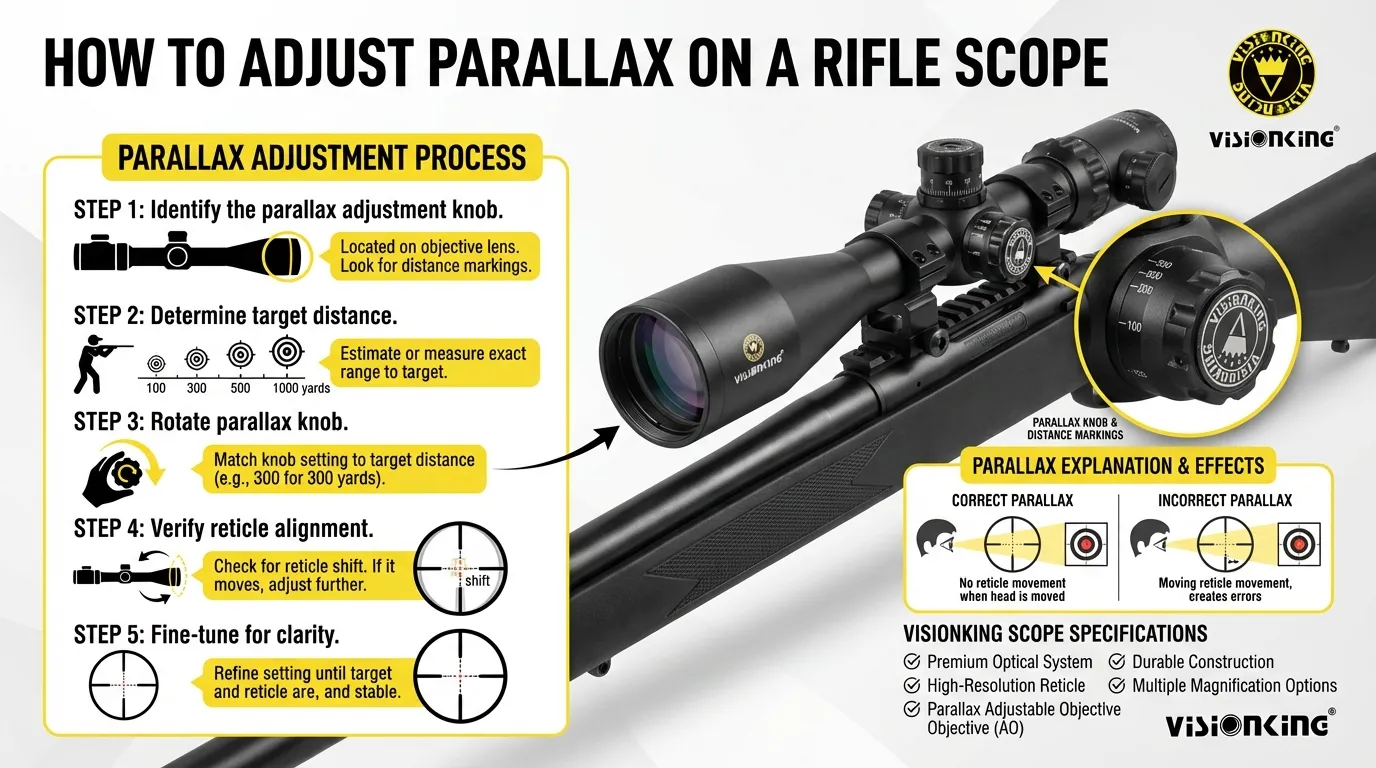
What is Rifle Scope Parallax and How It Works
Parallax is one of the most misunderstood concepts in long-range shooting, yet it is the primary cause of unexplained misses at distance. In simple terms, parallax is an optical error that occurs when the target image and the reticle are not on the same focal plane within the scope.
Think of it like looking at a speedometer from the passenger seat of a car. Because of your angle, the needle appears to point at a different speed than what the driver sees. In a rifle scope, if the internal lenses aren\’t aligned perfectly for the specific distance you are shooting, the crosshairs will appear to shift position relative to the target, even when the rifle remains perfectly still.
Understanding the Parallax Effect and What You See
When parallax is present, your point of aim changes based on where your eye is positioned behind the ocular lens. This creates a \”floating\” sensation.
- The \”Swim\” Effect: If you move your head slightly up, down, left, or right, the reticle will appear to slide or \”swim\” across the target face.
- The Result: If your eye isn\’t perfectly centered (which is difficult to maintain under stress), you will miss the shot, regardless of how steady the rifle is.
- The Goal: When you successfully learn how to adjust parallax on a rifle scope, the reticle stays \”glued\” to the target, regardless of slight head movement.
The Difference Between Reticle Focus and Target Focus
A common mistake among new shooters is confusing the eyepiece focus (diopter) with the parallax adjustment. While both knobs affect clarity, they perform completely different mechanical functions. You cannot use the parallax knob to fix a blurry reticle, and you cannot use the eyepiece to fix parallax error.
Comparison of Scope Adjustments:
| Feature | Reticle Focus (Diopter) | Parallax Adjustment (Side Focus/AO) |
|---|---|---|
| Location | Rear of the scope (Ocular Lens) | Side knob or Front Objective (AO) |
| Primary Function | Focuses the Crosshairs to your eye | Focuses the Target & aligns focal planes |
| Adjustment Frequency | Set once and leave it alone | Adjusted constantly for different distances |
| Visual Effect | Makes the reticle crisp black | Makes the target image sharp |
To ensure precision, you must understand that how to adjust rifle scope parallax effectively relies on having a properly focused reticle first. If the crosshair is blurry, no amount of parallax adjustment will fix your sight picture.
The Importance of Focusing Your Reticle First
Before you dive into learning how to adjust parallax on a rifle scope, you must ensure your reticle is calibrated to your specific eyesight. A common mistake shooters make is trying to clear up a blurry image using the parallax adjustment knob, when the actual problem is the eyepiece focus. These are two distinct optical systems: the eyepiece focuses the crosshairs, while the side focus or adjustable objective focuses the target image. If your reticle isn\’t sharp, your parallax adjustments will never be precise.
Adjusting the Eyepiece Diopter for Clarity
To set your reticle focus, you need to isolate the crosshairs from the target image. Point your rifle at a neutral, uncluttered background, such as a clear blue sky or a blank white wall. Do not look at a specific target, as your eye will try to focus on the object rather than the reticle.
- Locate the Adjustment: Find the fast-focus eyepiece or the locking ring at the rear of the scope.
- Rotate Smoothly: Turn the eyepiece all the way out, then slowly rotate it in until the reticle lines appear crisp and black.
- Check Quickly: If you stare too long, your eye muscles will compensate for the blur.
For example, if you are setting up a Visionking 1.5-6×42 rifle scope with illuminated reticle, make sure the illumination is turned off during this process so you are focusing strictly on the physical reticle lines.
How to Tell if Your Reticle is Properly Focused
The best way to verify your setting is to trick your eye so it doesn\’t have time to auto-correct. Look away from the scope at a distant object for a few seconds, then quickly look back through the scope at the neutral background.
- Instant Clarity: The reticle should be sharp the instant you look through the lens.
- The Lag Test: If it takes a split second for the crosshairs to come into focus, your diopter is slightly off. Readjust until the image is instantly clear.
Once you have achieved a crisp reticle, lock the ring (if your model has one) or simply leave the eyepiece alone. Unlike how to adjust parallax on rifle scope settings, which change with distance, the reticle focus is set once for your eye and generally does not need to be changed.
How to Adjust Parallax on a Rifle Scope: Step-by-Step
Learning how to adjust parallax on a rifle scope isn\’t complicated, but it does require a specific process to ensure your point of aim matches your point of impact. Once you have your reticle focused for your eye, follow these steps to eliminate optical error at your target distance.
Stabilizing Your Rifle for Adjustment
You cannot accurately adjust parallax if your rifle is wobbling. Before touching any dials, place your rifle on a completely stable platform.
- Use a Rest: Utilize a shooting sled, sandbags, or a sturdy bipod.
- Hands-Free: Ideally, the rifle should be able to point at the target without you holding it.
- Target Selection: Aim at a clear target with defined contrast at the specific distance you intend to shoot.
If the rifle moves while you are trying to diagnose reticle movement, you won\’t be able to tell the difference between shooter wobble and parallax error.
Using the Side Focus Knob or Adjustable Objective (AO)
Identify your adjustment mechanism. Most modern long-range optics, like the Visionking 10-40×56 hunting rifle scope, use a Side Focus knob located on the left side of the turret housing. Older or budget-friendly scopes often use an Adjustable Objective (AO), which is a rotating ring on the front bell of the scope.
- Ignore the Numbers: The yardage markings on your parallax knob are rarely 100% accurate. Treat them as a rough estimate, not a rule.
- Turn for Clarity: While looking through the scope, turn the side focus or AO ring until the target image appears sharp and crisp.
- Fine Tune: Once the image is clear, you are close, but you might not be perfectly parallax-free yet. This is where many shooters stop, but you need to go one step further to truly understand how to adjust parallax on rifle scope systems for precision.
Performing the \”Head Bob\” Test to Eliminate Error
The \”Head Bob\” is the definitive test to confirm you have removed the error. This ensures the reticle is on the exact same focal plane as the target image.
- Position Yourself: Get behind the scope without touching the rifle.
- Move Your Head: Shift your eye slightly up and down, then left and right. Do not move the rifle.
- Watch the Reticle: Look closely at the center of the crosshair against the target background.
Interpreting the results:
- If the reticle \”floats\” or moves across the target while your head moves, you still have parallax error. Slightly adjust the knob until the movement stops.
- If the reticle stays \”glued\” to the specific spot on the target regardless of your eye position, you have successfully learned how to adjust rifle scope parallax for that distance.
Adjusting Parallax on Different Types of Scopes
Knowing how to adjust parallax on a rifle scope effectively depends heavily on the specific design of your optic. While the optical principle remains the same, the mechanical interface—where you actually put your hand—varies between models.
Side Focus vs. Adjustable Objective Systems
Most variable-power scopes that offer parallax adjustment fall into two main categories: Side Focus (SF) and Adjustable Objective (AO).
- Side Focus (SF): This is a third knob located on the scope\’s saddle, usually on the left side opposite the windage turret. It is popular in tactical and long-range optics because you can adjust it with your non-firing hand without breaking your shooting position.
- Adjustable Objective (AO): This system uses a rotating ring on the objective bell (the front lens housing). It is common on hunting scopes and air rifle scopes. While mechanically simple and robust, it requires you to reach forward to make adjustments.
Quick Comparison: SF vs. AO
| Feature | Side Focus (SF) | Adjustable Objective (AO) |
|---|---|---|
| Location | Left side turret | Front lens housing |
| Ergonomics | Excellent (reachable while aiming) | Lower (requires reaching forward) |
| Typical Application | Tactical, Long-Range Competition | Hunting, Plinking, Field Target |
| Speed | Fast adjustment | Slower adjustment |
When figuring out how to adjust rifle scope parallax, the goal is identical for both: turn the control until the image is sharp and the reticle stops moving when you bob your head. If you are at the range using a spotter to verify your adjustments, keeping your observation gear steady with a Visionking Car Window Mount for Spotting Scopes Cameras Monoculars Accessary allows you to focus entirely on manipulating these scope controls without distraction.
How to Adjust Parallax on a Fixed Parallax Scope
Many standard hunting scopes do not have a parallax adjustment knob. These are \”Fixed Parallax\” scopes, typically set at the factory to be parallax-free at a specific distance (usually 100 yards for centerfire rifles and 50 yards for rimfire).
Since you cannot mechanically adjust the internal lenses, you must manage the error through technique:
- Understand the Limit: At the factory-set distance, your scope is parallax-free. At other distances, some error will exist.
- Perfect Your Cheek Weld: This is the most critical step. If your eye is perfectly centered behind the ocular lens, parallax error is mathematically eliminated, regardless of the distance. Consistent head placement is your only adjustment on these scopes.
- Lower the Magnification: If you are shooting at a target closer than the fixed distance and the image looks blurry, dial down the magnification. This increases the depth of field, making the image appear sharper and reducing the visible effects of parallax.
Mastering how to adjust parallax on rifle scope setups that are fixed requires discipline in your shooting form rather than mechanical manipulation.
Troubleshooting Common Parallax Adjustment Issues
Why Your Parallax Dial Marks May Not Be Accurate
One of the first things I tell shooters learning how to adjust parallax on a rifle scope is to stop trusting the numbers painted on the dial. Those yardage markings are approximations, not gospel. It is incredibly common to range a target at exactly 300 yards, turn your dial to the \”300\” mark, and still find the image slightly out of focus or see the reticle shifting.
Several factors cause this discrepancy:
- Atmospheric Conditions: Temperature and humidity can shift the focal point of the internal lenses.
- Manufacturing Tolerances: Mass-produced scopes often have slight variations in where the markings align with the internal mechanics.
- Diopter Settings: If your rear eyepiece (diopter) isn\’t set perfectly for your eye, the parallax markings will not align with the actual distance.
While a standard Visionking large lens monocular is forgiving with focus for general observation, a rifle scope requires exact mechanical precision to ensure the crosshair stays on target. Always trust your eyes and the \”head bob\” test over the printed numbers.
Correcting Parallax for Different Shooting Distances
When you are in the field, you need a reliable workflow to fix parallax errors quickly. Knowing how to adjust rifle scope parallax on the fly can make the difference between a hit and a miss. If you switch from a 100-yard target to a 500-yard target, do not just blindly dial the knob.
Follow this quick troubleshooting checklist to ensure you are parallax-free:
| Issue Observed | Likely Cause | Immediate Fix |
|---|---|---|
| Reticle is Blurry | Diopter (Eyepiece) is out of focus. | Stop touching the parallax knob. Adjust the rear eyepiece until the crosshair is crisp against a plain background. |
| Target is Blurry | Parallax/Focus is set to the wrong distance. | Turn the Side Focus or Adjustable Objective (AO) until the target image is sharp. |
| Reticle \”Swims\” on Target | Parallax error is present. | Perform the head bob test. Fine-tune the parallax knob until the reticle stays frozen on the target, even if the image gets slightly less sharp. |
Pro Tip: If you have to choose between a perfectly sharp image and a parallax-free reticle, always choose the parallax-free reticle. A slightly blurry target is still hittable, but a reticle that shifts position will cause you to miss every time. Mastering how to adjust parallax on rifle scope turrets means prioritizing point-of-impact accuracy above all else.