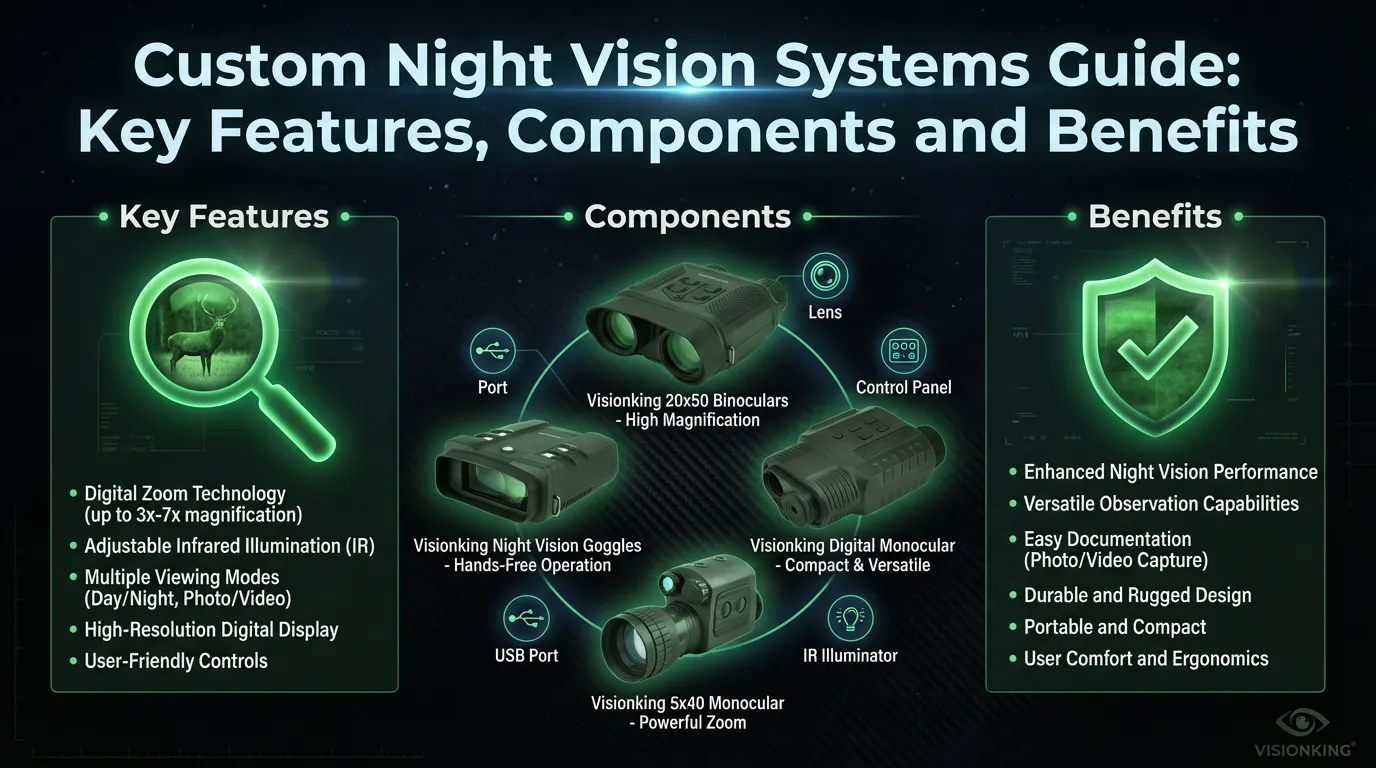
What is Custom Night Vision?
Custom night vision represents the pinnacle of optical engineering, moving beyond standard retail specifications to deliver bespoke solutions for precise operational needs. Unlike mass-produced optics, a **custom build** is configured directly at the manufacturing level to align with specific environmental conditions, whether for tactical surveillance, professional hunting, or security applications. As a manufacturer with full-scale R&D capabilities, Visionking engineers these systems to ensure that every element—from the multi-coated glass to the housing durability—is optimized for the end-user’s specific requirements.
The Advantages of Tailored Performance
Investing in a tailored **NVG system** grants professionals superior control over critical optical parameters. Our in-house design team focuses on maximizing light transmission and resolution, ensuring the device performs exceptionally in its intended setting.
Core Performance Benefits:
- Optimized Optics: Lenses feature specific multi-coatings to maximize clarity and light gathering in low-light environments.
- Rugged Reliability: Custom housings are Nitrogen-filled and O-ring sealed, guaranteeing waterproof and fog-proof performance.
- Recoil Resistance: High-grade aluminum construction is engineered to withstand shock and heavy recoil, far exceeding standard consumer grades.
- Enhanced Specifications: Tailored builds can prioritize Field of View (FOV) or detection range based on the mission profile.
Why Choose Custom Builds Over Off-the-Shelf Units
Off-the-shelf products often rely on generic components to satisfy a broad market, frequently sacrificing specialized performance. A **custom night vision** solution sourced directly from the factory ensures technical accountability and higher value. Through our professional OEM/ODM services, clients receive equipment that is purpose-built rather than simply re-branded.
| Feature | Standard Off-the-Shelf | Visionking Custom Build |
|---|---|---|
| Optical Quality | Generic coatings | Precision multi-coated systems |
| Build Integrity | Consumer-grade plastic | Shockproof metal/composite |
| Cost Structure | Retail markup | Manufacturer-direct pricing |
| Adaptability | Fixed specifications | Flexible configuration |
Modular and Upgrade-Friendly Design
A primary strength of a professional **custom build** is its modular architecture. Our manufacturing process prioritizes versatile housing designs capable of accommodating various grades of **image intensifier tubes** or high-sensitivity digital sensors. This adaptability is crucial for private label partners and distributors, as it allows for technical upgrades and maintenance without replacing the entire optical system. By engineering specifically for modularity, we ensure that the device remains a long-term asset capable of evolving with advancing night vision technology.
Key Components of a Custom Night Vision System
Building a reliable custom night vision setup requires understanding the sum of its parts. It is not just about the sensor; it is about how the housing, optics, and electronics work together to deliver clarity in low-light environments. We focus on precision engineering to ensure every component meets rigorous field standards.
Selecting the Right Night Vision Housing
The housing is the chassis of your device, protecting the sensitive internal electronics from the elements. A high-quality housing must offer more than just a shell; it needs to be shockproof, waterproof, and ergonomically designed for extended use. We engineer our housings using durable materials like high-grade aluminum and reinforced composites to withstand recoil and impact.
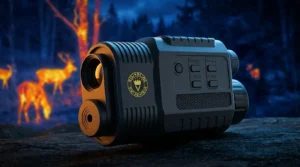
Crucially, the housing determines the optical alignment. Our designs feature nitrogen-filled bodies to prevent internal fogging during rapid temperature changes. Whether you are looking for a compact unit like the Visionking Night Vision 3×42 Infrared Scopes Hunting Monocular or a dual-tube system, the housing integrity ensures that your zero holds true and the device survives harsh field conditions.
Comparing Image Intensifier Tubes: L3 Harris, Elbit, and Photonis
When configuring a custom build, the choice of image intensifier tube defines the system’s low-light performance. While we specialize in manufacturing the optical systems and digital sensors, understanding the global market leaders in analog tubes is essential for enthusiasts building bespoke kits.
- L3 Harris: Known for their Gen 3 Unfilmed White Phosphor technology. These tubes typically offer the highest sensitivity in extreme low-light conditions but come at a premium price point.
- Elbit Systems: These are generally Thin-Filmed Gen 3 tubes. They provide an excellent balance of performance and cost, often serving as the standard for military and law enforcement contracts.
- Photonis: Famous for their ECHO tubes. These are often classified as Gen 2+ or “hybrid” technology. They excel in high-dynamic-range environments (like urban areas) where light levels fluctuate rapidly, offering superb clarity and fast auto-gating.
Understanding Tube Specifications and Classifications
Reading a spec sheet can be confusing, but a few key metrics determine the actual quality of the image you see. In our R&D process, we prioritize matching high-transmission multi-coated lenses with the sensor’s capabilities to maximize these figures.
Critical Specifications:
| Spec | Definition | Why It Matters |
|---|---|---|
| FOM (Figure of Merit) | Resolution × SNR | The overall performance score of the tube. Higher is better. |
| SNR (Signal-to-Noise Ratio) | Signal strength vs. background noise | Determines low-light clarity. A higher SNR means less “static” or “snow” in the image. |
| Resolution (lp/mm) | Line pairs per millimeter | Defines how sharp the image is. High resolution is vital for identifying targets at range. |
| EBI (Equivalent Background Illumination) | The amount of light the tube emits when completely dark | Lower EBI is better for very dark environments, like deep forests or caves. |
Regardless of the tube classification, the objective lens quality plays a massive role. Even a high-spec tube will underperform behind poor glass. Our Visionking Digital Zoom Night Vision Infrared Hunting Binoculars utilize advanced optical coatings to ensure maximum light transmission, allowing the sensor to perform at its peak potential.
Popular Custom Night Vision Configurations
When sourcing a custom night vision setup directly from our factory, choosing the right configuration is the first step. We manufacture and assemble various optical systems tailored to specific tactical, hunting, or surveillance requirements. Whether you need a lightweight unit for casual observation or a heavy-duty NVG system for professional use, we have the manufacturing capacity to deliver.
Custom Built Monocular Night Vision (PVS-14)
The monocular configuration remains the most versatile option for global distributors and individual users. A single-tube system allows the user to maintain natural night adaptation in one eye while viewing the intensified image through the other. This setup is lightweight, cost-effective, and multifunctional.
We engineer our monocular housings to be robust and adaptable. They can be handheld, weapon-mounted, or helmet-mounted depending on the mission profile. For those looking for high-quality optical glass in a compact form, our Visionking lens monoculars showcase the precision we apply to all our handheld devices.
Key Monocular Benefits:
- Versatility: Handheld or hands-free operation.
- Situational Awareness: One eye remains unaided.
- Cost-Efficiency: Requires only one sensor or tube.
Custom Built Binocular Night Vision Systems
For applications requiring depth perception, such as driving or navigating complex terrain, a binocular custom build is superior. These systems use two independent optical channels, providing a stereoscopic image that makes judging distance significantly easier compared to monoculars.
Our manufacturing lines produce durable binocular housings designed to withstand recoil and impact. We integrate advanced sensors to ensure clarity in low-light conditions. You can see this technology in action with our digital night vision binoculars, which combine powerful infrared illuminators with ergonomic design for extended use in the field.
Panoramic Night Vision Options (GPNVG)
Panoramic configurations are the pinnacle of custom night vision performance, designed to break the standard 40-degree field of view (FOV) limit. By utilizing multiple optical channels or specialized wide-angle lenses, these systems drastically increase peripheral vision, which is critical for close-quarters environments.
While traditional panoramic units are heavy and complex, our R&D team focuses on optimizing the optical train to reduce weight without sacrificing durability. We supply the high-transmission lenses and precision housings necessary to build these advanced wide-view systems.
Configuration Comparison:
| Feature | Monocular (PVS-14 Style) | Binocular (Dual Tube) | Panoramic (Wide FOV) |
|---|---|---|---|
| Depth Perception | Low | High | High |
| Field of View | Standard (40°) | Standard (40°) | Wide (97°+) |
| Weight | Lightest | Medium | Heavy |
| Cost | Entry-Level | Mid-Range | High-End |
The Custom Build and Assembly Process
At Visionking, we view the creation of **custom night vision** not just as assembly, but as precision engineering. Our manufacturing facility controls the entire production lifecycle, ensuring that every device is built to withstand extreme environments while delivering superior optical clarity. We leverage our in-house R&D to tailor specifications directly to the needs of hunters, tactical teams, and distributors.
How We Build Custom Night Vision Devices
Our process moves beyond simple parts kits. We start by selecting high-grade aluminum or reinforced composite housings designed for shock resistance. The core of our **custom build** process involves the precise integration of multi-coated optical lenses with the chosen sensor or **image intensifier tubes**.
* **Precision Alignment:** We align the optical train to ensure maximum light transmission and edge-to-edge clarity.
* **Nitrogen Purging:** Every unit is nitrogen-filled to eliminate internal moisture and make the device fog-proof.
* **Custom Configuration:** We adjust the objective lens and eyepiece focus mechanisms to meet specific Field of View (FOV) requirements.
Quality Control and Professional Bench Testing
We do not ship a unit until it has survived our testing gauntlet. A **custom night vision** device must be as durable as it is clear. We utilize professional collimation benches to ensure the optical axis is perfectly centered, preventing eye strain during prolonged use.
* **Impact Testing:** We simulate heavy recoil to ensure the **NVG system** maintains zero and structural integrity.
* **Environmental Stress:** Units are tested for waterproofing and thermal stability.
* **Optical Inspection:** We rigorously check for artifacts or debris, adhering to the same high standards found in our Visionking large lens monoculars.
Typical Turnaround Times for Custom Builds
Since we operate as a direct manufacturer rather than a middleman, we offer efficient timelines for custom orders. Our large-capacity production lines allow us to handle both single prototype adjustments and bulk OEM/ODM runs without the delays associated with third-party sourcing. Standard customization projects move quickly from design to assembly. For larger private label orders, we provide transparent schedules and regular updates via our Visionking company news channels, ensuring you know exactly when your gear will be ready for deployment.
Essential Accessories for Custom Night Vision Setups
To get the most out of your custom night vision device, pairing it with the right hardware is non-negotiable. A high-performance optical tube requires a solid support system to function effectively in the field. We focus on ensuring that every unit we manufacture is compatible with standard industry interfaces, allowing for seamless integration with a wide range of tactical and hunting accessories.
Helmet Mounts and Stabilization Systems
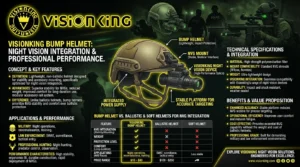
Stability is the foundation of a reliable NVG system. Whether you are navigating rough terrain or setting up for a static observation, your device needs to remain secure. For helmet-mounted setups, a robust interface prevents the wobble that causes eye fatigue and disorientation.
If you are adapting your optical gear for weapon-mounted applications, precision is even more critical. We recommend using high-grade rifle scope rings and tube mounts to secure monoculars or sights to Picatinny rails. This ensures the device handles recoil without losing alignment, providing the durability needed for tactical environments.
- Shock Absorption: Protects internal tube components from impact.
- Quick Release: Allows for fast transitions between helmet, weapon, or handheld use.
- Adjustability: Ensures the optic aligns perfectly with your eye or day scope.
Infrared Lasers and Illuminators
While image intensifier tubes amplify existing light, total darkness requires an active light source. Infrared (IR) illuminators act as invisible flashlights that are only detectable by your night vision gear.
- Short-Range IR: Ideal for indoor clearing or map reading without washing out the image.
- Long-Range Illuminators: Essential for outdoor hunting to identify targets at distance.
- IR Lasers: Used for aiming when the device is helmet-mounted, as looking through a traditional scope is difficult with goggles on.
Our optical coatings are engineered to maximize IR light transmission, ensuring that when you switch on your illuminator, the resulting image is crisp and bright rather than grainy.
Thermal Overlays and Handheld Accessories
A custom build often serves multiple roles. Beyond helmet mounting, many users require the ability to document their observations or combine technologies. For surveillance and scouting, converting your night vision monocular into a recording setup is a powerful upgrade.
By attaching a universal digiscoping camera bracket, you can mount a phone or camera directly to the eyepiece. This setup allows you to capture high-resolution footage of what your night vision device sees, perfect for training review or mission documentation. Additionally, clip-on thermal imagers can be used in conjunction with night vision to provide thermal detection capabilities, giving you a distinct advantage in spotting heat signatures through camouflage or light fog.
Maintenance and Care for Your Custom Gear
Cleaning and Protecting Image Intensifier Tubes
Protecting the core of your **custom night vision** device is critical for longevity. The **image intensifier tubes** are the most expensive and sensitive component in your setup. Never turn the unit on in daylight without the protective lens cap securely in place, as bright light can permanently burn the tube or degrade its sensitivity.
For the external optics, our multi-coated lenses require gentle handling to maintain their high light transmission.
- Dust Removal: Use a soft blower or camel hair brush to remove loose particles before wiping.
- Lens Cleaning: Use a dedicated microfiber cloth and optical cleaning solution. Avoid rough fabrics like T-shirts, which can scratch the coatings.
- Housing Care: Wipe down the body with a damp cloth to remove salt, mud, or oil after use.
Storage Best Practices and Battery Management
Even though our **NVG system** housings are nitrogen-filled and engineered to be waterproof, proper storage ensures they remain ready for action. Store your device in a cool, dry environment, preferably in a hard case with foam inserts to prevent physical shock.
Battery Safety Tips:
- Remove Batteries: Never leave batteries inside the unit during long-term storage. Chemical leakage can corrode the contacts and destroy internal electronics.
- Use Quality Power: Stick to high-quality lithium batteries for consistent voltage and performance in extreme temperatures.
- Check Contacts: Periodically inspect the battery compartment for debris or oxidation.
Warranty and Long-Term Service Plans
As a direct manufacturer, we stand behind the engineering and durability of every **custom build** we ship. Regular maintenance prevents minor issues from becoming system failures. If you need specific replacement parts or upgrades, you can browse our full range of optical products to keep your gear operational. We provide technical accountability for our devices, ensuring that your investment continues to perform in the field for years to come.
Frequently Asked Questions About Custom Night Vision
How Do I Choose a Build Based on My Budget?
Selecting the right custom night vision setup starts with defining your primary use case. As a manufacturer, we recommend prioritizing the core components that impact performance the most. If you are operating on a strict budget, focus on a robust housing and high-transmission glass first, as these provide the foundation for the system.
Because we offer manufacturer-direct pricing, your budget goes further compared to buying retail off-the-shelf units. For professional distributors or bulk orders, we can adjust the specifications—such as the grade of the image intensifier tubes or the body materials—to hit specific price points without sacrificing essential durability.
Budget Prioritization Tips:
- Entry-Level: Focus on digital sensors and standard multi-coated optics.
- Mid-Range: Prioritize Gen 2+ equivalents and nitrogen-filled housings.
- High-End: Invest in high FOM (Figure of Merit) tubes and lightweight, shockproof materials.
What Is the Difference Between Night Vision and Thermal?
This is the most common technical inquiry we receive. While both technologies allow you to see in the dark, they operate on completely different principles. Night vision amplifies existing ambient light (like moonlight or starlight) through an objective lens and intensifier tube. In contrast, thermal imaging detects heat signatures emitted by objects and living things, requiring no light at all.
For a clear comparison, see the table below:
| Feature | Night Vision (NVG System) | Thermal Imaging |
|---|---|---|
| Technology | Light Amplification (Optical/Digital) | Heat Detection (Infrared Sensor) |
| Light Requirement | Needs some ambient light or IR Illuminator | Works in zero light |
| Image Detail | High resolution, realistic recognition | Lower resolution, contrast-based |
| Best For | Navigation, identification, driving | Detection, tracking through fog/smoke |
How Do I Know Which Tube Is Best for My Needs?
Choosing the right tube depends on the environment where the NVG system will be deployed. The two critical metrics to look at are Resolution (clarity) and Signal-to-Noise Ratio (SNR) (low-light performance).
- Urban/High Light Areas: You need a tube with good halo values and autogating to prevent damage from bright streetlights.
- Deep Woods/Rural Areas: High SNR is critical here to pull detail from very dark shadows where ambient light is scarce.
Our R&D team tests various configurations to ensure reliability under these different conditions. You can understand more about our manufacturing and testing capabilities on our company profile. We help clients balance these specifications to build a custom build that performs exactly as required for the specific mission or hunting environment.