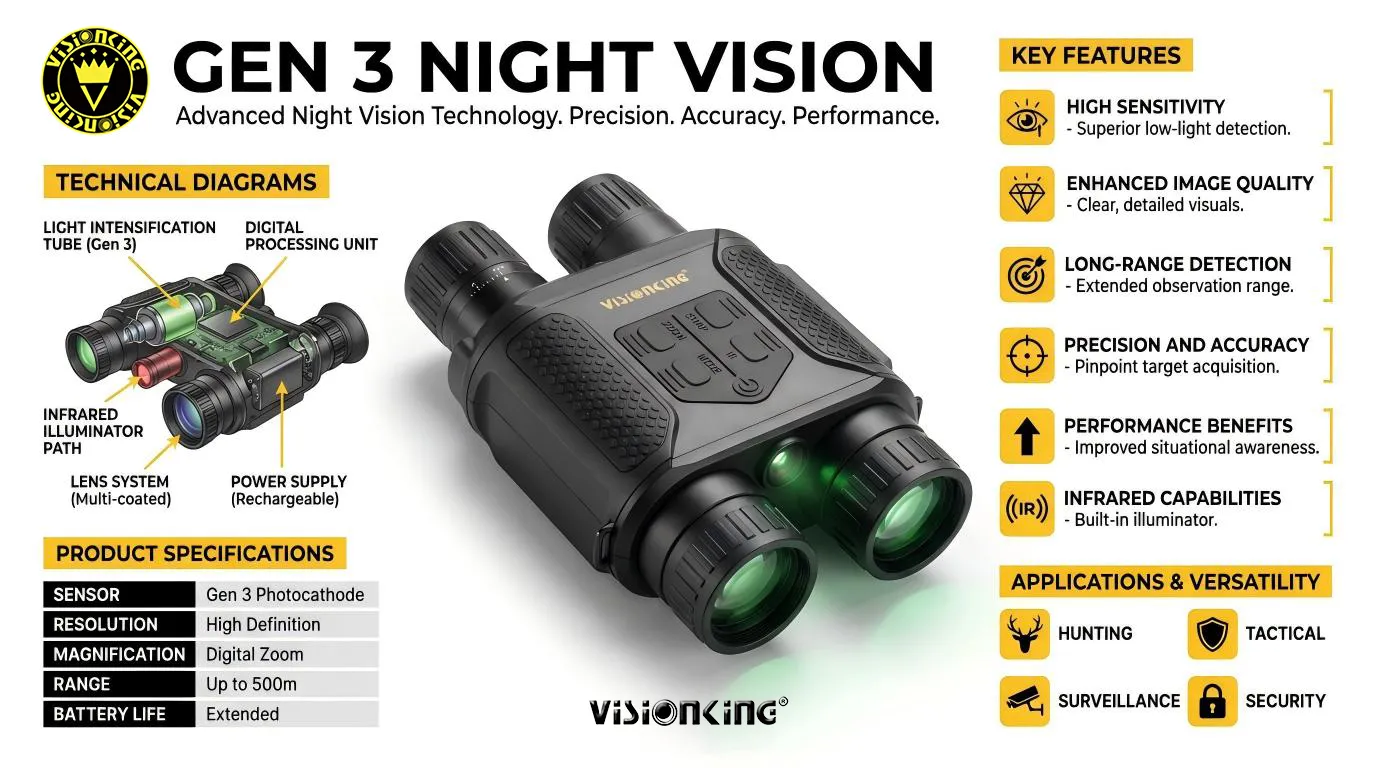
What Defines Gen 3 Night Vision Technology?
When we talk about the gold standard for US military and law enforcement, Gen 3 night vision is the benchmark. The leap from previous generations isn\’t just a minor specification tweak; it is a fundamental overhaul of the internal tube architecture. The defining characteristic that separates Gen 3 from its predecessors is the Gallium Arsenide (GaAs) photocathode. Unlike the Multi-Alkali photocathodes found in Gen 2 units, GaAs provides a massive increase in sensitivity, particularly in the near-infrared spectrum (800nm-900nm). This allows the system to convert even the faintest photons into a crisp, usable electronic signal.
The Critical Role of the Ion Barrier Film
To sustain the high-performance output of the GaAs photocathode, Gen 3 image intensifier tubes utilize a Microchannel Plate (MCP) coated with a specialized ion barrier film. This film serves a vital protective function:
- Cathode Protection: It prevents positive ions, generated during electron multiplication, from striking back against the photocathode.
- Prevents Degradation: Without this barrier, the sensitive photocathode would degrade rapidly, ruining the image quality.
- Signal Trade-off: While the film slightly increases the halo effect around bright lights, it is essential for the tube\’s longevity.
Passive Mode and 10,000+ Hour Lifespan
The superior sensitivity of the GaAs photocathode allows Gen 3 night vision devices to excel in passive mode operation. This means you can operate effectively in near-total darkness without relying on active Infrared (IR) illuminators, which can reveal your position to opposing forces equipped with NVGs. This efficiency, combined with the protective ion barrier film, results in exceptional durability. Users can expect a tube life expectancy exceeding 10,000 hours, a drastic improvement over the 2,000 to 4,000-hour lifespan typical of older Gen 2 technology.
Gen 2+ vs Gen 3: The Performance Showdown
When comparing Gen 2+ vs Gen 3, the difference isn\’t just about the price tag; it is about operational capability in the darkest environments. While Gen 2+ technology has improved significantly, Gen 3 night vision remains the undisputed gold standard for military and professional use due to its superior internal components.
Optical Resolution and Clarity
The clarity of an image is often defined by Optical Resolution (lp/mm). Standard Gen 3 tubes typically range from 64 to 72 lp/mm, offering a crispness that older generations struggle to match.
- cURL Too many subrequests. cURL Too many subrequests.
- cURL Too many subrequests. cURL Too many subrequests. cURL Too many subrequests. cURL Too many subrequests.
cURL Too many subrequests.
cURL Too many subrequests. Gen 3 night vision cURL Too many subrequests. cURL Too many subrequests..
- cURL Too many subrequests. cURL Too many subrequests.
- cURL Too many subrequests. cURL Too many subrequests.
cURL Too many subrequests.
cURL Too many subrequests.
- cURL Too many subrequests. cURL Too many subrequests.
- cURL Too many subrequests. cURL Too many subrequests.
cURL Too many subrequests.
cURL Too many subrequests.
- cURL Too many subrequests. cURL Too many subrequests.
- cURL Too many subrequests. cURL Too many subrequests., cURL Too many subrequests. cURL Too many subrequests.
cURL Too many subrequests.
cURL Too many subrequests. cURL Too many subrequests., cURL Too many subrequests.
cURL Too many subrequests.
cURL Too many subrequests. cURL Too many subrequests. cURL Too many subrequests. cURL Too many subrequests. cURL Too many subrequests. cURL Too many subrequests..
- cURL Too many subrequests. cURL Too many subrequests.
- cURL Too many subrequests. cURL Too many subrequests.
Generally, a higher FOM indicates a higher performing tube, combining sharpness with low-light capability.
Why Signal-to-Noise Ratio (SNR) is Crucial
cURL Too many subrequests. is arguably the most critical spec for real-world usage. It measures the ratio of the true light signal reaching your eye versus the background electronic noise (often seen as \”snow\” or scintillation).
- High SNR: Results in a clean, crisp image even in extremely dark conditions.
- Low SNR: The image becomes grainy and fuzzy as light levels drop.
For cURL Too many subrequests. users operating in deep shadows or under heavy cloud cover, a high SNR ensures you can actually identify what you are looking at, rather than just seeing a shape.
The Importance of Autogated Power Supplies
Modern cURL Too many subrequests. systems utilize an autogated power supply. This technology rapidly switches the tube\’s voltage on and off at a speed undetectable to the human eye. This is essential for dynamic lighting environments. If you look at a bright light source—like a street lamp or a flashlight beam—autogating protects the tube from damage and maintains high resolution. Without autogating, bright lights would cause the image to \”bloom\” or wash out, blinding the user and potentially degrading the photocathode.
White Phosphor vs Green Phosphor Options
When configuring cURL Too many subrequests., one of the most visible choices I make is selecting the phosphor screen. This component determines the color of the image I see through the tube. While the underlying performance specs like SNR and Resolution might be similar, the phosphor type drastically changes the user experience.
P43 Green Phosphor: Classic Contrast
P43 Green Phosphor is the traditional standard that most people associate with night vision. The human eye is naturally most sensitive to green light, which allows us to distinguish subtle shades of detail even in very dark conditions.
- Pros: High sensitivity to the human eye, generally more affordable.
- Cons: Can cause more eye fatigue during extended use compared to white phosphor.
P45 White Phosphor: Modern Clarity
The industry has seen a massive shift toward P45 White Phosphor. Instead of a green glow, these tubes produce a black-and-white (grayscale) image. This looks much more natural to the brain, similar to a black-and-white photograph. The primary benefit of White Phosphor vs Green Phosphor is a reduction in eye strain. When I am wearing gen 3 night vision goggles for hours at a time, the grayscale image feels less harsh, allowing for better object recognition and contrast separation.
Selecting the Right Screen for Your Mission
Choosing the right phosphor often comes down to budget and application. White phosphor tubes, particularly high-spec units from manufacturers like L3Harris and Elbit, typically command a premium price.
Comparison: P43 vs. P45
| Feature | Green Phosphor (P43) | White Phosphor (P45) |
|---|---|---|
| cURL Too many subrequests. | cURL Too many subrequests. | cURL Too many subrequests. |
| cURL Too many subrequests. | cURL Too many subrequests. | cURL Too many subrequests. |
| cURL Too many subrequests. | cURL Too many subrequests. | cURL Too many subrequests. |
| cURL Too many subrequests. | cURL Too many subrequests. | cURL Too many subrequests. |
cURL Too many subrequests. cURL Too many subrequests..
cURL Too many subrequests.
cURL Too many subrequests. Gen 3 night vision cURL Too many subrequests.
cURL Too many subrequests.
cURL Too many subrequests. cURL Too many subrequests. cURL Too many subrequests. Gen 3 night vision cURL Too many subrequests. cURL Too many subrequests.. cURL Too many subrequests. cURL Too many subrequests. cURL Too many subrequests.
cURL Too many subrequests.
cURL Too many subrequests. cURL Too many subrequests., cURL Too many subrequests.
cURL Too many subrequests.
cURL Too many subrequests. cURL Too many subrequests. cURL Too many subrequests. cURL Too many subrequests. cURL Too many subrequests.
cURL Too many subrequests.
- cURL Too many subrequests. cURL Too many subrequests.
- cURL Too many subrequests. cURL Too many subrequests.
- cURL Too many subrequests. cURL Too many subrequests.
cURL Too many subrequests.
Owning Gen 3 night vision comes with serious legal responsibilities, specifically regarding ITAR Regulations (International Traffic in Arms Regulations). The United States government strictly controls the export of this technology. While it is generally legal for US citizens to purchase and own these devices domestically, taking them out of the country—or even allowing a non-US citizen to look through them in some contexts—without a proper license from the Department of State is a federal crime. I always advise keeping these units strictly within borders to avoid severe penalties, as the Gallium Arsenide (GaAs) technology inside is considered sensitive military-grade hardware.
Protecting Your Investment
To ensure you achieve the standard Tube Life Expectancy of 10,000+ hours, proper maintenance is non-negotiable. The most critical rule is light discipline. Never turn on your device in daylight without the objective lens cap securely in place. Even with the cap on, prolonged exposure to bright environments can cause pinhole burns on the tube.
Follow these maintenance best practices:
- Avoid Bright Light: Direct exposure to intense light sources can burn the image intensifier tube instantly, causing permanent black spots or \”blemishes.\”
- Battery Safety: Always remove batteries during storage. A leaking battery can destroy the internal electronics and housing.
- Lens Care: Clean the optics with the same care you would use for high-quality glass, such as Visionking 7×50 Military Marine Binoculars, using proper lens paper and solution to avoid scratching the delicate coatings.
By adhering to these protocols, you protect the sensitive Microchannel Plate (MCP) and photocathode, ensuring your gear remains operational for years.
FAQ: Common Questions About Gen 3 Night Vision
Navigating the world of cURL Too many subrequests. can be complex due to the technical specs and regulations involved. Here are the answers to the most frequent questions we encounter regarding these high-performance devices.
Is Gen 3 night vision legal for civilians to own?
In the United States, it is generally legal for civilians to own gen 3 night vision goggles and monoculars. However, these devices are heavily regulated under ITAR (International Traffic in Arms Regulations). This means you cannot export cURL Too many subrequests. equipment outside the U.S. without a license from the State Department, and you cannot allow non-U.S. citizens to access the technology. Always check your local and federal laws before purchasing.
What is the real-world difference between thin-filmed and unfilmed tubes?
The difference lies in the ion barrier film on the Microchannel Plate (MCP).
- Thin-Filmed (e.g., Elbit Systems): These tubes have a very thin protective layer. They offer excellent performance and durability at a slightly lower price point.
- Unfilmed (e.g., L3Harris): These tubes remove the ion barrier significantly, allowing more electrons to pass through. This results in a higher cURL Too many subrequests. and superior performance in extremely low-light environments, though they come at a premium cost.
Can I use Gen 3 devices during the day?
No. You should never use cURL Too many subrequests. in daylight or bright environments without a proper pinhole lens cap. The cURL Too many subrequests. is extremely sensitive. Exposing it to intense light can cause permanent burn-in or catastrophic failure of the tube. While cURL Too many subrequests. cURL Too many subrequests.
cURL Too many subrequests.
cURL Too many subrequests. cURL Too many subrequests. cURL Too many subrequests.
- cURL Too many subrequests. cURL Too many subrequests.
- cURL Too many subrequests. Gen 3 night vision cURL Too many subrequests.
cURL Too many subrequests. cURL Too many subrequests..