The Heart of the Beast: Understanding Image Intensifier Tubes (IIT)
When you invest in a pvs 14 night vision monocular, you aren\’t just buying a housing; you are buying the Image Intensifier Tube (IIT) inside. This component accounts for the vast majority of the unit\’s cost and performance. I always tell buyers that the housing is just the shell—the tube is the engine. Understanding the manufacturer and technology behind that tube is the first step in building a reliable setup.
Gen 2+ vs. Gen 3: Photonis, Elbit, and L3Harris
The market is currently dominated by three main players, and knowing the difference helps manage both expectations and budget.
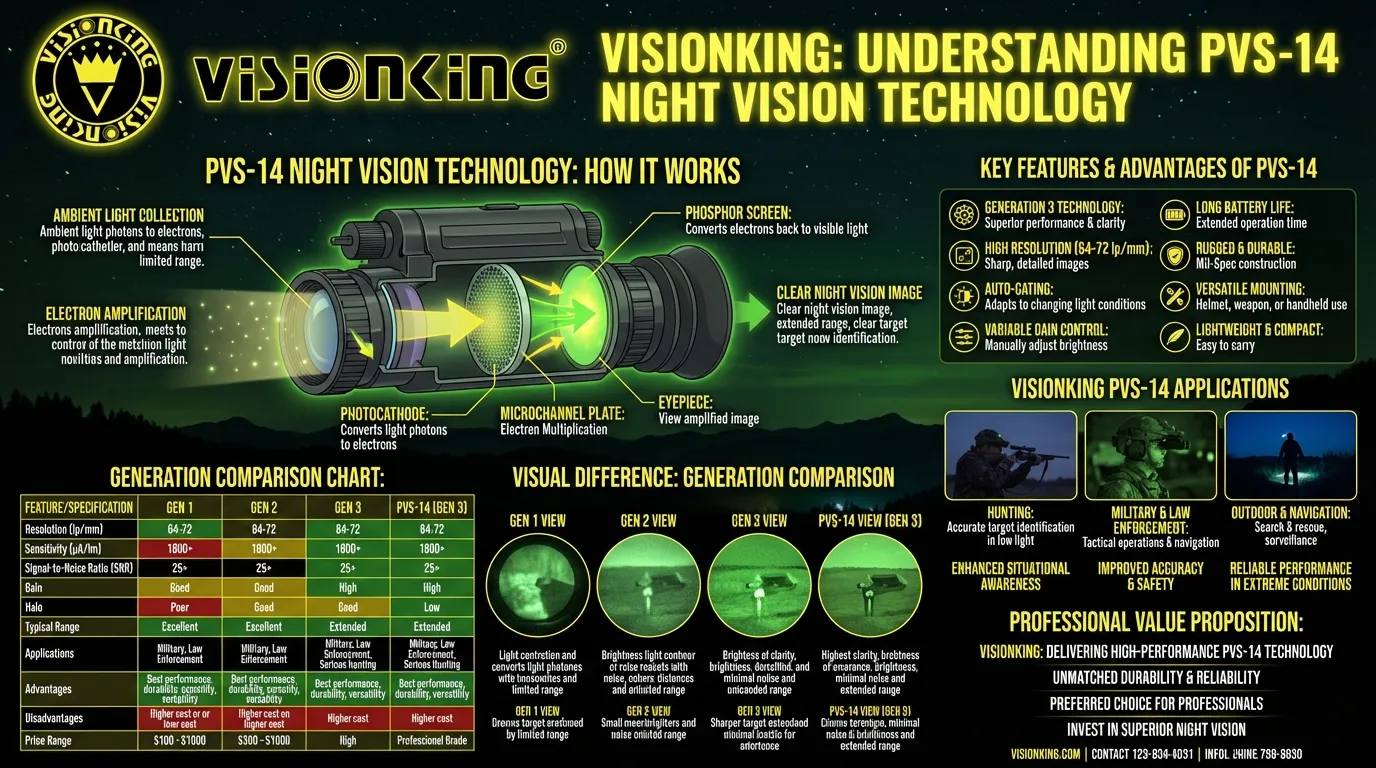
- Photonis (Gen 2+): Specifically the Photonis Echo tubes. These are often marketed as high-end Gen 2+. They are excellent for urban environments because they handle high-light situations well, but they generally lack the raw low-light amplification found in Gen 3 tubes.
- Elbit Systems (Gen 3): These are the workhorses of the night vision world. Elbit tubes are Gen 3 Image Intensifier Tubes that offer a fantastic balance of performance and cost. For most users, a high-spec Elbit tube provides 90-95% of the capability of top-tier options at a lower price point.
- L3Harris (Gen 3): The current gold standard. If you need the absolute best performance in the darkest conditions, L3Harris is the go-to choice. They consistently push the boundaries of specification limits.
Green Phosphor vs. White Phosphor: Choosing Your View
The choice between Green Phosphor (GP) and White Phosphor Night Vision (WP) is largely subjective, but the industry has shifted heavily toward white.
- Green Phosphor: The classic \”night vision\” look. The human eye is very sensitive to green, which can help in distinguishing shades, but some users find it causes more eye strain over long periods.
- White Phosphor: Produces a black-and-white or blueish-grey image. I find that WP provides better perceived contrast and shapes look more natural to the brain. This can lead to faster object recognition and less fatigue during extended operations.
Filmed vs. Unfilmed: Balancing Cost and Performance
This technical distinction is the main separator between Elbit and L3Harris tubes.
- Elbit Thin-Filmed: These tubes use a thin ion barrier film to protect the photocathode. While this adds durability, it slightly inhibits the amount of light that passes through. However, modern Elbit Thin-Filmed tubes are incredibly capable and robust.
- L3Harris Unfilmed: By removing the ion barrier film, L3Harris Unfilmed tubes allow more electrons to hit the photocathode. This results in a higher Signal-to-Noise Ratio (SNR) and superior clarity in extremely dark environments where there is little to no ambient light. This performance bump commands a premium price, but for critical applications, it is often worth the investment.
Decoding the PVS-14 Spec Sheet
When investing in a pvs 14 night vision monocular, the specification sheet is your most valuable asset. It provides the hard data on the performance of the specific Image Intensifier Tube (IIT) inside your device. Rather than relying on generic marketing tiers, we look at the actual metrics to determine image quality and low-light capability. Understanding these numbers ensures you get the performance you are paying for.
Understanding FOM (Figure of Merit)
cURL Too many subrequests. cURL Too many subrequests. cURL Too many subrequests. cURL Too many subrequests. cURL Too many subrequests.
cURL Too many subrequests.
cURL Too many subrequests., cURL Too many subrequests. cURL Too many subrequests.
- cURL Too many subrequests. cURL Too many subrequests.
- Low Light Performance: cURL Too many subrequests.
- cURL Too many subrequests. cURL Too many subrequests.
cURL Too many subrequests.
cURL Too many subrequests.’
- cURL Too many subrequests. cURL Too many subrequests.
- cURL Too many subrequests. cURL Too many subrequests.
- cURL Too many subrequests. cURL Too many subrequests.
cURL Too many subrequests.
cURL Too many subrequests.
cURL Too many subrequests.
cURL Too many subrequests. cURL Too many subrequests. cURL Too many subrequests.
- cURL Too many subrequests. cURL Too many subrequests.
- cURL Too many subrequests. cURL Too many subrequests.
- cURL Too many subrequests. cURL Too many subrequests.
cURL Too many subrequests.
cURL Too many subrequests. cURL Too many subrequests. cURL Too many subrequests.
cURL Too many subrequests.
cURL Too many subrequests., cURL Too many subrequests. cURL Too many subrequests.
- Clarity: cURL Too many subrequests.
- Light Transmission: cURL Too many subrequests.
- Flare Suppression: Quality coatings reduce stray light artifacts when looking near light sources.
Some builds use OE (Optronics Engineering) or Apache optics, which can be decent, but Carson remains the benchmark for a reason. If you are accustomed to the clarity of a cURL Too many subrequests. for daytime use, you will appreciate why premium glass is non-negotiable for night operations.
PVS-14 Housing Durability and Battery Compartments
The housing is the armor for your Image Intensifier Tube. A standard PVS-14 night vision monocular housing is built to be rugged and weather-resistant. It holds the electronics, the tube, and the lenses in precise alignment while protecting them from moisture, dust, and impact.
- Battery Type: Most standard housings run on a single AA battery, making power sources easy to find globally.
- Switchology: The power switch usually integrates the IR illuminator activation, requiring a specific pull-and-turn motion to avoid accidental discharge of infrared light.
- cURL Too many subrequests. A proper mil-spec housing balances durability with weight, ensuring the unit doesn\’t strain your neck when helmet-mounted.
How Manual Gain Control Works
One of the defining features of the PVS-14 night vision device is cURL Too many subrequests.. Unlike some night vision units that only use automatic brightness control (ABC), a PVS-14 lets you dictate the brightness of the image.
- High Light: In urban environments with streetlights or moonlight, you can turn the gain down. This reduces \”scintillation\” (noise) in the image and saves your natural night vision from being blown out by a super-bright tube.
- cURL Too many subrequests. In deep woods or inside dark structures, you can turn the gain up to maximize signal detection.
Having this control is essential for dynamic environments. It allows the user to fine-tune the night vision monocular to the exact ambient conditions, providing a tactical advantage that fixed-gain systems cannot match.
Practical Application: Mounting and Accessories
Helmet Mounting: J-Arms and Wilcox Mounts
Getting your pvs 14 night vision unit off your hands and onto your head requires a reliable Tactical Helmet Setup. The interface between your helmet and the monocular is critical for stability. The industry standard for the helmet interface is the Wilcox G24 Mount, known for its breakaway feature and solid lock-up. However, the piece that connects the PVS-14 to that mount—the J-Arm—is where many users upgrade. While standard USGI J-Arms work, I highly recommend looking at the Noisefighters AX-14 Pro. This articulating arm allows you to swing the monocular out of the way or switch eyes easily, and it sits much closer to the helmet when stowed, reducing the snag hazard compared to rigid metal arms.
Using IR Illuminators Effectively
Every PVS-14 comes with a built-in cURL Too many subrequests., but it is important to understand its limitations. The onboard IR is a floodlight designed for very close tasks, like reading a map or checking gear in pitch blackness. It is not meant for long-range spotting. For navigating or identifying targets at distance, you will need a separate, focused IR device mounted on your helmet or rail. Keep in mind that when your IR is on, you are like a lighthouse to anyone else using night vision, so light discipline is key.
Counterweights and Helmet Balancing
One of the most overlooked aspects of running a cURL Too many subrequests. cURL Too many subrequests.
cURL Too many subrequests.
cURL Too many subrequests.
cURL Too many subrequests. pvs 14 night vision cURL Too many subrequests. cURL Too many subrequests. cURL Too many subrequests. cURL Too many subrequests. cURL Too many subrequests.
cURL Too many subrequests. Visionking digital night vision monocular cURL Too many subrequests.
cURL Too many subrequests.
| Feature | cURL Too many subrequests. | cURL Too many subrequests. |
|---|---|---|
| cURL Too many subrequests. | cURL Too many subrequests. | cURL Too many subrequests. |
| Depth Perception | cURL Too many subrequests. | cURL Too many subrequests. |
| Weight | cURL Too many subrequests. | Heavy |
| cURL Too many subrequests. | cURL Too many subrequests. | cURL Too many subrequests. |
cURL Too many subrequests.
cURL Too many subrequests. pvs 14 night vision cURL Too many subrequests.
cURL Too many subrequests.
- cURL Too many subrequests. cURL Too many subrequests.
- cURL Too many subrequests. cURL Too many subrequests.
- cURL Too many subrequests. cURL Too many subrequests.
*** cURL Too many subrequests. cURL Too many subrequests. cURL Too many subrequests. cURL Too many subrequests. or cURL Too many subrequests.
cURL Too many subrequests.
cURL Too many subrequests. pvs 14 night vision cURL Too many subrequests.
cURL Too many subrequests.
cURL Too many subrequests. cURL Too many subrequests. cURL Too many subrequests. PVS-14 builds, offering superior light transmission and clarity compared to some OE (Optronics Engineering) or Noctis alternatives. Always verify the glass origin; if a vendor doesn\’t list it, you might be getting inferior lenses that distort the image.
Reputable vendors—such as Apollo Gear, Custom Night Vision, and Steele Industries—provide solid warranties and customer support. Understanding the nuances of cURL Too many subrequests. is essential to verify you are getting genuine mil-spec glass rather than commercial-grade substitutes.
The \”Buy Once, Cry Once\” Philosophy
Night vision is an expensive game, and cutting corners usually leads to regret. A high-quality Gen 3 Image Intensifier Tube (like L3Harris or Elbit) housed in a durable body generally costs between $3,000 and $4,500. Spending this amount upfront for a high-performance unit is far more economical than buying a cheap Gen 2 or digital unit that you will struggle to resell later.
- Hand-Select Your Unit: Never buy a \”random\” tube if you can avoid it. Choose a specific unit where you can see the tube images and review the spec sheet before purchase.
- Prioritize Specs: Look for high SNR (Signal-to-Noise Ratio) and low EBI (Equivalent Background Illumination) to ensure the device performs in the darkest conditions.
- Avoid Mystery Meat: Stick to known manufacturers for both the tube and the housing kit.
Investing in a proper pvs 14 night vision device ensures you have a reliable tool for observation and navigation that holds its value over time.
Frequently Asked Questions About PVS-14 Night Vision
How long does a PVS-14 tube last?
When you source your unit from reputable vendors like Apollo Gear, Custom Night Vision, or Steele Industries, you are investing in professional-grade hardware. High-quality Gen 3 Image Intensifier Tubes manufactured by L3Harris and Elbit Systems are engineered for significant longevity. The lifespan relies heavily on how well you protect the device from bright light sources, but these are durable components designed for serious field use, backed by solid warranties from trusted retailers.
cURL Too many subrequests.
cURL Too many subrequests. pvs 14 night vision system is primarily optimized for helmet mounting to assist with observation and navigation. The reference material highlights the importance of accessories like the J-Arm (specifically the AX-14 PRO) for attaching the monocular to a helmet. While the housing is tough, the device is most effective when worn on the head for situational awareness, rather than being used as a dedicated rifle scope where recoil could be a factor.
Is White Phosphor worth the extra cost?
Choosing between tube types often comes down to balancing performance with your budget. L3Harris Unfilmed tubes represent the highest performance tier and typically cost more than Elbit Thin-Filmed options. If your application requires the best possible cURL Too many subrequests. and low-light clarity, the premium price of L3 is justified. However, Elbit tubes provide strong mid-to-high tier performance and are an excellent value if you want to save money without sacrificing too much capability.
What is the difference between auto-gated and non-gated?
While power supply management is important, the most critical feature to look for in a cURL Too many subrequests. is cURL Too many subrequests.. cURL Too many subrequests.