The Science: What Actually Changes Inside the Tube?
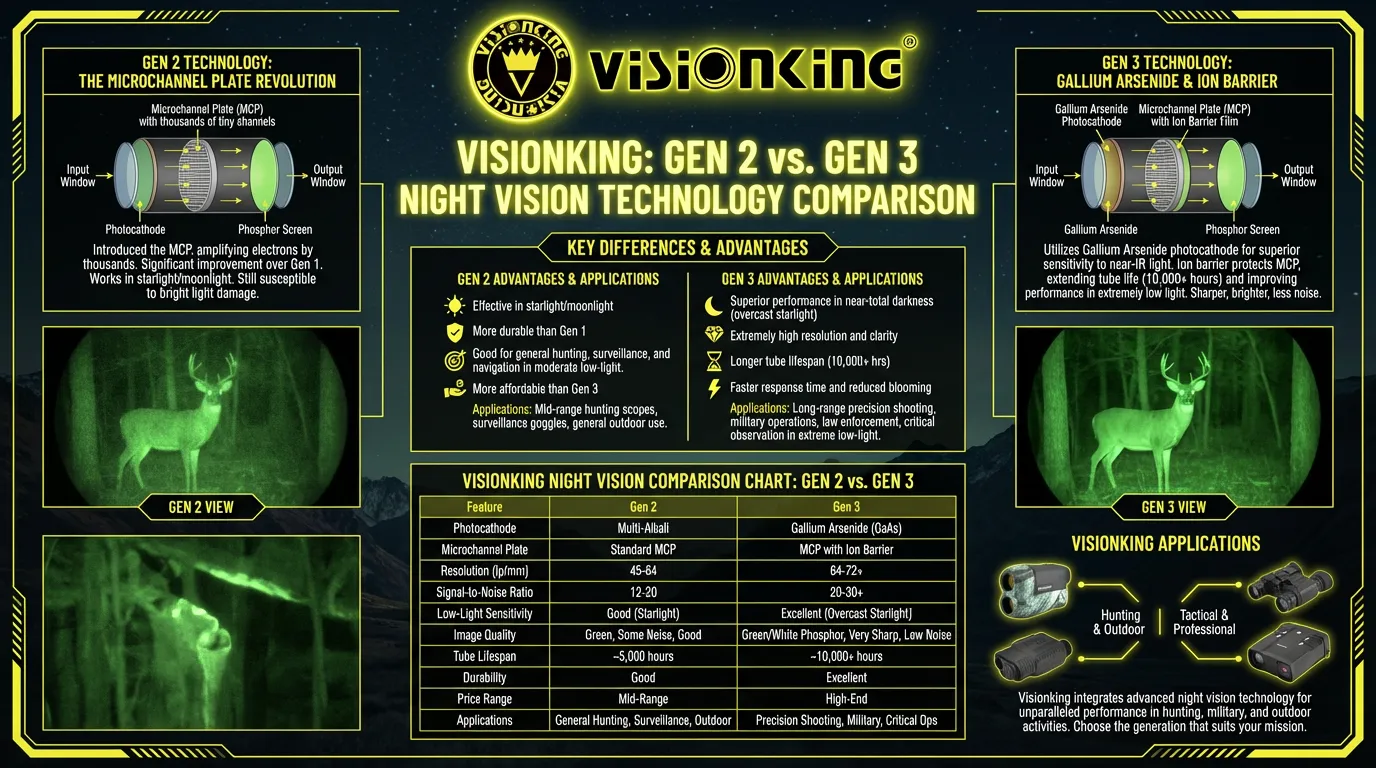
When we talk about the jump from Gen 2 to Gen 3, we aren\’t just discussing a software update or a digital tweak. We are looking at a fundamental shift in the chemistry and mechanics inside the Image Intensifier Tube (IIT). The \”Generation\” classification is defined by the specific components used to convert photons into electrons and back into visible light. Understanding these internal changes is the only way to justify the price difference.
Generation 2: The Multi-Alkali Era and Micro-Channel Plate (MCP)
The defining characteristic of Generation 2 night vision is the introduction of the Micro-Channel Plate (MCP) combined with a Multi-Alkali photocathode (specifically the S-25). Before Gen 2, tubes struggled to amplify light efficiently.
Here is how the Gen 2 architecture changed the game:
- The S-25 Photocathode: This component converts incoming light into electrons. While effective, the multi-alkali composition has limits in sensitivity, particularly in extremely dark environments.
- The MCP Advantage: Located behind the photocathode, the MCP acts like a high-tech amplifier. It is a glass disk with millions of microscopic holes. When an electron hits the walls of these channels, it releases thousands more electrons.
- Ergebnis: This allows Gen 2 units to function without the massive size and distortion issues of Gen 1, offering a lifespan of roughly 2,500 to 5,000 hours.
Generation 3: The Gallium Arsenide (GaAs) Game Changer
Generation 3 represents the gold standard in modern night vision, primarily due to a complete change in the photocathode material. We moved away from Multi-Alkali mixtures to Gallium Arsenide (GaAs).
Why does GaAs matter?
- Photocathode Sensitivity: Gallium Arsenide is significantly more efficient at converting photons into electrons, especially in the near-infrared spectrum.
- Low-Light Dominance: This chemical shift allows Gen 3 tubes to produce a brighter, clearer image in conditions where Gen 2 would simply show noise or darkness.
- Auflösung: The electron flow is cleaner, resulting in higher resolution and a better Signal-Rausch-Verhältnis (SNR).
The Function of the Ion Barrier Film
To protect the sensitive cURL Too many subrequests. photocathode, Gen 3 tubes incorporate a critical component known as the Ion Barrier Film.
In high-performance tubes, the acceleration of electrons can create positive ions that bounce back and damage the photocathode—a process called \”ion poisoning.\” The ion barrier film acts as a shield:
- Schutz: It prevents positive ions from striking the photocathode, preventing premature failure.
- Longevity: This film is the primary reason Gen 3 tubes boast a massive lifespan increase, typically rated for cURL Too many subrequests. of operation.
- Kompromiss: While essential for durability, thicker films can slightly reduce the number of electrons passing through, which is why modern \”Thin-Filmed\” or \”Unfilmed\” technology attempts to minimize this barrier to maximize light transmission.
Head-to-Head Comparison: Performance Metrics
When deciding between gen 2 vs gen 3 night vision, the spec sheet can look like a confusing mix of acronyms and numbers. However, these metrics directly translate to what you see in the dark. We break down the technical jargon into real-world performance differences.
cURL Too many subrequests.
cURL Too many subrequests. Gen 3 cURL Too many subrequests. Gallium Arsenide (GaAs), cURL Too many subrequests. cURL Too many subrequests. cURL Too many subrequests.
- Gen 3: cURL Too many subrequests. passive night vision cURL Too many subrequests.
- Gen 2: cURL Too many subrequests. IR Illuminator cURL Too many subrequests.
cURL Too many subrequests.
cURL Too many subrequests. cURL Too many subrequests.. cURL Too many subrequests. Image Intensifier Tube (IIT) cURL Too many subrequests.
cURL Too many subrequests. cURL Too many subrequests. cURL Too many subrequests.
cURL Too many subrequests.
Signal-Rausch-Verhältnis (SNR) cURL Too many subrequests.
- cURL Too many subrequests. cURL Too many subrequests.
- cURL Too many subrequests. cURL Too many subrequests.
cURL Too many subrequests.
Das cURL Too many subrequests. cURL Too many subrequests. Ion Barrier Film cURL Too many subrequests.
cURL Too many subrequests.
cURL Too many subrequests.
| Merkmal | cURL Too many subrequests. | cURL Too many subrequests. |
|---|---|---|
| cURL Too many subrequests. | cURL Too many subrequests. | Gallium Arsenide (GaAs) |
| cURL Too many subrequests. | cURL Too many subrequests. | cURL Too many subrequests. |
| cURL Too many subrequests. | cURL Too many subrequests. | cURL Too many subrequests. |
| cURL Too many subrequests. | cURL Too many subrequests. | cURL Too many subrequests. |
Gen 3 cURL Too many subrequests. Ion Barrier Film, cURL Too many subrequests. 2x to 4x longer than standard Gen 2 models. If you plan to use your gear extensively, the cost per hour of operation actually favors Gen 3.
The Gen 2+ Factor: The Value Sweet Spot?
Defining Gen 2+ Technology Improvements
When we talk about getting the most bang for your buck, Gen 2+ (Generation 2 Plus) often sits right in the sweet spot. While standard Gen 2 tubes rely on the S-25 Multi-alkali photocathode, Gen 2+ technology optimizes this chemistry and the Micro-Channel Plate (MCP) to squeeze out higher performance. These tubes aren\’t just \”budget\” options anymore; they offer significantly improved photocathode sensitivity and reduced noise compared to older standard Gen 2 units. We see higher cURL Too many subrequests. scores here, meaning you get a cleaner image without the steep price jump associated with Gen 3 manufacturing.
High-End Gen 2+ vs. Low-End Gen 3
There is a common misconception that any Gen 3 tube automatically beats a Gen 2 tube. That is simply not true. A high-specification Gen 2+ tube, often featuring White Phosphor screens, can actually outperform an entry-level or older Gen 3 tube in mixed lighting conditions.
- Bildqualität: Premium Gen 2+ tubes often have fewer blemishes and a cleaner image than low-tier Gen 3 tubes that might be rejected from military contracts.
- cURL Too many subrequests. Gen 2+ tubes generally handle bright light sources (like streetlights) better, showing smaller halos than some un-filmed Gen 3 options.
- Leistung bei schlechten Lichtverhältnissen: While Gen 3 dominates in near-total darkness due to Gallium Arsenide (GaAs), high-end Gen 2+ holds its own remarkably well in moonlight or starlight.
The Critical Role of High-Quality Optics and Glass
You can have the most advanced Image Intensifier Tube (IIT) in the world, but if you put it behind cheap glass, you will get a poor image. The objective lens acts as the funnel for light; if it has poor transmission, the tube is starved of photons. This is why we emphasize the importance of housing quality. Just as a portable Visionking 8×40 BaK4 monocular utilizes high-density glass to ensure edge-to-edge sharpness, your night vision device requires premium optics to resolve the high lp/mm the tube is capable of producing. If the glass is blurry, your high-tech night vision is wasted.
Real-World Scenarios: Which One Do You Need?
cURL Too many subrequests. Gen 2 vs Gen 3 night vision isn\’t just about budget; it is about matching the technology to your specific environment. The chemical differences in the tubes—specifically the shift from Multi-Alkali to Gallium Arsenide—dictate how these units perform when the lights go out. Here is how they stack up in practical applications.
Scenario A: Varmint Hunting (Hog/Coyote) with IR
For most hunters targeting hogs or coyotes, Gen 2 technology is often the value winner. Since animals cannot detect infrared light, you can freely use a high-powered IR Illuminator. This artificial light source compensates for the lower sensitivity of the Gen 2 cURL Too many subrequests..
- Verdict: Gen 2 is sufficient.
- Why: You rely on IR Illuminator Dependency cURL Too many subrequests.
- cURL Too many subrequests. cURL Too many subrequests. cURL Too many subrequests. cURL Too many subrequests.
cURL Too many subrequests.
cURL Too many subrequests. cURL Too many subrequests., cURL Too many subrequests.
- Verdict: Gen 3 cURL Too many subrequests.
- Why: Das Gallium Arsenide (GaAs) cURL Too many subrequests.
- cURL Too many subrequests. cURL Too many subrequests. Signal-Rausch-Verhältnis (SNR), cURL Too many subrequests.
cURL Too many subrequests.
cURL Too many subrequests.
- cURL Too many subrequests. cURL Too many subrequests.
- cURL Too many subrequests. cURL Too many subrequests. photocathode sensitivity cURL Too many subrequests.
- Verdict: cURL Too many subrequests.
cURL Too many subrequests.
cURL Too many subrequests.
- Verdict: Gen 3 cURL Too many subrequests.
- Why: cURL Too many subrequests. cURL Too many subrequests. cURL Too many subrequests.
- Longevity: cURL Too many subrequests. ion barrier film cURL Too many subrequests. cURL Too many subrequests. cURL Too many subrequests.
cURL Too many subrequests.
When deciding between gen 2 vs gen 3 night vision, cURL Too many subrequests. Gallium Arsenide (GaAs) cURL Too many subrequests.
cURL Too many subrequests.
cURL Too many subrequests. Zielfernrohr cURL Too many subrequests.
- cURL Too many subrequests. cURL Too many subrequests.
- cURL Too many subrequests. cURL Too many subrequests. Image Intensifier Tube (IIT) cURL Too many subrequests. cURL Too many subrequests. of operation, whereas Gen 2 tubes typically last between 2,500 and 5,000 hours.
- Das Urteil: You might pay significantly more upfront for Gen 3, but you are getting up to four times the operational lifespan.
Resale Value and Market Longevity
From an investment perspective, Gen 3 hardware holds its value significantly better. Because it represents the current gold standard for analog performance, demand remains high on the secondary market.
- Depreciation: Gen 2 technology is older. As digital night vision improves, the resale value of standard Gen 2 analog tubes may face more pressure.
- Liquidity: A clean Gen 3 unit is much easier to liquidate if you decide to upgrade or exit the hobby later.
- Haltbarkeit: The inclusion of the Ion Barrier Film in Gen 3 tubes protects the photocathode from degradation, ensuring the unit retains its performance specs for years, which keeps the resale value stable.
Häufig gestellte Fragen
Can Gen 2 see in total darkness?
No Image Intensifier Tube (IIT) can function in absolute zero light (like a sealed basement). Night vision technology works by amplifying existing photons from ambient sources like starlight or moonlight. Because Gen 2 tubes use S-25 Multi-alkali photocathodes, they are less sensitive than Gen 3. This means they have a higher IR Illuminator Dependency in extremely dark conditions. If you are operating in deep shadows or under heavy canopy, you will likely need to activate an infrared light source to see clearly. For users exploring different setups, understanding the capabilities of custom monoculars can help in choosing the right device for these low-light scenarios.
What is Autogating and do I need it?
Autogating is a crucial feature for dynamic lighting environments. It electronically controls the power supply to the tube, rapidly switching it on and off to maintain image clarity when exposed to bright light sources.
- Schutz: It prevents the tube from sustaining damage when hit by sudden flashes.
- cURL Too many subrequests. It reduces the \”blooming\” effect from streetlights or headlights, preserving resolution.
If you plan to use your device in urban areas or around artificial lighting, autogating is highly recommended to protect your investment and maintain a high Signal-Rausch-Verhältnis (SNR).
Is Gen 3 illegal for civilians to own?
In the United States, it is fully legal for civilians to own and use Gen 3 night vision systems. However, these devices are heavily regulated under ITAR (International Traffic in Arms Regulations). This means:
- Ownership: Legal domestically within the US.
- Export: Strictly prohibited without a license. You cannot take Gen 3 units out of the country.
For international customers, export restrictions often limit availability to Gen 2+ or specific export-cleared tubes. Always verify local laws regarding the possession of Gallium Arsenide (GaAs) based optics.